Introduction to the Enneagram and Type 5 - The Observer
The Enneagram is a personality classification system of 9 types, each representing a different way of perceiving the world and a core motivation. Among them, Type 5, often called The Observer, tends to withdraw from the external world to observe, analyze, and understand. They are driven by fears of energy depletion, intrusion by others, and being seen as incompetent. Thus, they tend to hoard knowledge, time, and private space to feel safe and autonomous.
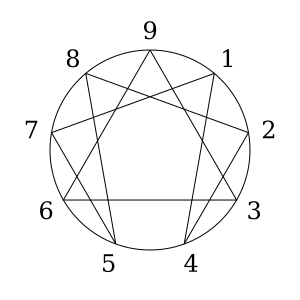
The core value of the Enneagram lies not only in identifying your type, but also in the constant movement between types through arrows. Each type has two characteristic arrows: one pointing to the type they move toward when growing and healthy (integration arrow), and one pointing to the type they fall into when stressed and unhealthy (disintegration arrow). This movement is not a change of essence, but an expression of different potentials or coping reactions under pressure.
How the Arrows Work for Type 5
For Type 5, the integration arrow points to Type 8, and the disintegration arrow points to Type 7. This means:
- Integration Arrow (5 toward 8): When an Observer develops healthily, they exhibit the positive qualities of Type 8 (The Challenger). They become assertive, confident, act rather than just observe, and are ready to stand up for what they believe is right.
- Disintegration Arrow (5 toward 7): When an Observer is under stress, they display the negative traits of Type 7 (The Enthusiast). They may become talkative, scattered, plan many things to avoid emotions and real work, and seek external stimulation to forget inner insecurity.
Understanding this mechanism helps Type 5 individuals recognize their psychological state and find suitable development paths, rather than being swept away by automatic reactions.
Integration Arrow: Journey from Observation to Action (5 toward 8)
Integration to Type 8 is a challenging but highly valuable journey for Type 5. The essence of Type 5 is to conserve energy and knowledge; they believe only with enough information and preparation can they safely engage in life. They often stand outside the game to observe the rules before joining. However, true safety lies not in hoarding, but in the ability to face and handle situations.
When a Type 5 begins to integrate toward Type 8, they undergo profound changes:
- From hoarding to sharing: Instead of clinging to knowledge and energy for themselves, they learn to share generously. They realize knowledge has value only when used and spread, not when stored in a personal library.
- From observing to participating: Instead of standing on the sidelines analyzing, they start engaging directly in life. They make decisions based on what they know, accept risks, and take responsibility for their actions. Type 8's assertiveness helps them overcome the fear of being unprepared.
- From detachment to connection: They learn to use their power and influence constructively. Instead of avoiding intrusion, they confidently set clear boundaries and protect their private space healthily, while opening up to deeper connections with others.
- Healthy assertiveness: An integrated Type 5 is no longer a passive observer. They speak up to protect the vulnerable, fight for justice, and use their deep understanding to create positive change, like a brilliant strategist stepping out of the research room.
For example, a Type 5 researcher, after years in the lab, when integrated, may become a decisive project leader who faces challenges head-on and inspires colleagues with clear vision and confidence.
Disintegration Arrow: Escaping into Scatteredness (5 toward 7)
When a Type 5 falls into stress, anxiety, or feels overwhelmed, they do not retreat deeper into isolation as many might think. Instead, they tend to disintegrate toward Type 7. This is a unique coping mechanism, showing a chaotic burst of energy to avoid inner emptiness and helplessness.
Signs of a Type 5 disintegrating toward Type 7 include:
- Talking a lot and rambling: Usually quiet and reserved, under stress a Type 5 may talk excessively. They jump from topic to topic, sharing unfinished ideas as a way to release pressure and hide insecurity. This talking is not for connection but as a form of venting.
- Over-planning: They start making grand plans, dreaming about future projects, trips, or new business ideas. However, they rarely execute them. This is procrastination, keeping busy with exciting possibilities to avoid facing current stressors.
- Seeking stimulation: They may dive into entertainment, eating, web surfing, movies, or anything providing temporary stimulation to fill the emotional void. This scatteredness helps them forget feelings of low energy and fear of intrusion.
- Impatience and impulsiveness: Instead of calm and careful analysis, they become impatient, easily distracted, and impulsive. They may make commitments they later don't want to keep, simply carried away by the momentary excitement of a new idea.
This disintegration is a vicious cycle: the more stressed, the more they avoid through scatteredness, and the more scatteredness exhausts them and increases anxiety about not accomplishing anything. This inadvertently amplifies their core fear of incompetence and insufficient resources.
Comparison Table of Type 5 States
| Characteristic | Healthy State (Integration 5-8) | Stressed State (Disintegration 5-7) |
|---|---|---|
| Energy | Focused, assertive, powerful | Scattered, restless, exhausted |
| Behavior | Participates, acts, leads | Talks a lot, makes unrealistic plans, procrastinates |
| Thinking | Sharp, strategic, clear | Jumpy, rambling, hard to focus |
| Emotions | Calm, confident, confrontative | Anxious, fearful, avoidant of emotions |
| Connection | Open, protective, positively influential | Superficial, detached, seeks external stimulation |
Practical Applications of Understanding the Arrows
Understanding these two arrows provides valuable tools for personal growth of a Type 5:
Recognizing States and Adjusting
- When noticing oneself being scattered, talkative, and planning without executing, a Type 5 should remind themselves they are in a disintegrated state. Instead of continuing the scatteredness, they should stop, breathe, and ask: "What is really worrying me? What problem am I avoiding?" Facing the root of stress helps them return to balance.
- When feeling stuck in over-observing and over-analyzing, they should find ways to act. They can start with small steps: make a decision, share an idea with someone, or join an activity instead of just watching. Each small action builds confidence and brings them closer to Type 8 integration.
Proactive Self-Development
- Practice assertiveness: Type 5 can practice expressing opinions and needs directly. They might start by saying "no" clearly to bothersome requests, or proactively making suggestions in meetings.
- Accept imperfection: Learn that not every action needs full information. Integration requires accepting risks and learning from mistakes. Acting on 80% information is better than waiting for 100% and never starting.
- Connect with the body: One of the best ways for Type 5 to escape disintegration is reconnecting with the body through physical activities like walking, running, yoga, or martial arts. This helps them step out of mental overload and feel the strong physical energy within, similar to Type 8.
Conclusion
The integration and disintegration arrows are among the most subtle and profound elements of the Enneagram system. For Type 5, the journey of integration to Type 8 is not about becoming someone else, but about discovering and using their own inner strength to act and connect with the world more fully. Conversely, disintegration to Type 7 serves as a clear warning about the pitfalls of avoidance.
Recognizing and understanding these two directions is not just a theoretical exercise but a powerful practical tool for each Type 5 to self-observe, adjust behavior, and move toward a more balanced, confident, and fulfilling life. When an Observer learns to combine deep wisdom with the assertiveness of a leader, they truly become a formidable force capable of making significant contributions to the community.