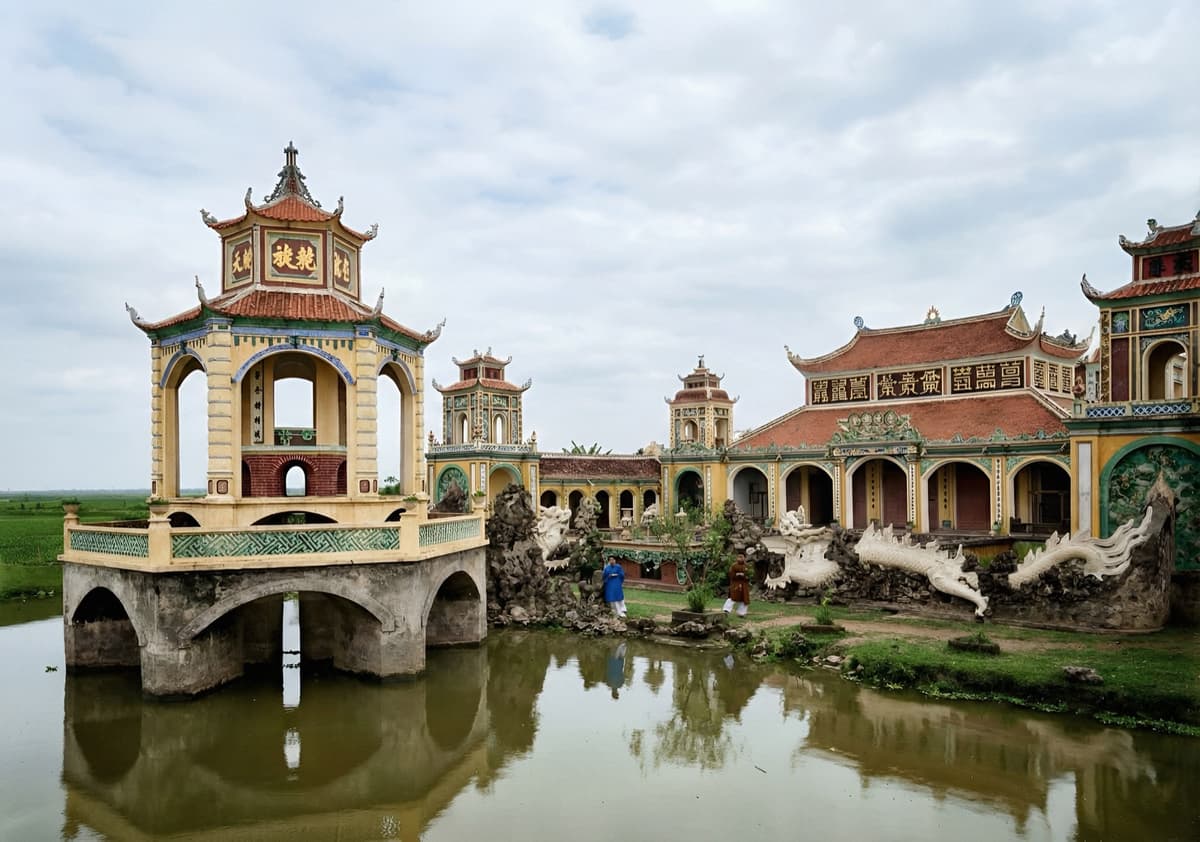
Choosing an Auspicious Year to Build a House: Kim Lau, Hoang Oc, Tam Tai, and the Vietnamese Custom of Borrowing Age
For Vietnamese people, building a house is not just a material matter, but also a major event marking a lifetime of savings and serving as the foundation for family happiness. Due to this importance, our ancestors accumulated experience and formed beliefs and customs around house building. Among these, consulting auspicious years to avoid Kim Lau, Hoang Oc, and Tam Tai, along with the custom of borrowing age, are practices deeply ingrained in many generations.
Origins and Meaning of Choosing an Auspicious Year
Folk beliefs consider building a house one of life's major undertakings, requiring careful calculation to seek smoothness and luck. It is believed that if construction begins in a year that falls into bad luck periods like Tam Tai, Kim Lau, or Hoang Oc, the homeowner and family may face misfortunes such as illness, business failures, family discord, or construction difficulties.
Therefore, consulting an auspicious year before building has become an essential step in many families' preparations. A favorable year, free from these restrictions, is thought to ensure smooth construction, a sturdy home, and bring wealth and peace.
Details of Kim Lau, Hoang Oc, and Tam Tai Restrictions
Kim Lau is generally understood as inauspicious years for major events like building a house or marriage. A folk saying goes, "Choose a wife by the woman's age, build a house by the man's age," and Kim Lau is considered one of the most critical factors to avoid. The common calculation uses the homeowner's nominal age (lunar age). Divide the nominal age by 9; if the remainder is 1, 3, 6, or 8, it is considered Kim Lau. Specifically: remainder 1 is Kim Lau Than (harms oneself), remainder 3 is Kim Lau The (harms the wife), remainder 6 is Kim Lau Tu (harms children), and remainder 8 is Kim Lau Luc suc (harms livestock).
Hoang Oc means deserted house, believed in folklore to be a dwelling place for ghosts, bringing misfortune. Building in a Hoang Oc year is thought to bring health, wealth, and relationship problems. The calculation is more complex, counting through six zones in a circle: Nhat Cat, Nhi Nghi, Tam Dia Sat, Tu Tan Tai, Ngu Tho Tu, and Luc Hoang Oc. The homeowner's nominal age determines the zone; the inauspicious zones to avoid are Tam Dia Sat, Ngu Tho Tu, and Luc Hoang Oc.
Tam Tai refers to misfortune occurring over three consecutive years. According to folklore, every 12 years, there are 3 consecutive years of Tam Tai. The rule is based on the clashes among zodiac animals within the same trine group: Than - Ty - Thin face hardship in Dan, Mao, Thin years; Dan - Ngo - Tuat in Than, Dau, Tuat years; Ty - Dau - Suu in Hoi, Ty, Suu years; and Hoi - Mao - Mui in Ty, Ngo, Mui years. The middle year is often considered the heaviest, but major tasks are avoided throughout all three years.
Scientific and Practical Feng Shui Perspective
From a scientific and practical feng shui viewpoint, being overly fixated on age to decide whether to build is a one-sided approach. Experts argue that in feng shui, factors influencing human life are prioritized as: Thien thoi (time), Dia loi (land advantage), and Nhan hoa (human harmony). This means timing, land quality, and environmental harmony matter more than the homeowner's age.
According to feng shui expert Tam Nguyen, determining the house's orientation is the most important factor in construction. One must assess whether the land has vital energy and whether the house direction aligns with the natural energy currents at that time. Only after confirming the land and direction are good should one consider the homeowner's age for groundbreaking. This view is summarized: "Any age can build a house; it's not about age but whether this land and direction are suitable for building at that time."
Architect and feng shui expert Pham Cuong also emphasizes that finances, land, and administrative procedures are prerequisites for building. If the homeowner has good land, a favorable house direction, solid finances, and completed paperwork, they can build regardless of age restrictions. Conversely, poor land or incompatible direction cannot be compensated by merely choosing an auspicious age.
The Custom of Borrowing Age: Meaning and Debate
When a homeowner's age falls into Kim Lau, Hoang Oc, or Tam Tai, but they still wish to build, the custom of borrowing age is offered as a solution. In folklore, the homeowner asks someone with an auspicious age, free from restrictions, ideally someone prosperous with many children and grandchildren (described as "bách niên giai lão, con đàn cháu đống"), to perform the groundbreaking and roof-raising ceremonies. The borrowed-age person acts on behalf of the homeowner in spiritual rituals, believed to bear the misfortunes.
However, from a scientific feng shui perspective, borrowing age only carries psychological and procedural meaning, with no real effect on fate or resolving negativity. Expert Pham Cuong argues that a house's feng shui only affects its actual occupants, not the person named on documents or performing rituals. Borrowing age by "changing the name and owner" not only fails to solve the problem but may also create unnecessary legal and emotional complications.
Expert Tam Nguyen agrees, stating that borrowing age is unnecessary because any age can build if the land and direction are good. If homeowners remain anxious, they might ask a healthy middle-aged person with good energy, from family or close friends, to perform the groundbreaking ritual. This is purely procedural to ease the mind, without elaborate formalities like transferring legal ownership or roof-raising ceremonies.
Advice for Homeowners Planning to Build
Consulting an auspicious year to build is a beautiful spiritual cultural practice of Vietnamese people, reflecting hopes for a peaceful and happy life. However, we should view it objectively and balanced, avoiding excessive superstition that might miss good opportunities or cause undue worry.
The most important aspects remain thorough financial preparation, selecting suitable land, and designing a home that fits actual needs and conditions. If homeowners still wish to consult ages or choose auspicious dates for peace of mind, that is acceptable, as long as it does not overly influence major decisions.
In summary, view age consultation as a reminder to be careful and thorough in life's significant endeavors, not as a barrier or obsession. A beautiful, lasting home is built on scientific planning, quality materials, and skilled craftsmen, not just age factors.


