What is Can Chi?
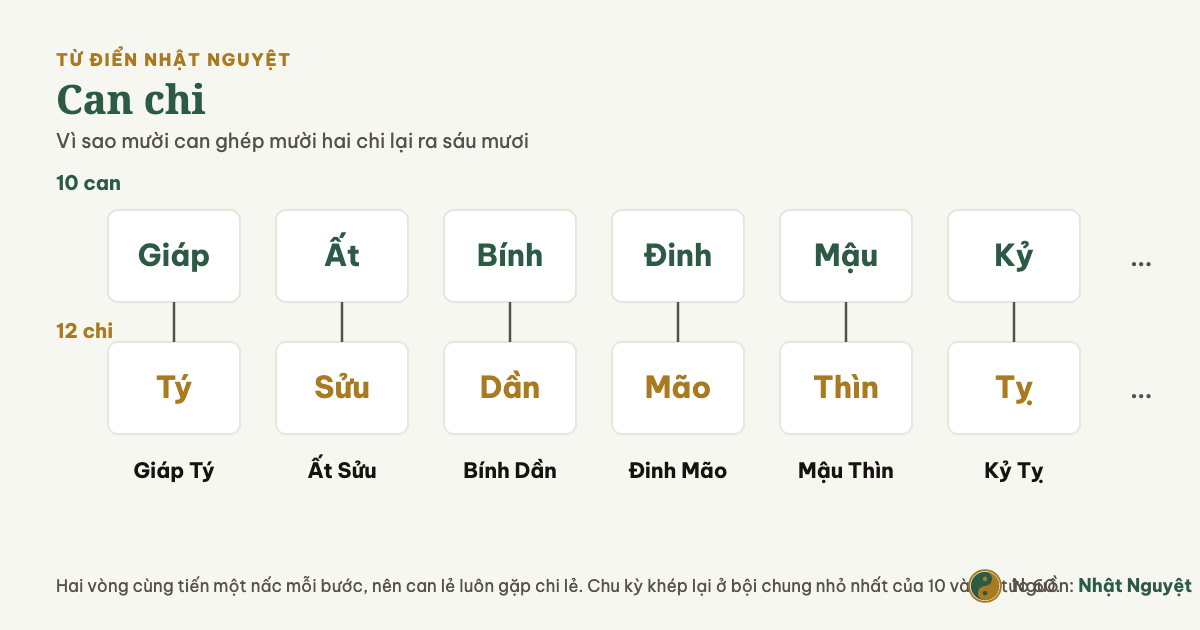
Can Chi (Chinese: 干支) is the short name for the system that combines Heavenly Stems and Earthly Branches. The Heavenly Stems consist of ten elements: Giáp, Ất, Bính, Đinh, Mậu, Kỷ, Canh, Tân, Nhâm, Quý. The Earthly Branches consist of twelve elements: Tý, Sửu, Dần, Mão, Thìn, Tỵ, Ngọ, Mùi, Thân, Dậu, Tuất, Hợi. Pairing one Stem with one Branch in a recurring cycle yields a cycle of 60 combinations known as the sixty-year cycle.
What is Can Chi used for?
In the traditional calendar, Can Chi is used to name and number years, months, days and hours. Each year carries a Stem-Branch pair, for example the year Giáp Tý or the year Ất Sửu, and after 60 years the cycle repeats. In fate analysis, the Can Chi of the four markers of birth (Year, Month, Day, Hour) form the Bát Tự (Four Pillars), eight characters in total, used to analyse Yin-Yang and Five Elements relationships. In the Kinh Dịch (I Ching), each Heavenly Stem and Earthly Branch is also assigned Yin-Yang, Five Elements, direction and season attributes; for instance Canh is Yang Metal linked to the West and autumn, while Bính is Yang Fire linked to the Ly trigram.
Why is the Can Chi cycle 60 rather than 120?
Ten Stems and twelve Branches paired freely would give 120 combinations, but in practice only 60 appear. The reason is that Stems and Branches are paired by the Yin-Yang rule: Yang Stems pair only with Yang Branches, Yin Stems only with Yin Branches. Since the ten Stems split into five Yang and five Yin, and the twelve Branches split into six Yang and six Yin, the number of valid combinations reduces to 60. This is also why combinations such as Giáp Sửu or Ất Tý do not exist in standard notation.
How does Can Chi differ from Bát Tự?
Can Chi is a notation system for recording time, whereas Bát Tự is an interpretive method built on those notations. In other words, Can Chi is the raw material and Bát Tự is the way of processing it. A person can know the Can Chi of their birth year without ever touching Bát Tự; conversely, a student of Bát Tự must master Can Chi before moving on to analyse the Five Elements, clashes and combinations, or the Day Master.
Is Can Chi only used for divination?
Not exactly. Can Chi originated as a tool for counting and recording time in the calendar, and was later extended into interpretive fields such as Bát Tự, Kinh Dịch, feng shui and date selection. These interpretive applications belong to traditional knowledge of a referential nature, not yet verified by modern science, and should be viewed as a cultural perspective.