How is Cung Thân understood in Tử Vi?
Cung Thân is a special palace in the Tử Vi chart, not among the twelve fixed palaces ordered by earthly branches, but placed separately based on the birth month (lunar calendar) and birth hour. Unlike cung Mệnh, which represents the native's essence, personality, and general tendencies, cung Thân is often seen as the "later life" aspect, the domain of action, and what unfolds after a person has matured. In many traditional texts, cung Thân is also called "thân cung" and serves as an additional layer of information for cung Mệnh.
Why is cung Thân not fixed?
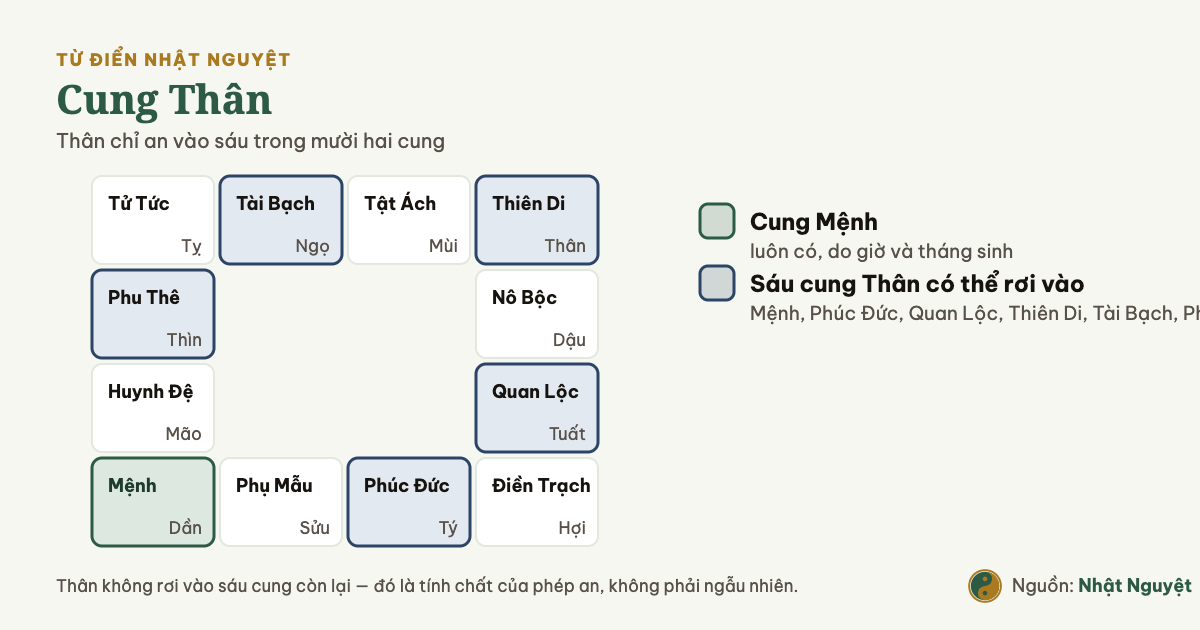
Cung Thân is determined by combining the birth month and birth hour. Depending on the lunar birth month and birth hour, cung Thân falls into one of the chart's palaces. Therefore, the same birth date with different birth hours can place cung Thân in different positions. This makes cung Thân highly individualized and impossible to guess without knowing the exact birth hour.
What does it mean when cung Thân coincides with cung Mệnh?
When cung Thân overlaps with cung Mệnh, tradition holds that the native has unity between essence and action, between will and deed. This is often regarded as a favorable placement, as there is no split between the inner person and the person expressed outwardly. However, this interpretation is only for reference and should not be treated as an absolute rule.
What if cung Thân enters other palaces?
When cung Thân does not coincide with cung Mệnh, it enters one of the remaining palaces such as Phụ Mẫu, Phúc Đức, Điền Trạch, Quan Lộc, Nô Bộc, Thiên Di, Tật Ách, Tài Bạch, Tử Tức, Phu Thê, or Huynh Đệ. Each position suggests that the native's "body" aspect is more tied to the corresponding domain. For example, cung Thân in Quan Lộc is often interpreted as a person closely bound to career and status; in Phu Thê, marriage and partner have great influence. These readings are only directional and should be placed within the whole chart.
How does cung Thân differ from cung Mệnh?
Cung Mệnh is often seen as the "root" of the person: temperament, innate abilities, and reactions to circumstances. Cung Thân leans toward the "branch": action, transformation over time, and later-life matters. Many old texts emphasize that Mệnh is prenatal and Thân is postnatal. However, both palaces should be read together, not separated or concluded from a single palace.
Notes on interpreting cung Thân
Cung Thân does not exist in isolation but is influenced by main stars, auxiliary stars, four transformations, and related palaces. Interpretation should be placed in the context of the whole chart, avoiding exaggeration of one palace. This is traditional knowledge for reference, not scientifically verified; readers should approach it with an open mind, not as a fixed destiny.