What is Tay Tu Trach?
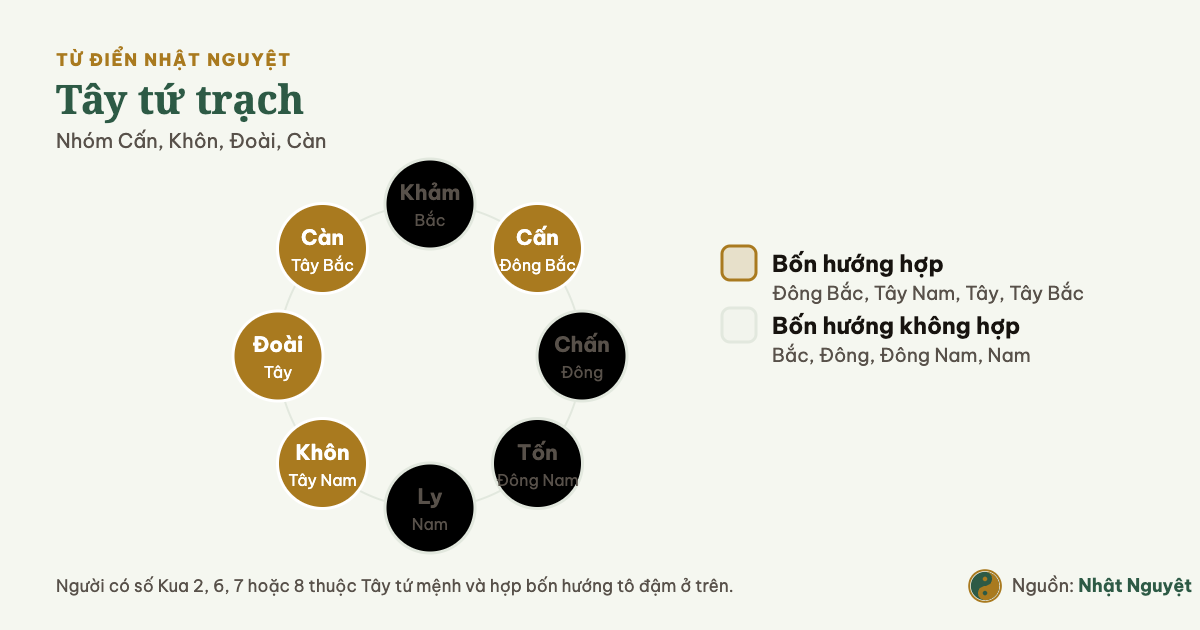
Tay Tu Trach (西四宅) is one of the two house orientation groups in the Bat Trach school of feng shui, comprising four directions: Can (Northwest), Khon (Southwest), Can (Northeast), and Doai (West). The other group is Dong Tu Trach, including Kham (North), Ly (South), Chan (East), and Ton (Southeast).
Origin and theoretical basis
Tay Tu Trach originates from the Bat Trach system, based on the eight trigrams of the I Ching and the relationship between a person's gua number and house orientation. The gua number (also called cung phi or Kua number) is calculated from birth year and gender, dividing people into two groups: Dong Tu Menh and Tay Tu Menh. The four trigrams Can, Khon, Can, Doai belong to the Tay Tu Menh group, corresponding to gua numbers 2, 5, 6, 7, 8 (depending on calculation for males and females). People of Tay Tu Menh are considered compatible with Tay Tu Trach houses.
Application in feng shui practice
When choosing a house or arranging the main door, practitioners often compare the owner's gua number with the house group. If the owner belongs to Tay Tu Menh, they should choose a house with an orientation in Tay Tu Trach, and prioritize good directions such as Sinh Khi, Dien Nien, Thien Y, Phuc Vi. Conversely, they should avoid bad directions such as Tuyet Menh, Ngu Quy, Luc Sat, Hoa Hai. Articles on the site also emphasize that interpretation should combine time cycles, specific mountain-direction, and purpose of use.
Distinguishing Tay Tu Trach from Tay Tu Menh
Tay Tu Trach is a group of house orientations, while Tay Tu Menh is a group of people whose gua numbers belong to the four trigrams Can, Khon, Can, Doai. The two concepts often go together but are not identical: a person may belong to Tay Tu Menh but still needs to consider other factors such as land position, surrounding environment, and overall design. Additionally, it should be distinguished from Dong Tu Trach, which is for the Dong Tu Menh group.
Note
This is traditional knowledge for reference, not scientifically verified. Readers should consider combining it with practical factors and not treat it as a mandatory rule.