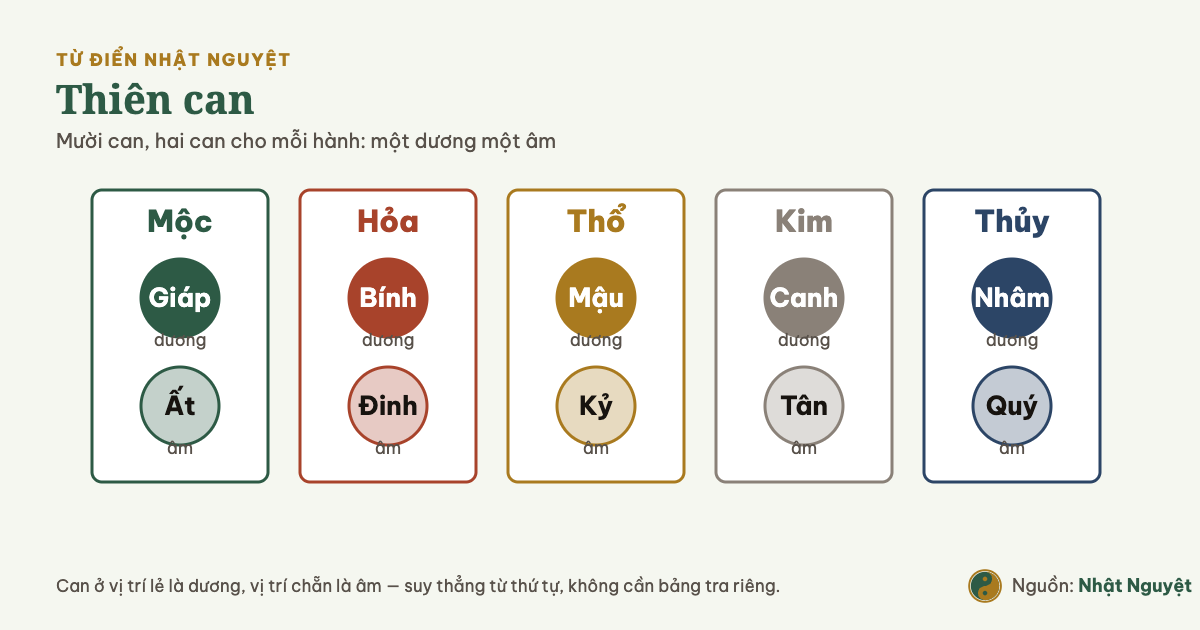
What are Heavenly Stems?
Heavenly Stems are ten symbols used in the Stem-Branch system of East Asian calendrics. The full name is the Ten Heavenly Stems, including: Jia, Yi, Bing, Ding, Wu, Ji, Geng, Xin, Ren, Gui. Each stem carries a Yin-Yang attribute and one of the Five Elements (Metal, Wood, Water, Fire, Earth), forming the foundation for interpreting many metaphysical systems such as BaZi, the I Ching, and Feng Shui.
Origin and role in calendrics
According to tradition, Heavenly Stems appeared very early in ancient Chinese culture, initially used to count days. When combined with the twelve Earthly Branches, they form a 60-year cycle (sexagenary cycle) used to record years, months, days, and hours. For example, a year is called the year of Jiazi, Yichou, etc. In BaZi (Four Pillars), each pillar consists of a Heavenly Stem and an Earthly Branch, reflecting different aspects of a person's destiny.
The ten Heavenly Stems and their attributes
Each Heavenly Stem has its own characteristics:
- Jia: Yang Wood, symbolizing a large tree, beginning and growth.
- Yi: Yin Wood, soft and flexible grass, yet resilient.
- Bing: Yang Fire, the radiant sun, spreading power.
- Ding: Yin Fire, a small flame, gentle and warm light.
- Wu: Yang Earth, solid ground, center and nourishment.
- Ji: Yin Earth, soft soil, nurturing and transforming.
- Geng: Yang Metal, raw metal, strength and decisiveness.
- Xin: Yin Metal, refined metal, sharp yet subtle.
- Ren: Yang Water, large water, ocean, spreading.
- Gui: Yin Water, soft water, flexible and hidden.
These attributes are applied in interpreting the I Ching, BaZi, and many other fields.
Distinguishing Heavenly Stems from Earthly Branches
Heavenly Stems and Earthly Branches often go together but have different roles. Heavenly Stems consist of 10 symbols, representing "heaven", indicating energy, qualities, and interactions. Earthly Branches consist of 12 symbols, representing "earth", associated with specific space, time, and zodiac animals. Their combination creates the complete Stem-Branch system. Additionally, Heavenly Stems differ from the Five Elements in that each element has two stems (yin and yang), for example, Wood has Jia (yang) and Yi (yin).
Notes for study
Information about Heavenly Stems is traditional knowledge, for reference, and has not been verified by modern science. Readers should approach it with a spirit of cultural learning, not as absolute truth or for making important life decisions.