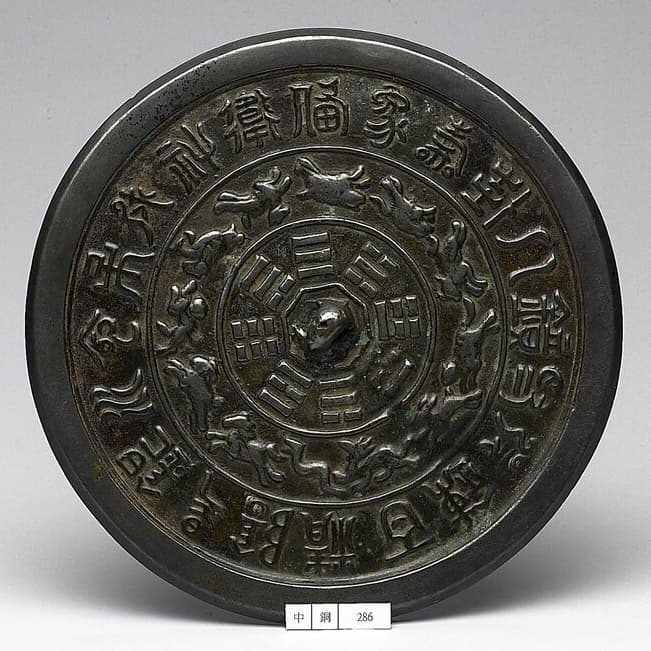
What are Ha Do and Lac Thu?
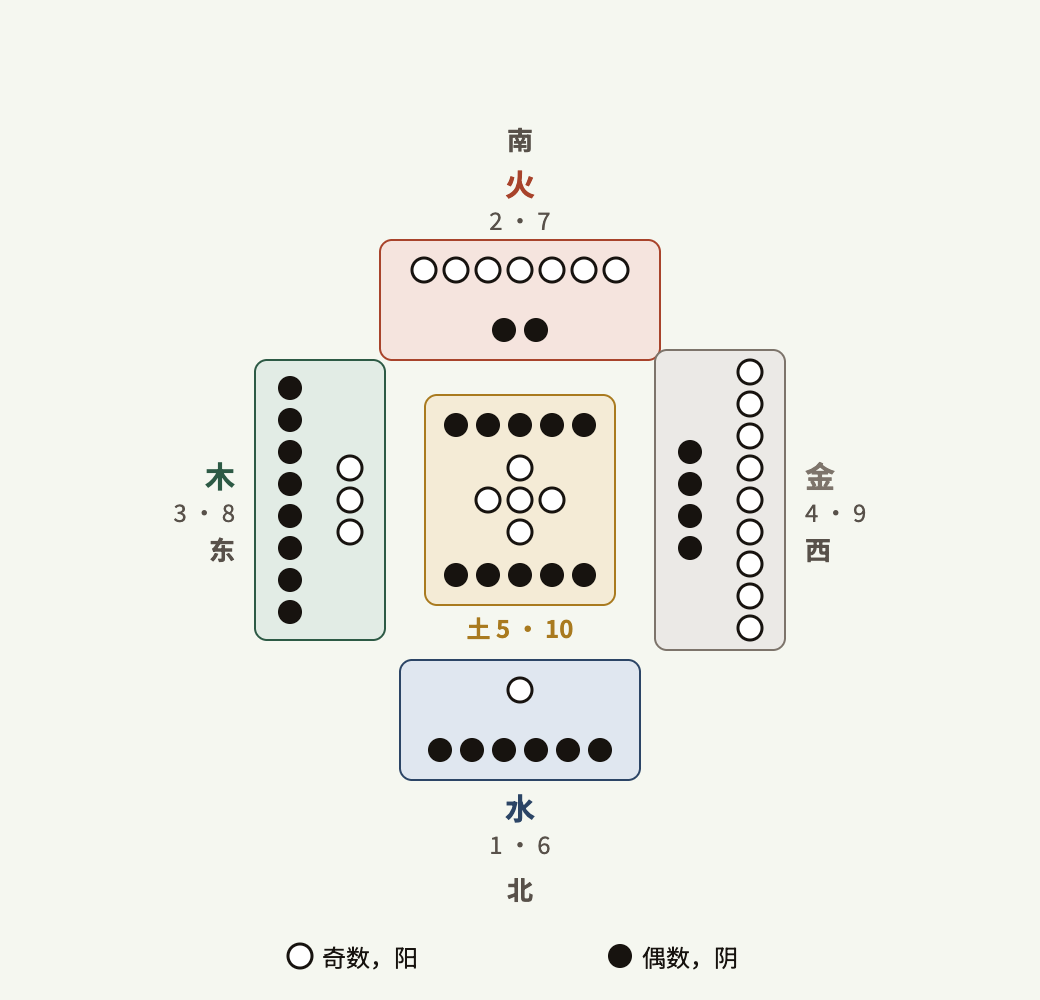
Ha Do and Lac Thu are two ancient diagrams of the I Ching tradition, regarded as early maps describing how heaven and earth operate. Ha Do has 55 black and white dots arranged in number pairs across five directions and five elements. Lac Thu has nine numbers from 1 to 9 placed in a 3x3 square, forming the only standard third order magic square, where every row, every column and both diagonals sum to 15.
The two diagrams usually go together in I Ching studies, feng shui, numerology and even early natural science research in ancient China. They provide the set of numbers, images and interaction relations between basic factors, forming the foundation for later calculation and interpretation.
How does Ha Do arrange birth and completion numbers by direction and element?
In the common explanation, each element has a birth number (yang, belonging to Heaven) and a completion number (yin, belonging to Earth). The birth number is the starting number for the formation of that element, the completion number marks that it has taken shape. The I Ching records: number 1 belongs to Heaven and starts Water, number 6 belongs to Earth and completes Water; number 2 belongs to Earth and completes Fire, number 7 belongs to Heaven and completes Fire; number 3 belongs to Heaven and starts Wood, number 8 belongs to Earth and completes Wood; number 4 belongs to Earth and completes Metal, number 9 belongs to Heaven and completes Metal; number 5 belongs to Heaven and starts Earth, number 10 belongs to Earth and completes Earth. This wording shows Heaven with Earth, Yin with Yang interacting, and through this the five elements are created.
The table below summarizes how Ha Do arranges birth and completion number pairs by direction and element:
| Direction | Element | Birth number | Completion number | Pair |
|---|---|---|---|---|
| North | Water | 1 (Heaven) | 6 (Earth) | 1 and 6 |
| South | Fire | 2 (Earth) | 7 (Heaven) | 2 and 7 |
| East | Wood | 3 (Heaven) | 8 (Earth) | 3 and 8 |
| West | Metal | 4 (Earth) | 9 (Heaven) | 4 and 9 |
| Center | Earth | 5 (Heaven) | 10 (Earth) | 5 and 10 |
A quick way to remember: birth and completion numbers always differ by exactly 5, meaning the birth number plus 5 gives the completion number. Odd numbers 1, 3, 5, 7, 9 are yang, even numbers 2, 4, 6, 8, 10 are yin. This arrangement also shows Ha Do places its focus at the central palace with the pair 5 and 10, while the other four elements spread out to the four directions.
How exactly is Lac Thu a 3x3 square where every row sums to 15?
Lac Thu places the nine numbers 1 to 9 into a 3x3 grid so that every horizontal row, every vertical column and both diagonals sum to 15. This is the only standard third order magic square, meaning there is only one arrangement if rotations and reflections are not counted. In the presentation commonly used by Vietnamese and Chinese people, number 1 sits at the bottom and number 9 at the top, because ancient maps place the South at the top and the North at the bottom.
| 4 | 9 | 2 |
|---|---|---|
| 3 | 5 | 7 |
| 8 | 1 | 6 |
In this square, number 5 sits at the center. The four even numbers 2, 4, 6, 8 sit at the four corners, the four odd numbers 1, 3, 7, 9 sit at the four middle edges, forming a cross around number 5. One notable property: because 5 is at the center, the sum of two cells symmetric through the center always equals 10, for example 4 with 6, 9 with 1, 2 with 8, 3 with 7. This number 10 equals the sum of the birth and completion pair of Earth in Ha Do, that is 5 plus 5.
How does Lac Thu link to the Hau Thien bagua and the nine stars?
In the common mapping, the eight outer cells of Lac Thu correspond to the eight trigrams of the Hau Thien bagua. This mapping matches the directions of the Hau Thien bagua: Kham in the North, Ly in the South, Chan in the East, Doai in the West, Can in the Northwest, Khon in the Southeast, Can in the Northeast, Ton in the Southeast. Because ancient maps place the South at the top, number 9 at the top corresponds to Ly and the Fire element, number 1 at the bottom corresponds to Kham and the Water element.
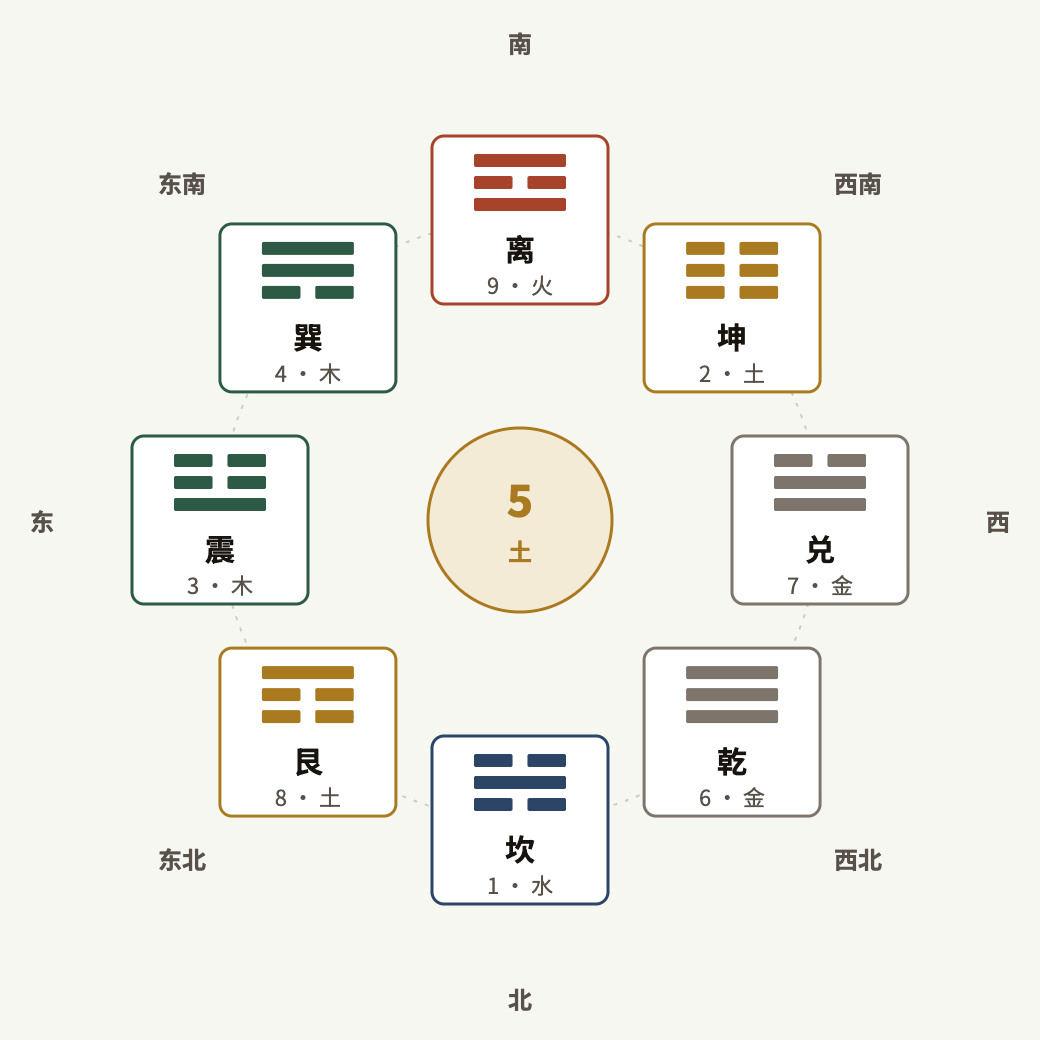
| Lac Thu cell | Number | Hau Thien trigram | Direction | Element |
|---|---|---|---|---|
| Top left | 4 | Ton | Southeast | Wood |
| Top center | 9 | Ly | South | Fire |
| Top right | 2 | Khon | Southwest | Earth |
| Middle left | 3 | Chan | East | Wood |
| Center | 5 | Central palace | Center | Earth |
| Middle right | 7 | Doai | West | Metal |
| Bottom left | 8 | Can | Northeast | Earth |
| Bottom center | 1 | Kham | North | Water |
| Bottom right | 6 | Can | Northwest | Metal |
Because the eight outer cells correspond to the eight trigrams and number 5 is at the center, Lac Thu is also called the Nine Palace Diagram or the nine palace diagram. In Huyen Khong Phi Tinh feng shui, these nine numbers are used as names for the nine stars, and the flight path of the stars is based on their original positions in Lac Thu. Feng shui texts note: Ha Do with its 55 dots shows the five elements and yin yang operating by the principle of mutual generation, while Lac Thu with its 9 numbers shows that the world, after heaven and earth are formed, is balanced and orderly.
How does Ha Do link to the Tien Thien bagua?
According to legend and the familiar explanation, King Phuc Hi looked at Ha Do and established the Tien Thien bagua and the 64 hexagrams. The mapping of Ha Do to the Tien Thien bagua is based on birth and completion number pairs by direction: the pair 1 and 6 in the North corresponds to Khon, the pair 2 and 7 in the South to Can, the pair 3 and 8 in the East to Ly, the pair 4 and 9 in the West to Kham. This is the common mapping in many I Ching books, though some books present slightly different details in matching each trigram.
One Vietnamese folk I Ching source pushes the comparison further: it holds that Ha Do gives rise to the Tien Thien bagua and follows the forward direction, Lac Thu gives rise to the Hau Thien bagua and follows the reverse direction. The forward direction is explained as clockwise, where yin and yang do not oppose each other, taking compassion and righteousness as the standard. The reverse direction is counterclockwise, taking conflict and opposition as the basis. This interpretation is heavily colored by cultivation philosophy, is not the only way, and other books may stop at matching numbers with trigrams.
Why is Ha Do said to be Tien Thien and Lac Thu Hau Thien?
This wording comes from Ha Do being considered earlier, linked to the time of Phuc Hi and the establishment of the Tien Thien bagua, while Lac Thu is linked to the time of Great Yu controlling floods and establishing the Hong Pham Cu Tru, after which King Van established the Hau Thien bagua. In philosophical interpretation, Ha Do is seen as the symbol of Tien Thien and Non action, while Lac Thu is the symbol of Hau Thien and Action.
Note that this is a philosophical assignment, not a verifiable historical event. Different schools may emphasize different aspects of the two diagrams, some leaning toward numerology, some toward cultivation, some toward feng shui. Learners should know clearly which interpretation they follow instead of mixing the different wordings together.
What do the Long Ma and sacred turtle legends say about the two diagrams?
Legend tells that in the time of King Phuc Hi, a Long Ma appeared at the Ha River, carrying a diagram on its back, hence the name Ha Do. King Phuc Hi then established the Tien Thien bagua and the 64 hexagrams. As for Lac Thu, according to the Book of Documents, it was granted by Heaven to King Great Yu after he successfully controlled the floods, and from it the king devised the Hong Pham Cu Tru, the method of governing society. King Van used Lac Thu to establish the Hau Thien bagua.
In another variant, Lac Thu appeared on the shell of a sacred turtle rising from the Lac River. This legend is also linked to King Yu controlling floods and the formation of the numbers. An English Wikipedia document on Lac Thu also records the variant of a sacred turtle rising from the Lac River with the Lac Thu figure on its shell, the round dots representing integers from 1 to 9 arranged in a 3x3 grid. The variants are not fully consistent with each other about the animal, the river and the king, so this is a place to present as legend rather than fact.
Why are the diagrams only clearly seen from the Song dynasty and why is there a story of reversed names?
A point rarely mentioned in popular articles: Ha Do and Lac Thu as we see them today are not images from the time of Phuc Hi or Great Yu. One source on Tu Vi records that these two diagrams were lost before Confucius edited the I Ching, and the present Ha Do and Lac Thu were redrawn by a Han dynasty man named Khong An, twelfth generation descendant of Confucius, without clear basis. This wording reflects the view that the current diagrams are products of later generations.
Another source on experiential Tu Vi also mentions that passages in the I Ching contradict each other when discussing the origin of the bagua, forcing later people to propose many hypotheses. One theory holds that Phuc Hi observed nature and drew them, another that he redrew them from a diagram on the bank of the Ha River, another that it came from the pattern on a turtle shell rising from the Lac River.
On naming, modern researchers often note that the Ha Do and Lac Thu diagrams only appear clearly from the Song dynasty, linked to names such as Tran Doan and Luu Muc. One notable point is that Luu Muc and Chu Hy sometimes called the two diagrams by reversed names, meaning the diagram one book calls Ha Do another may call Lac Thu. This is where documents disagree, and readers should check each book's convention before comparing.
Some theories hold that Ha Do and Lac Thu have ancient Viet roots, how should this be understood?
Some authors, notably the research direction in the book Thuat so Lac Thu, hold that the Lac Thu table together with the Nine Palaces and the Hau Thien bagua belong to the Lac Viet people, appearing before 2357 BCE, that is before King Nghiêu in the North. Ancient Chinese history records that in the Mau Than year of King Nghiêu's reign, envoys of the Viet Thuong people from the South came to the Binh Duong capital, presenting the king a sacred turtle with the Khao Dau script on its shell recording events since the opening of heaven and earth, and the king had it copied and named the Turtle Calendar. From this these authors infer that the turtle calendar of the Viet Thuong people must use the eight Hau Thien trigrams of the Lac Thu table, and that the original meaning of Lac Thu is the book of the Lac people.
This is a hypothesis of some authors, not a conclusion generally accepted by researchers. The reasoning relies heavily on inference from one passage of ancient history and on assigning meaning to the name, so when presenting it one should state clearly that this is the view of that group of authors. Readers may note it as one line of explanation, and should not treat it as settled historical fact.
Distinguishing Ha Do and Lac Thu from Ha Lac ly so
Ha Lac ly so is a separate discipline, using Ha Do and Lac Thu as the number foundation to convert the four pillars, that is the year month day and hour of birth, into I Ching hexagrams, then interpret them. It differs from simply reading the two diagrams as maps of numbers and elements. An I Ching document describes Ha Lac ly so as the combination of Ha Do, Lac Thu and I Ching principles, in which each number and each position in the two diagrams carries meaning about the five elements, yin yang and palace position. If one is only interested in Ha Do and Lac Thu as two ancient diagrams, there is no need to go deep into this method of converting the four pillars into hexagrams.
What should be noted when using Ha Do and Lac Thu?
First, books disagree on some details, especially the mapping of Ha Do to the Tien Thien bagua and the reversed naming of the two diagrams between Luu Muc and Chu Hy. Learners should follow one clear convention and state which convention they follow.
Second, one should not assign these numbers or diagrams an absolute auspicious or inauspicious value. The same number can be interpreted in different ways depending on school and context. Applications in feng shui, Tu Vi and Ha Lac are all interpretive systems, not formulas giving fixed results for everyone.
Third, one must clearly distinguish legend, historical record and research hypothesis. The Long Ma and sacred turtle legends belong to the legend layer; the fact that the diagrams only appear from the Song dynasty belongs to the historical record layer; and the ancient Viet roots theory belongs to the hypothesis layer of some authors. Mixing these three layers leads to poorly grounded conclusions.