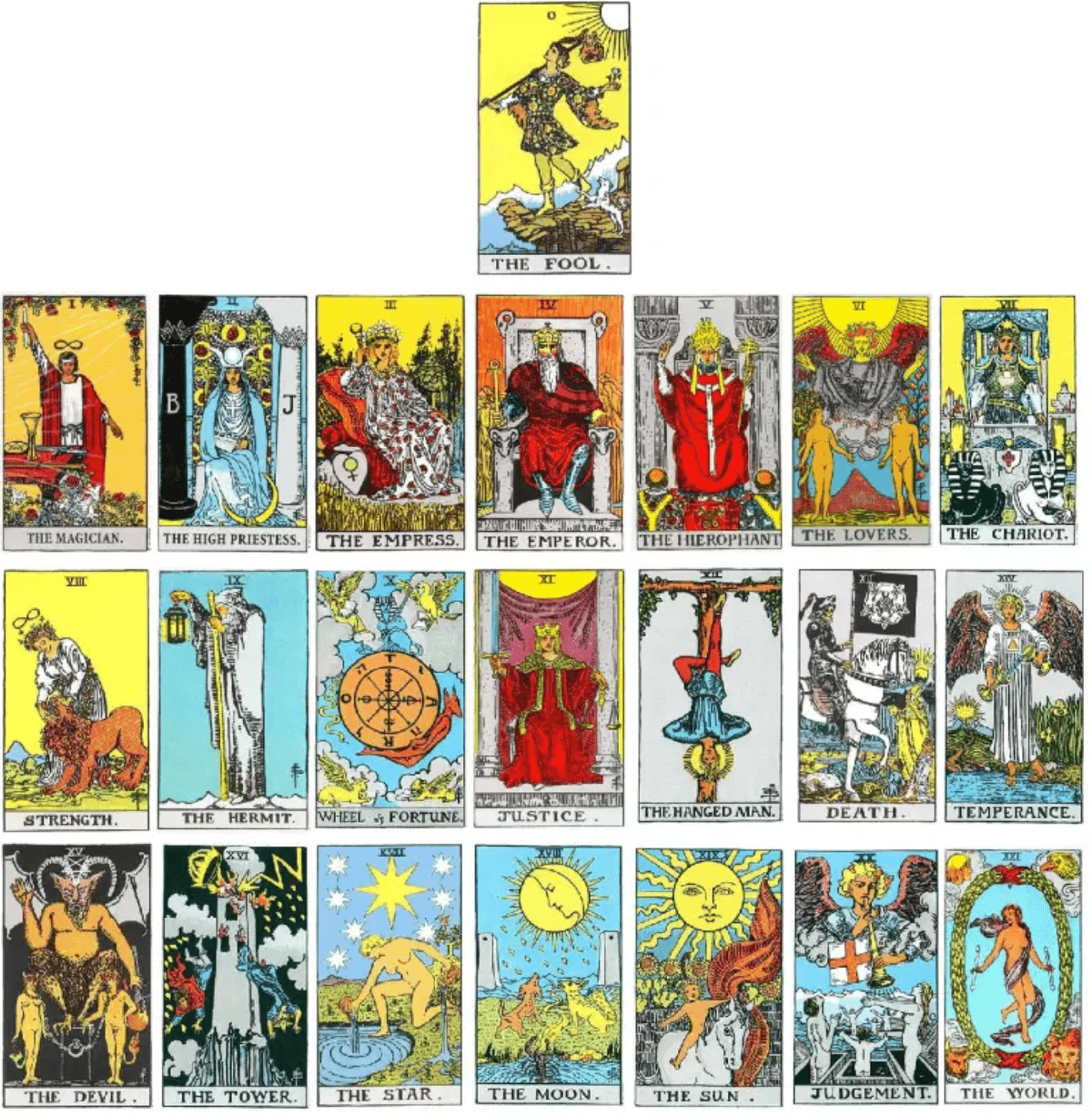
What is Tarot and what is it not?
Tarot is a deck of 78 cards, each a picture containing astrological, constellation, or religious symbolism, carrying its own story tied to human life. The reader, often called a Tarot Reader, uses the cards to open up a story, ask questions, and offer guiding advice. In the West, Tarot was once seen as a form of prophecy and healing; when it entered Vietnam, it was often used as a way of "fortune telling" to relieve spiritual needs.
One thing must be said clearly from the start: Tarot is not a recognized psychological therapy. It has no basis for diagnosing depression, anxiety, post-traumatic stress disorder, or any mental disorder. It also cannot replace medication, cognitive behavioral therapy, or any clinically validated intervention. Tarot is a symbolic tool, a language for you to dialogue with yourself. Its value lies there, and should stop there.
Psychologist Nguyen Thi Dao Luu, a lecturer at Van Lang University, says plainly that she does not support the overuse of Tarot because it is basically an activity that has not been scientifically proven. She also notes that if a person lets themselves be dominated by "cosmic signals" provided by others, the querent falls into a passive state. In some respects, Tarot is also similar to fortune telling, and this is completely unsupported.
Why does Tarot make querents feel lighter?
The pleasant feeling after a reading is real, but the mechanism behind it is not in the cards. It is in the psychology of the querent.
First, Tarot gives a concrete answer while you are still vague. When life is messy, the brain craves structure, order, a name for its unease. The cards provide exactly that structure: an image, a keyword, a story with a beginning and an end. The relief comes from the worry being framed, not from the future having been foretold.
Second, the reader is often a stranger, and a stranger is sometimes easier to be honest with than a family member. A 25-year-old in District 3 shares that there are many things they cannot share with family, so it feels easier to talk with a stranger; every concern is almost fully answered in the cards, and that helps them make decisions faster. This is the effect of being listened to without judgment, a very basic therapeutic factor, but it does not equal therapy.
Third, there is a familiar psychological effect that makes Tarot feel "right": general, positive descriptions that can apply to almost anyone are often nodded along to as accurate about oneself. Many readings are designed to say things true of nearly everyone, so the perceived "hit rate" is always high.
Where is the boundary between a hobby and a problem that needs a professional?
The boundary is not in how many times you draw cards, but in whether you still hold the power to decide.
If you see Tarot as a way to relax, an occasion to sit with your emotions, then weigh and decide for yourself, you are in the safe zone. If you start using the cards as the main basis to continue or end a relationship, to quit a job, to move house, to believe you will get sick or have an accident, then Tarot has crossed the entertainment boundary and is thinking for you.
Psychologist Dao Luu describes this mechanism clearly: reading Tarot too much makes a person dependent on others' predictions, losing their own capacity for thought, decision, and autonomy. She also warns that reading Tarot too much and promoting this spiritual form inadvertently aids and spreads an unhealthy activity.
Another notable detail: quite a few people are exploited for extortion when bad actors uncover the querent's weaknesses and anxieties. Bad actors can lure and entice the querent deeper into other superstitious paths such as rituals and luck-cleansing, leaving them with lost money and ruined health. There have also been cases where querents transferred deposits to book Tarot appointments and then the reader vanished. These are concrete risks, not far-fetched worries.
| Criterion | Safe zone, just a hobby | Caution zone, signs of dependence |
|---|---|---|
| Purpose | Relaxation, opening up thoughts | Seeking certain answers for big problems |
| Frequency | Occasional, on occasions | Almost every time difficulty arises |
| Basis for decisions | Self-weighing, cards only as suggestion | Using cards as the main reason |
| Emotion after reading | Lighter, clearer-headed | Anxious, fearful, wanting another reading immediately |
| Spending | Within normal entertainment budget | Gradually increasing, hard to control, plus other services |
| Relationship with reader | Temporary advisor | The one who decides your life for you |
How specifically does Tarot misuse cause harm?
The biggest risk is gradually losing the right to self-determination. When every event must be asked of the cards, you no longer practice the ability to tolerate uncertainty, a core life skill. You become passive before your own life.
The second risk is falling into the hands of profiteers. Tarot services appear quickly and widely on social media, with signs of profiteering. Just type a search and a flood of posts appears with attractive wording, even fanpages promising a partial refund if the result is wrong, a trick to create false credibility. There are groups with tens of thousands of followers, where posts offer readings at publicly stated prices from a few tens of thousands to a few hundred thousand dong, or "pay as you wish". Many readers treat this as their main income.
The third risk is spending on courses that promise too much. The popularity of Tarot attracts many young people willing to quit jobs to take long and short courses priced from a few million to tens of millions of dong, under the guidance of people claiming a few years of experience and advertising that one can practice professionally after just a few courses.
The fourth risk, and this is a health risk, is using Tarot to delay going to the doctor. A persistent symptom is not resolved by a card. If you are depressed, having thoughts of self-harm, or experiencing uncontrollable anxiety, then each reading is just another round of delay before you meet someone with expertise.
What signs indicate you should see a doctor instead of drawing another card?
This is the most important part of the article, and also the most easily overlooked.
Seek a mental health professional when you have the following signs, lasting two weeks or more or clearly affecting study, work, or family relationships:
- Sadness, loss of interest in things you once enjoyed, a feeling of emptiness almost all day.
- Excessive worry, rapid heartbeat, difficulty breathing, insomnia, inability to relax despite trying.
- Marked changes in sleep and eating: sleeping too little or too much, eating poorly or losing control of eating.
- Difficulty concentrating, forgetfulness, inability to complete simple tasks.
- Thoughts of self-harm, or a feeling of being a burden to others. This is a sign needing immediate medical support, not waiting.
- Continuing to seek fortune telling, Tarot, rituals as the only way to cope with stress, and feeling worse after each time.
- Spending on spiritual services beyond financial capacity, or borrowing to pay.
- Being pressured or threatened by the reader, hinted that you are haunted by "vong", "nghiep", or need to pay to resolve it.
If you recognize yourself in several lines above, that is not a sign you lack faith, but a sign you need someone with expertise. Psychiatrists, clinical psychologists, and properly trained psychological counselors are the ones who can assess, diagnose, and treat. Tarot is not on that list.
So how should Tarot be used healthily?
There is no need to absolutize prohibition. The practical approach is to put Tarot in its proper place.
Treat Tarot as a self-reflection ritual. Instead of asking "what will my future be", ask "what is worrying me so much that I must seek answers outside". The cards then are only a mirror, not a verdict.
Keep the power to decide. After each reading, ask yourself: if this card did not exist, what would I choose? If the answer depends entirely on the card, you have handed your power to someone else.
Choose a reader with professional ethics. A decent person will not promise absolute accuracy, will not scare with vong and nghiep, will not upsell resolution services, will not ask for unnecessary sensitive information, and will not keep you in a loop of having to return constantly.
Build your own capacity in parallel. Expert Dao Luu recommends that young people cultivate their own abilities to boost self-confidence, trusting in their own problem-solving ability instead of waiting for supernatural forces to open the way. The most important thing is to build a healthy spiritual life, firm beliefs, and safe spiritual anchors, because Vietnamese culture places considerable importance on spiritual life.
Cultural and social perspective: why is this demand not small?
This phenomenon must be viewed with a cultural eye, not only a critical one.
Cultural studies PhD Le Thi Truc Anh of the Ho Chi Minh City Academy of Cadres analyzes that the need for curiosity and fondness for guessing the future is a very human motive. Around Tet and the coming of spring, everyone likes to hear predictions for the new year to feel more excited, or to know where difficulties lie so as to resolve them. The problem only arises when fortune telling is distorted and tied to profiteering motives and exploits the spread of social media to commercialize, "trading in gods and saints". Then it becomes a social problem causing negative effects, needing attention from management levels and thorough, appropriate handling measures.
She also points out the psychological root: people turn to fortune telling because they are confused in identifying core personal values, having lost goals and direction in life. The pressure of making a living, along with global difficulties appearing in the post-Covid-19 period such as unemployment, sensitivity to life risks, illness, separation, rising divorce, make people more easily bewildered. A lack of firmness in reason and psychology pushes them to see fortune tellers to anchor their faith.
As for solutions, she proposes two parallel directions. One is strengthening awareness education about positive humanistic values and a lifestyle of independence, autonomy, self-respect and striving, especially for young people, using social media itself to create forums for Q&A, talks, and debates with the participation of scientists, educators, and managers. Two is strictly enforcing existing provisions in the Law on Cyber Security, the 2015 Penal Code, and decrees on administrative penalties for superstitious activities. She emphasizes: if there is a law, it must be strictly enforced, anyone violating must be sanctioned, otherwise it becomes "wasting the law" and the humanistic environment is polluted.
For young people, she advises the most practical way is to self-recognize and list one's own bad habits to plan to leave them each day, each week. A person is considered to have good fortune not because of one good habit, but because of countless good habits forming a reliable character, making surrounding relationships more pleasant and useful. Persistence and sincerity in each person's sowing and reaping journey will bring worthy results.
Conclusion: put Tarot in its proper place
Tarot can be an interesting hobby, an opening tool for you to look back at yourself. It is not psychotherapy, not a medical diagnosis, and not the one who decides for you. When you still hold the right to self-determination, still distinguish between suggestion and command, still know to stop before scare tactics and ever-growing sums of money, you are using it correctly. When you find yourself dependent, more anxious after each reading, or having persistent symptoms affecting your life, seek a mental health professional. That is the boundary, and knowing that boundary is the best way to protect yourself.