Where does BaZi originate from?
BaZi is tied to the Heavenly Stems and Earthly Branches system of Eastern culture, which was used early on to record years, months, days, and hours. Over centuries, people combined the Stems and Branches with the theories of the Five Elements and Yin-Yang to form a method of destiny analysis based on four pillars. Articles on the site such as "What is BaZi (Four Pillars)? How to read destiny through 8 Stem-Branch characters" and "BaZi (Four Pillars): Reading destiny through birth hour, day, month, and year" present BaZi as an analytical system based on birth time converted into Stems and Branches.
How is BaZi structured?
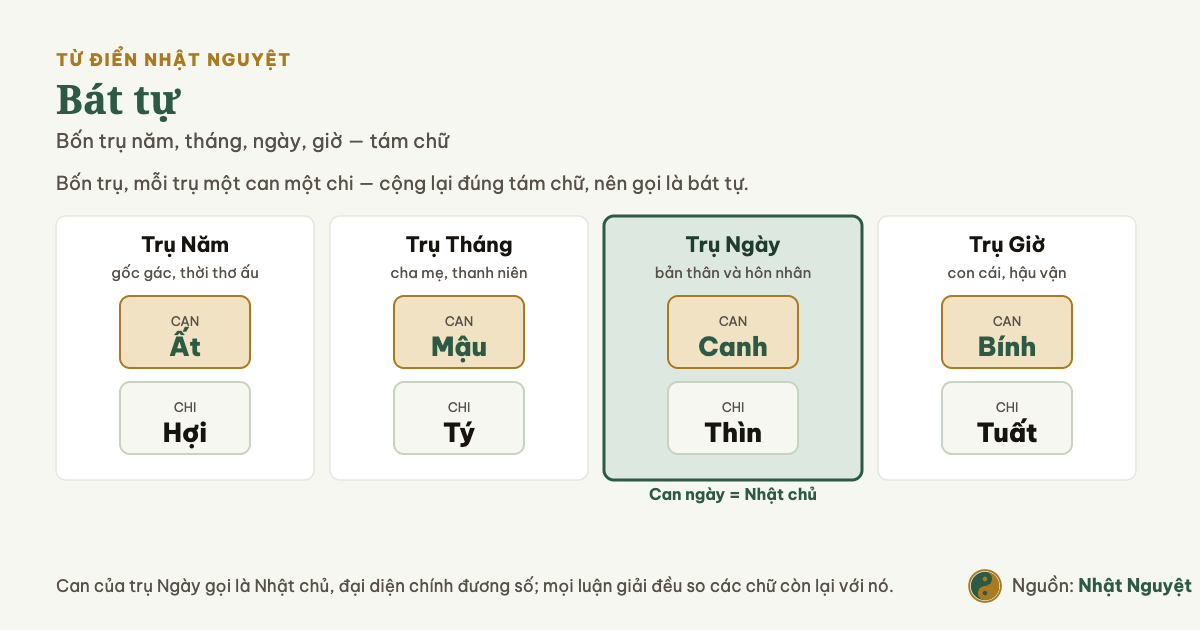
The four pillars are Year, Month, Day, and Hour. Each pillar consists of one Heavenly Stem and one Earthly Branch, giving eight characters, hence the name BaZi (eight characters). The stem of the birth day is called the Day Master (or Day Stem), representing the person being analyzed. The other pillars correspond to ancestors, parents, siblings, children, and life stages. Articles "What is the Year Pillar in BaZi (Four Pillars)?" and "What is the Month Pillar in BaZi (Four Pillars)?" explain the role of each pillar.
What is BaZi used for?
From the eight Stem-Branch characters, interpreters analyze the strength and weakness of the Five Elements (Metal, Wood, Water, Fire, Earth), the generating and controlling relationships, and clashes or combinations among pillars, to infer personality, life trends, and relationships. Concepts such as the Ten Gods (Direct Resource, Indirect Resource, Eating God, Indirect Wealth, Seven Killings, Rob Wealth, etc.) and Useful God are tools for interpretation. Articles on the site about Indirect Resource, Direct Resource, Indirect Wealth, Eating God, Seven Killings, Rob Wealth, and Useful God all belong to this system.
How is BaZi different from Zi Wei Dou Shu?
Both are traditional destiny analysis methods but use different data and charting methods. BaZi relies on the eight Stem-Branch characters of birth year, month, day, and hour, directly analyzing the Five Elements and their generating and controlling relationships. Zi Wei Dou Shu creates a chart with palaces and stars based on birth hour, day, month, and year. The article "What is Zi Wei Dou Shu? Overview of reading methods and foundational concepts" introduces the Zi Wei system, helping distinguish it from BaZi.
What should be noted when studying BaZi?
BaZi is traditional knowledge for reference, not scientifically verified. Interpretation depends heavily on the experience and viewpoint of the reader, and should not be taken as a definitive conclusion about the future or personality. Learners should maintain an objective attitude, avoid superstition, and not use BaZi to make important life decisions.