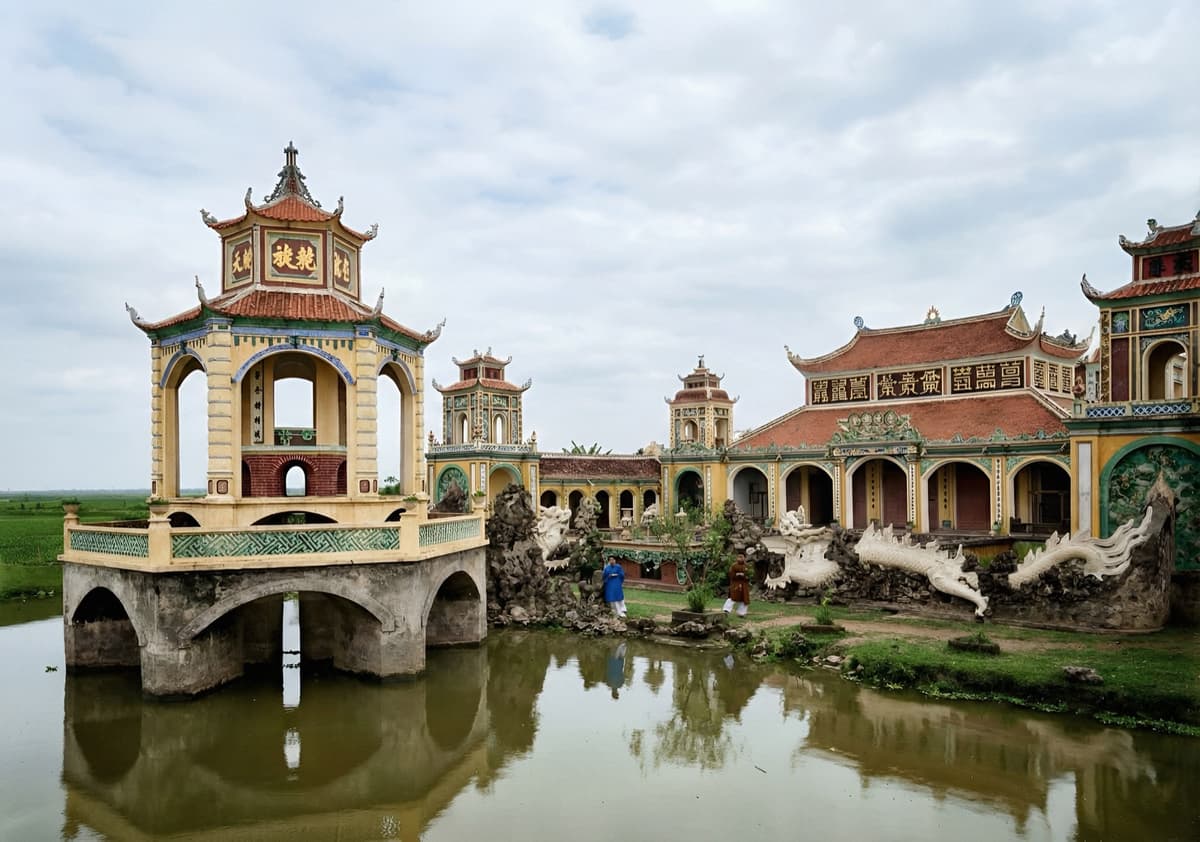
Overview of Huong Pagoda Festival
Huong Pagoda (Huong Tich Pagoda) is located in Huong Son commune, My Duc district, Hanoi. It is a complex of Buddhist relics and landscapes stretching along Yen stream valley. The festival traditionally opens on the 6th day of the first lunar month and lasts until the end of the third lunar month.
The Pilgrimage Journey
The festival follows a "pilgrimage" style combined with sightseeing. Visitors take boats from Duc wharf upstream along Yen stream for about 3 kilometers, passing limestone mountains and small temples. The main destinations are Thien Tru Pagoda (outer pagoda) and Huong Tich Cave (inner pagoda) at approximately 500 meters altitude.
Huong Tich Cave was inscribed with four characters "Nam Thien De Nhat Dong" (the most beautiful cave in the Southern sky) by Lord Trinh Sam in 1770. Inside, stalactites form various shapes, notably images of Goddess of Mercy and figures resembling Buddhas and Bodhisattvas.
The Legend of Goddess of Mercy at Huong Pagoda
The legend is associated with the Vietnamese folktale of Thi Kinh (Quan Am Thi Kinh). According to the story, Thi Kinh was a beautiful and virtuous woman. One night, seeing a stray hair on her sleeping husband's chin, she tried to remove it. Her husband woke up startled, thinking she intended to harm him, and accused her publicly. Thi Kinh was rejected by her husband's family and had to disguise herself as a man to become a monk.
She was given the dharma name Kinh Tam. During her practice, a rich girl named Thi Mau tried to seduce her. When Thi Mau became pregnant and blamed Kinh Tam, the young monk accepted the blame silently to maintain monastic discipline and was expelled from the temple.
From Thi Kinh to Goddess of Mercy
Kinh Tam raised Thi Mau's child and later retreated to Huong Tich mountain for deep meditation. After years of ascetic practice, she attained enlightenment and was ordained by Buddha as Quan Am Bodhisattva. Her body manifested with a compassionate face holding a pearl, radiating brilliant light. People revered her virtue and built temples to worship her as Phat Ba Quan Am (Goddess of Mercy).
This is why Huong Tich Cave is considered the place where Quan Am practiced and attained Buddhahood, making Huong Pagoda the most important pilgrimage destination for Vietnamese Buddhists.
Cultural and Spiritual Significance
Integration of Buddhism and Folk Beliefs
The festival shows a clear blend of Mahayana Buddhism with indigenous folk beliefs. Besides worshipping Buddha, locals also worship mountain gods, river gods, and Mother Goddesses. The complex includes Trinh Temple, Cua Vong Temple, Tien Son Pagoda, and the temple dedicated to Quan Am Thi Kinh.
A Festival of Moral Cultivation
Pilgrimage to Huong Pagoda represents returning to the land of Buddha and seeking inner peace. The legend of Quan Am Thi Kinh conveys messages of compassion, patience, and forgiveness. Despite being wronged, she maintained her virtue without resentment and finally achieved enlightenment.
The Festival in Contemporary Context
The opening ceremony is held solemnly at Thien Tru Pagoda with incense offering, rituals, and traditional performances. In recent years, the festival has been managed toward civilization, safety, and economy. Authorities have implemented traffic management, limited votive paper burning, and strengthened environmental sanitation.
The distinction between religious activities and tourism services has been emphasized. Today, Huong Pagoda Festival serves both as a spiritual space and a distinctive cultural tourism product, promoting Vietnam's image internationally.


