


Cúng giỗ thường (yearly death-anniversary offering)
Also called: Cát kỵ, Chính kỵ, Húy nhật, Đám giỗ, Kỵ nhật, Văn khấn ngày giỗ thường, Giỗ chồng, Văn khấn ngoài mộ ngày giỗ
- Ancestors and death anniversaries
Culture and belief A record of custom.
By custom, giỗ thường is the yearly anniversary of a death, counted in the lunar calendar from the third year on, after the first and second anniversaries. In folk practice the family prepares offerings, addresses the household deities first, then invites the deceased and the ancestors; many families also announce the rite the day before (tiên thường).
At a glance
- When it is held
- The date of death counted by the lunar calendar, from the third year onward; by custom there is a tiên thường (advance offering) rite on the day before
- For whom
- The deceased for whom the giỗ (death anniversary) is held; ancestors on both the paternal and maternal sides; the household deities (Thổ Công (Earth God of the house), Táo quân (Kitchen Gods)) are addressed first
- Where
- Ancestral altar, Grave, Courtyard or outdoors
Each family and each region may do it differently.
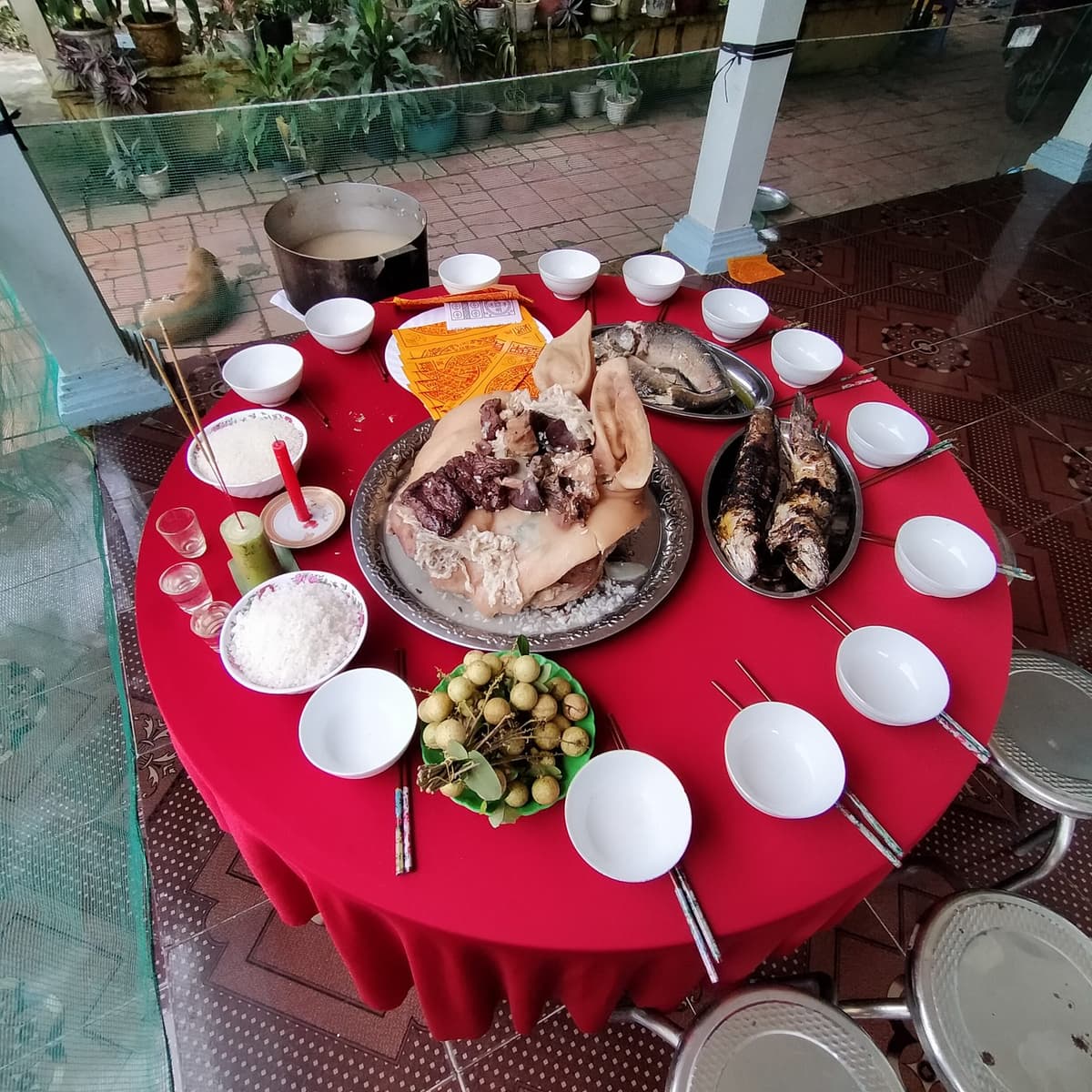
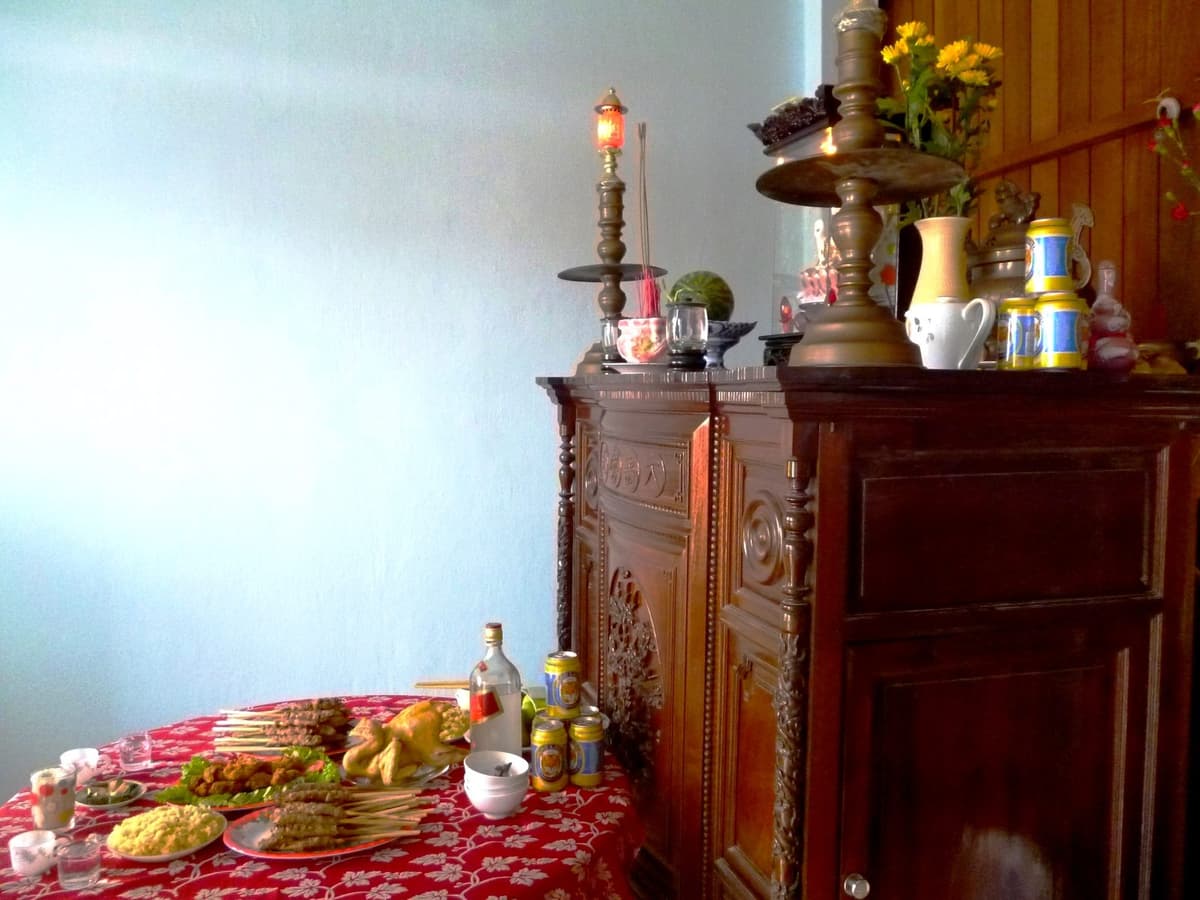
The offering tray

.jpg)
Nationwide
Folk practice
- When
- The main day of the giỗ (death anniversary) by the lunar calendar; on the day before there is the tiên thường rite (cáo giỗ, announcing the death anniversary)
- Where the offerings are set
- The ancestors' altar; for the tiên thường rite there is also a visit to the grave to invite the deceased
- Who makes the offering
- The person presiding over the giỗ (the household head, the eldest son)
| Offering | Vegetarian or not | Notes |
|---|---|---|
| Incense, lamps, candles | ||
| Incense, flowers, fruit, phẩm oản (offering cakes) | Vegetarian | Required |
| Votive paper | ||
| Vàng mã (votive paper) | ||
| Betel leaves and areca nuts | ||
| Trầu (betel), rượu (wine) | Vegetarian | |
| Xôi (steamed sticky rice) and cakes | ||
| Savory offering tray: xôi (steamed sticky rice), chicken, various rice and soup dishes | Meat or fish | |
| A bowl of rice turned over onto a boiled egg | Meat or fish | Phan Kế Bính (1915) records that however large or small the giỗ, this must be there, placed first |
| Meat and savoury dishes | ||
| Pig's head or cow's head | Meat or fish | Used to worship Thổ Công (Earth God of the house) on the day of the giỗ |
Buddhist
- When
- The main day of the giỗ (death anniversary)
- Where the offerings are set
- The altar at home
- Who makes the offering
- Chủ sám (the person presiding over the rite in the house)
| Offering | Vegetarian or not | Notes |
|---|---|---|
| Vegetarian dishes | ||
| Vegetarian food offerings | Vegetarian | The version from the pagoda: do not offer food that one has killed oneself or had others kill |
North
- Where the offerings are set
- An elaborately arranged altar, with plenty of flowers and fruit
| Offering | Vegetarian or not | Notes |
|---|---|---|
| Flowers | ||
| Flowers and fruit | Vegetarian | |
| Meat and savoury dishes | ||
| Feast tray: boiled chicken, xôi (sticky rice), fried spring rolls, bamboo shoot soup, giò chả (pork rolls) and braised dishes | Meat or fish | Arranged as "tam sên" (3 dishes) or "ngũ vị" (5 dishes) |
Central
| Offering | Vegetarian or not | Notes |
|---|---|---|
| Meat and savoury dishes | ||
| Local specialities: bánh bèo (steamed rice cakes), bánh bột lọc (tapioca dumplings), roast pork, fish braised with turmeric, sour soup | Meat or fish | Giỗ in the Centre are usually simple, without insisting on lavish trays |
South
Mekong Delta, Folk practice
- When
- The mâm tiên on the afternoon before, the mâm chánh early on the morning of the main day, and hậu thường on the afternoon of the main day
- Where the offerings are set
- The central table inside the house and a tray out in the yard
| Offering | Vegetarian or not |
|---|---|
| Other | |
| Offering tray for the deceased relative | |
| Tray for the cửu huyền thất tổ (nine generations of ancestors), on the central table inside | |
| Tray in the yard for fallen soldiers and the spirits of the land and house | |
| Meat and savoury dishes | |
| Pork braised with duck eggs, snakehead fish sour soup, lotus stem salad, stewed bitter melon | Meat or fish |
| Curry, hot pot, bánh xèo (sizzling crêpes) | Meat or fish |
| Xôi (steamed sticky rice) and cakes | |
| Bánh tét (cylindrical sticky rice cake), bánh ít (small sticky rice cakes) | Meat or fish |
| Chè (sweet soup) | Vegetarian |
Steps of the rite
Used across Vietnam, Folk practice
- Laying out the offeringsFrom the morning of the tiên thường day, clean the altar and arrange the offerings of the head of the household and of those sending offerings
- Reciting the prayerAddress Thổ thần (Earth God), Táo quân (Kitchen Gods), Long mạch (Dragon Vein) first, then address the ancestors, both on the tiên thường day and on the main giỗ day
- PreparationOn the tiên thường day, go to the grave of the deceased to perform the inviting rite and tidy the grave
- Reciting the prayerGuests come, place their offerings on the altar, then perform 4 bows and 3 vái (bows with joined hands), and the head of the household returns the rite
- Clearing the offeringsAfter three rounds of incense, perform the farewell rite, burn the prayer text, burn votive paper, take down the offerings, and invite relatives to the giỗ meal
Used across Vietnam, Buddhist
- Reciting the prayerInsert incense, kneel, join palms, and the presiding person reads the address
- Make offerings in four tiers: the Buddhas; Bodhisattvas and the Holy Sangha; the devas and spirits; and the departed souls
- Clearing the offeringsChant three mantras, dedicate the merit, and take down the offerings
Mekong Delta, Folk practice
- PreparationThe day before, women of the family and the neighbourhood come to wrap bánh tét and bánh ít and cook
- Reciting the prayerOffer the mâm tiên on the afternoon before, the mâm chánh on the morning of the main day, and hậu thường that afternoon
- Sharing the blessed offeringsRelatives and neighbours are treated to a meal; guests leave with a portion to take home: a roll of bánh tét, bánh ít, sticky rice, fruit
Good to know
Used across Vietnam, Folk practice
- GuestsPhan Kế Bính records that guests coming to the giỗ bring tea, areca, rice wine or votive paper and incense; one guide notes that the descendants receive the guests' offerings and place them on the altar before the guests bow
Mekong Delta, Folk practice
- GuestsThanh Niên notes that some families prepare a gift bag for every guest to take home for relatives who could not come
What is avoided
Used across Vietnam, Folk practice
- From the time of cáo giỗ (announcing the death anniversary) until the end of the next day, incense is kept burning on the altar at all times
- ConductThe feast is offered first once cooked; before the offering no one may touch it
Used across Vietnam, Buddhist
- Do not kill living beings for the offering
The custom
Phan Kế Bính (1915) records that for distant anniversaries (great-grandparents, grandparents) families prepare a chicken, a tray of sticky rice or a few trays of dishes, offer them to the ancestors first and then gather to eat; anniversaries of parents are held on a larger scale.
Tuổi Trẻ notes that since a giỗ comes once a year, holding the anniversaries of parents and grandparents is treated as important; customs differ between regions, and many families now hold them more simply than before.
Questions
Is the death anniversary counted by the lunar or the solar calendar?
By custom the anniversary is counted by the lunar calendar: VOH notes that the death anniversary follows the lunar calendar and is held every year. One guide adds that families used to the lunar calendar take the lunar date, while families keeping the anniversary by the solar calendar or by their own religious tradition use the solar date.
Does a death-anniversary offering need a bowl of rice and an egg?
Phan Kế Bính (1915) records that however large or small the giỗ, there must be a bowl of rice turned over onto a boiled egg, placed first. One guide notes that a full bowl of rice, a boiled egg and a pinch of salt survive in the memory of some villages on the outskirts of Hà Nội, and are not an offering every household must have.
Can the death anniversary be held before the date of death?
By old custom the main rite is held on the actual date of death (the main anniversary), with the tiên thường rite the day before (Phan Kế Bính). Tuổi Trẻ notes that some families now choose a weekend instead so relatives can all come, or combine the anniversaries of parents who died close together into one day, while others still keep the exact date.
How do death-anniversary offering trays differ in the North, the Centre and the South?
Tuổi Trẻ describes: in the North the altar is elaborately arranged and the tray has boiled chicken, sticky rice, fried spring rolls, bamboo shoot soup, pork rolls and braised dishes, arranged as tam sên (3 dishes) or ngũ vị (5 dishes); in the Centre it is usually simple, with local specialities such as bánh bèo, bánh bột lọc, roast pork, fish braised with turmeric and sour soup; in the South there are pork braised with duck eggs, snakehead sour soup, lotus stem salad, bánh tét and sweet soup, and in some places the whole neighbourhood is invited.
How many days does a giỗ in the Mekong Delta last?
Usually two to three days: Thanh Niên describes a giỗ in An Giang held over two days, the tiên thường day and the chánh giỗ day, with hậu thường added on the afternoon of chánh giỗ; Tuổi Trẻ describes a family in Bạc Liêu that holds it for at least three days (gathering and cooking, the offering and the meal, clearing up). Sài Gòn Giải Phóng notes that three-day giỗ can still be seen in the Mekong Delta countryside.
Up to which generation are death anniversaries held?
Phan Kế Bính (1915) records that wealthy households keep spirit tablets for four generations (great-great-grandparents, great-grandparents, grandparents, parents); at the fifth generation the oldest tablet is buried, a practice called "ngũ đại mai thần chủ", while the founding ancestor's tablet in the clan hall is kept forever. One guide notes that household anniversaries cover the four nearest generations, and ancestors from the fifth generation up are remembered at the clan's ancestor anniversary.
Communities and regions
More about Cúng giỗ thường (yearly death-anniversary offering)
Sources
- Văn khấn ngày Giỗ Thường (vankhan.vn)
- Văn khấn Thờ cúng gia tiên (vankhan.vn)
- Việt Nam phong tục, Phần I, mục XI. Kỵ nhật, Phan Kế Bính, 1915 (vi.wikisource.org)
- Việt Nam phong tục, Phần I, mục IV. Phụng sự tổ tôn, Phan Kế Bính, 1915 (vi.wikisource.org)
- Đám giỗ thời nay: tinh gọn mà vẫn đong đầy, Phụ nữ Online (tuoitre.vn)
- Đi ăn đám giỗ miền Tây, vì sao khách còn có phần mang về? (thanhnien.vn)
- Vì sao đám giỗ ở miền Tây nhà nhà gói bánh tét? (tuoitre.vn)
- Văn khấn gia tiên ngày rằm, mùng 1 và các dịp quan trọng (voh.com.vn)
- Đám giỗ quê nhà (sggp.org.vn)
- Bài văn khấn cúng giỗ tổ dòng họ (docungtamlinh.com.vn)
Part of the open datasets Types of Vietnamese offering rites and Vietnamese offering procedures, licensed CC BY 4.0.
More ritesDeath anniversaries, Tết, the home, business, the life cycle, village and ethnic rites.Open