


Daily offering to Thần Tài (God of Wealth) and Thổ Địa (Earth God)
Also called: Cúng ông Địa, Xin lộc buôn bán, Thần Tài Ông Địa, Cúng Thần Tài mùng 1, ngày rằm
- Household deities
Culture and belief A record of custom.
According to folk belief, Thần Tài (God of Wealth) is associated with money and business, while Ông Địa (Earth God) is associated with land and houses, so the two are worshipped together, especially in business households. The worship cabinet is placed low, close to the ground, in a corner of the house near the door, unlike the ancestors' altar which is placed high.
At a glance
- When it is held
- Daily when opening the shop for business; the first day of the lunar month, the fifteenth day of the lunar month, and the 10th of every month; the major ceremony is the vía Thần Tài (God of Wealth's feast day) on the 10th of the first lunar month
- For whom
- Thần Tài (God of Wealth) and Thổ Địa (Earth God, Ông Địa) are worshipped together in one cabinet; the prayer text also pays respect to Táo quân (Kitchen Gods), Tiền chủ (former owner), and Hậu chủ (later owner)
- Where
- Thần Tài altar
Each family and each region may do it differently.
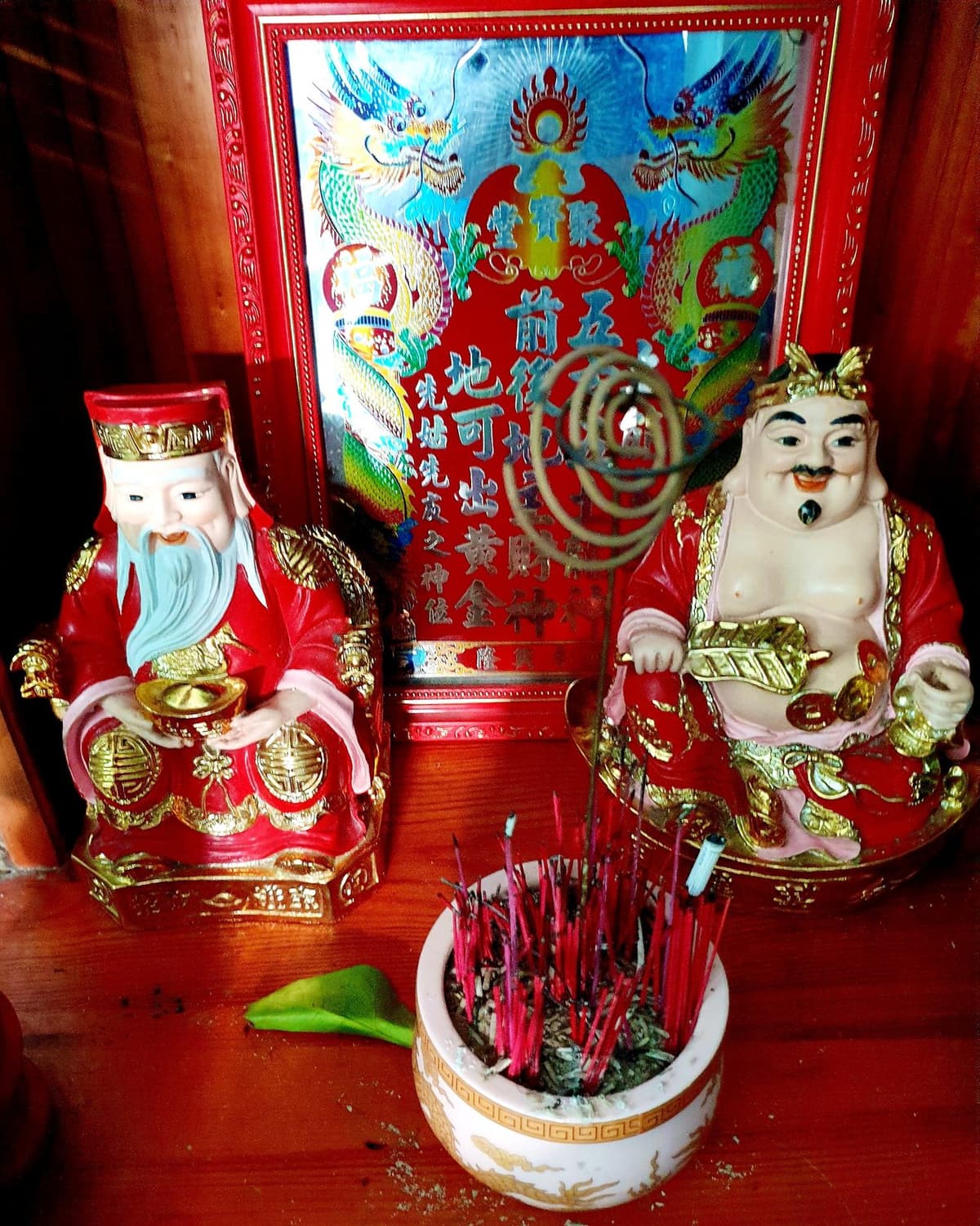
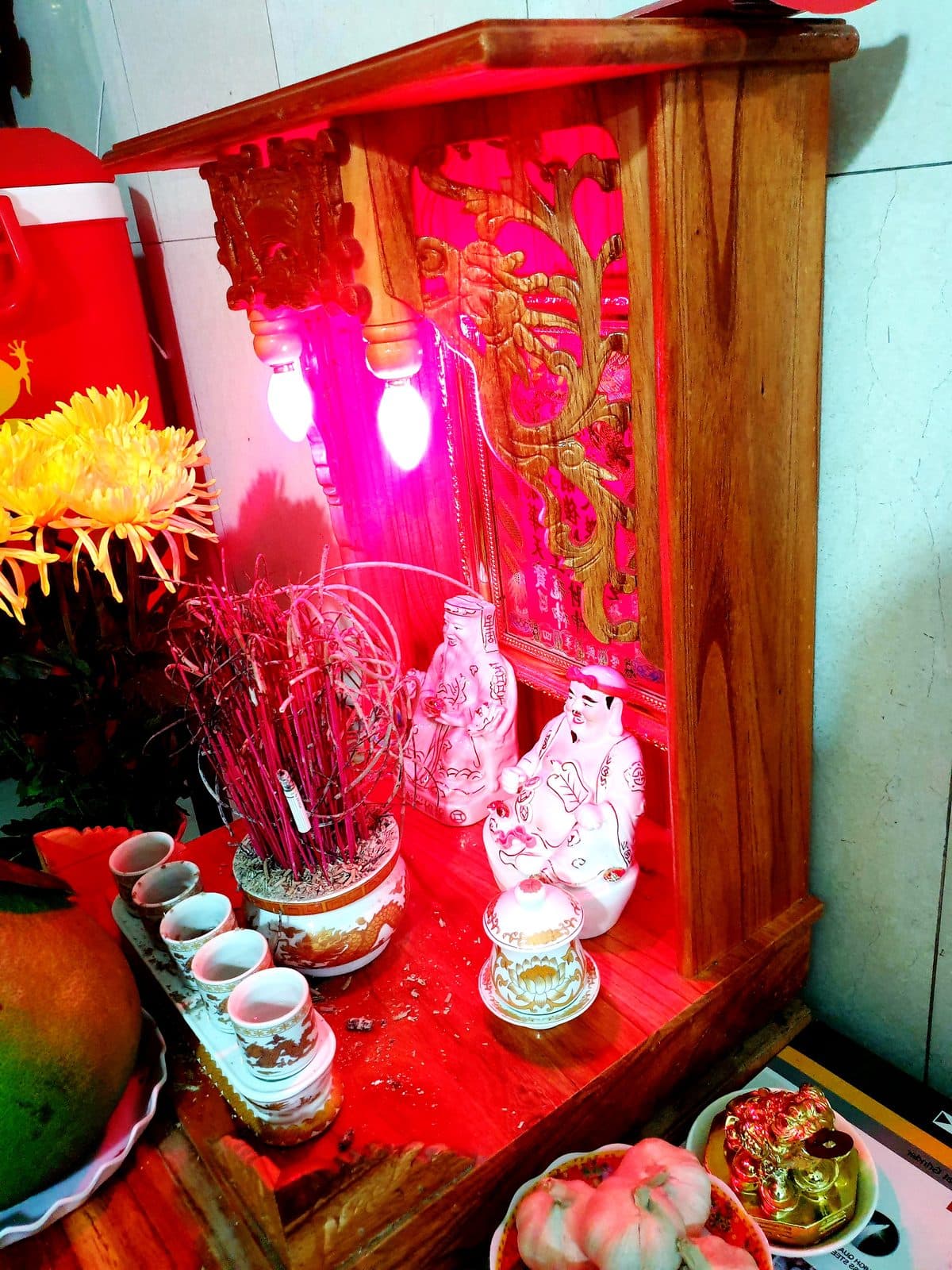
The offering tray
.jpg)
.jpg)
Nationwide
- When
- Every morning before working or doing business; the first day of the lunar month (lễ Sóc) and the evening of the fifteenth day of the lunar month (lễ Vọng)
- Where the offerings are set
- The worship cabinet is placed low, close to the ground, in a corner of the house near the entrance
| Offering | Quantity | Vegetarian or not | Notes |
|---|---|---|---|
| Incense, lamps, candles | |||
| Daily: incense, a cup of clean water | Vegetarian | May add flowers, fruit, cakes and candies | |
| Sóc vọng (first and fifteenth days of the lunar month), vegetarian offering: incense, flowers, betel leaves and areca nuts, fruit, votive paper | Vegetarian | ||
| Meat and savoury dishes | |||
| Sóc vọng (first and fifteenth days of the lunar month), savory offering: wine, boiled chicken, boiled meat, roasted meat, bánh chưng (square sticky rice cake), xôi (steamed sticky rice) | Meat or fish | Optional. May offer additionally | |
| Rice and salt | |||
| Three jars of rice, salt, water | Vegetarian | Placed between the two statues, replaced only at the end of the year | |
| Tea, rice wine, water | |||
| Five cups of water | 5 | Vegetarian | Arranged in a cross or a horizontal row in front of the incense bowl, water changed daily |
| A bowl of water with scattered flower petals | Placed at the very front | ||
South
- When
- Ông Địa in the market stalls is offered coffee and cigarettes every morning by the stall owners (Thanh Niên)
- Where the offerings are set
- On the floor inside the house, facing the main door; Thần Tài is worshipped in the same place as Ông Địa (Earth God)
| Offering | Vegetarian or not | Notes |
|---|---|---|
| Fruit | ||
| Chuối xiêm (Pisang Awak bananas) | Vegetarian | Rural Mekong Delta |
| Xôi (steamed sticky rice) and cakes | ||
| Chè xôi nước (glutinous rice balls in ginger syrup) | Vegetarian | Rural Mekong Delta |
Steps of the rite
- Laying out the offeringsThe Thần Tài statue is placed on the left, the Thổ Địa statue on the right, the tablet close to the central wall, the incense bowl in front of the tablet
- Laying out the offeringsFlower vase on the right, fruit plate on the left (from the outside looking in)
- Reciting the prayerChange the water, light incense, pray
Good to know
Used across Vietnam, Folk practice
- CafeF notes that because the shrine sits at floor level, the floor around it is kept clean when sweeping or mopping, so that dust, dirty water and floor cleaner do not splash onto it
- A feng shui expert answering in VnExpress says that when the incense bowl on the Thần Tài altar is full, the burnt stems are pulled out, and people usually leave 3 to 5 stems
Southern Vietnam, Folk practice
- In some places in the Mekong Delta the host eats one banana before offering the bunch, following the tale that Ông Địa fears being poisoned
What is avoided
- Do not move the incense bowl when cleaning
- Do not use artificial fruit or wilted flowers
The custom
According to folklorist Huỳnh Ngọc Trảng (Tuổi Trẻ), until the late 19th century the Earth God (Thổ Thần) still served as the god of wealth, following the idea that earth gives rise to metal; the Thần Tài (God of Wealth) that Vietnamese families worship today only appeared in the 1920s and 1930s as commerce grew, is most widespread in the South, and is still worshipped together with Ông Địa (Earth God).
Cultural researcher Dương Hoàng Lộc (Thanh Niên) says that in the South, Thần Tài is widely worshipped in households, together with Ông Địa, placed on the floor inside the house facing the main door; Vietnamese belief about Thần Tài is partly influenced by the Chinese god of wealth.
Assoc. Prof. Nguyễn Thanh Tú (CafeF) explains that the shrine of Thần Tài and Ông Địa is placed at floor level first of all to set it apart from the ancestral altar, which stands high.
Questions
What is needed for the daily offering to Thần Tài?
The daily offering is simple: one or three incense sticks, a cup of clean water, fresh flowers if available, fruit or a few sweets (according to some guides). Many shopkeepers light incense in the morning before opening; a feng shui expert answering in VnExpress holds that where there is a Thần Tài altar, incense is lit every day.
What is Ông Địa usually offered in the Mekong Delta?
According to a Thanh Niên article on the rural Mekong Delta, Ông Địa is usually offered chuối xiêm bananas and chè xôi nước (glutinous rice balls in syrup); in some places the host eats one banana before making the offering. Ông Địa in the markets is offered coffee and cigarettes every morning.
Communities and regions
More about Daily offering to Thần Tài (God of Wealth) and Thổ Địa (Earth God)
Sources
- Văn khấn Thần Tài, Thổ Địa hàng tháng (hoatieu.vn)
- Cách sắp xếp bàn thờ Thần Tài Thổ Địa (docungtamlinh.com.vn)
- Tại sao bàn thờ Thần Tài, Ông Địa thường đặt sát mặt đất? (cafef.vn)
- Cửa hàng kinh doanh có cần cúng ngày ông Công, ông Táo? (vnexpress.net)
- Ngày vía Thần tài: Ông là ai, bày mâm cúng thế nào để may mắn cả năm? (thanhnien.vn)
- Vì sao ông Địa... luôn cười? (thanhnien.vn)
- Bỗng lù lù đâu ra ông Thần Tài? (tuoitre.vn)
Part of the open datasets Types of Vietnamese offering rites and Vietnamese offering procedures, licensed CC BY 4.0.
More ritesDeath anniversaries, Tết, the home, business, the life cycle, village and ethnic rites.Open