Where does Nhật Nguyệt get its sources, and how is the content made?
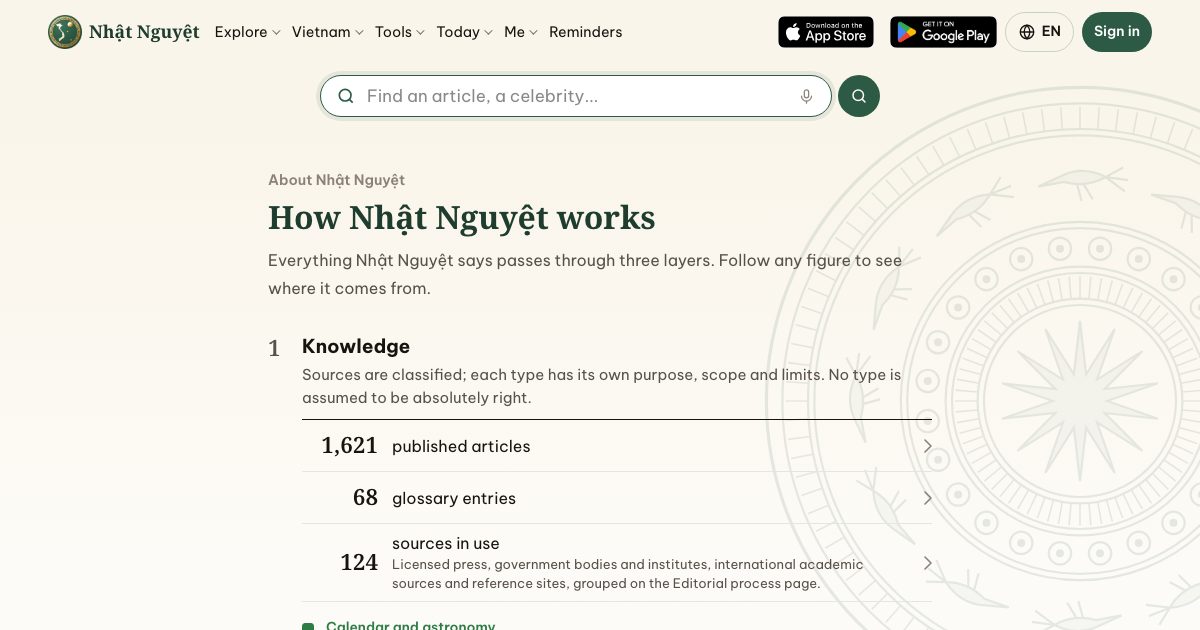
Nhật Nguyệt's content rests on four kinds of sources: classical texts and their translations, academic books and research, licensed press and institutions, and astronomical data for the calendar. Tables and numbers are produced by our calculation engine, not typed by hand. Where we got something wrong and fixed it, we say so in public.
Four kinds of sources
- Classical texts and translations: the classics of Tử Vi, Bát Tự, the I Ching, feng shui and other arts, most of them in the public domain; any book cited is named with its author at the end of the article. The Classical texts page introduces the core books.
- Academic books and research: monographs and peer-reviewed papers, including studies that test the divination arts themselves.
- Press and institutions: only licensed newspapers, government portals, institutes, museums and universities on an approved source list. Open encyclopedias such as Wikipedia are used for orientation only, never as the main source.
- Astronomical data: the lunar calendar uses Vietnam time and is checked against NASA new-moon data and solar-term data from IMCCE (Paris Observatory) and USNO.
How is an article made?
Articles are drafted by a language model from the chosen sources, then pass machine checks: numbers and tables must match the engine, quotes must appear in the source, and every article must exist in all three languages. Lookup tables in articles come straight from the engine, so the table in an article and the tool's result are the same thing. The full process is on the Editorial process page.
Every article says what kind of knowledge it is
Each article carries a label at the top: calendar (calculable, verifiable), culture (a record of custom), traditional arts (the rules of one school, not tested) or modern system. Inside the article, small labels mark individual passages too.
Errors are corrected in public
What was wrong, how it was fixed and against which sources are all logged on the Corrections page, along with issues still being fixed. If you spot an error, write to [email protected].
Check every number yourself
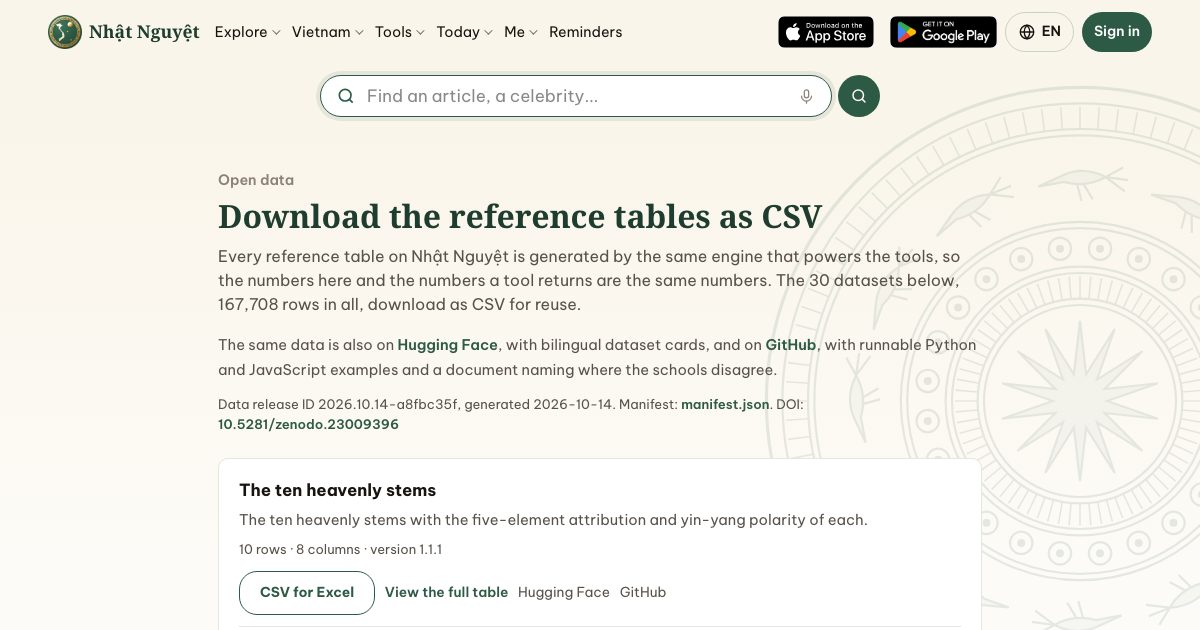
Every tool result shows its inputs, rules and each calculation step. Calendar, sexagenary and festival data are published as open datasets with a DOI, so anyone can download and compare. How the three layers of knowledge, calculation and openness fit together is on the How Nhật Nguyệt works page.