


Image: Wikimedia Commons (Public Domain / CC0)
TL;DR: The Five Yellow Star (Five Yellow Sha) is one of the most powerful malefic stars in Xuan Kong Flying Stars, representing disasters, illness, and destruction. When it flies to a palace, it brings misfortune and must be mitigated with Metal element items or by limiting activity in that area.
What is Nine Star Flying Star Feng Shui and where does the Ngũ Hoàng star sit?
Nine Star Flying Star (Cửu Tinh Huyền Không) is a well known school of feng shui, based on the principle of nine stars (Cửu Tinh) moving through space and time, known as flying stars (phi tinh). Each star carries its own colour, element and auspicious or inauspicious meaning. Among them, the Ngũ Hoàng star (also called Ngũ Hoàng sat, Ngũ Hoàng dai sat, or Liêm Trinh tinh) is one of the most feared inauspicious stars, described as the "star of great misfortune".
The Ngũ Hoàng star belongs to the Earth element and carries the colour yellow. In the Nine Star system, it sits at the centre of the Luo Shu (Lạc Thư) square, symbolising the supreme power of the emperor, but when it moves to a particular position, it brings threat, destruction and disaster with it. Understanding the Ngũ Hoàng star, how it works and how to neutralise it is extremely important if you want to respond proactively to the negative influences it brings.
What is the origin and nature of the Ngũ Hoàng star?
Its position in the Luo Shu and He Tu
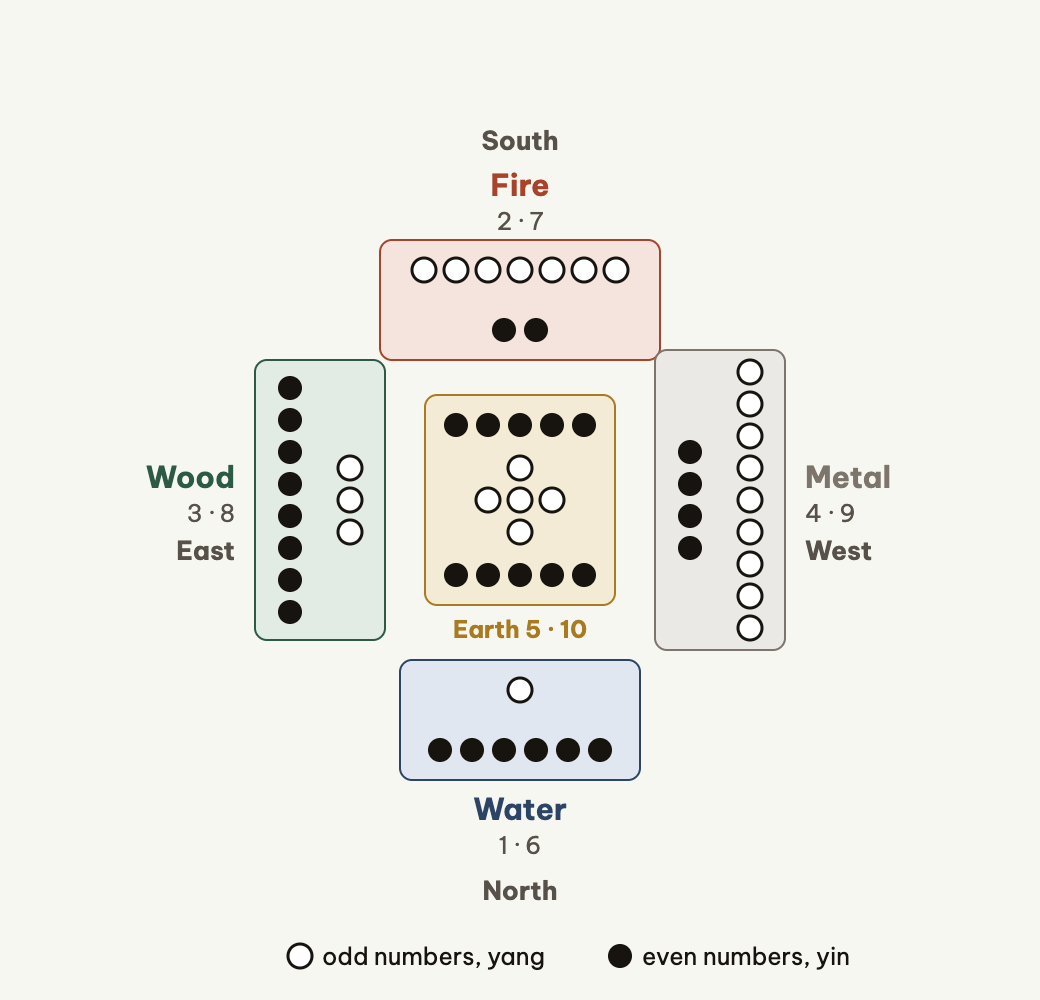
To understand the Ngũ Hoàng star, we need to trace back to the Luo Shu, one of the foundations of the I Ching (Kinh Dịch) and feng shui. In the Luo Shu, the number 5 sits at the centre, the number of balance, of the central palace. However, in Nine Star Flying Star feng shui, when this star leaves the central position to fly to other palaces, it becomes an inauspicious star. The reason is that its Earth element at the central palace is at its most prosperous, but when it moves, it carries the pressure, raw and hard to control power of the Earth element, easily overcoming other elements and causing many problems.
Why does Ngũ Hoàng both symbolise power and cause destruction?
The Ngũ Hoàng star is also called Liêm Trinh tinh. In ancient astrology, Liêm Trinh is an inauspicious star belonging to the Fire element, but in Flying Star feng shui it belongs to Earth. This combination shows that the power of Ngũ Hoàng is not simply destruction but also the threat that comes from supreme authority. It symbolises sudden disasters, severe illness, accidents, gossip, lawsuits and unpredictable obstacles. When Ngũ Hoàng arrives in an area, it makes that area chaotic, hard to control and prone to serious problems.
How does the Ngũ Hoàng star work in Flying Star feng shui?
What is the flying star principle?
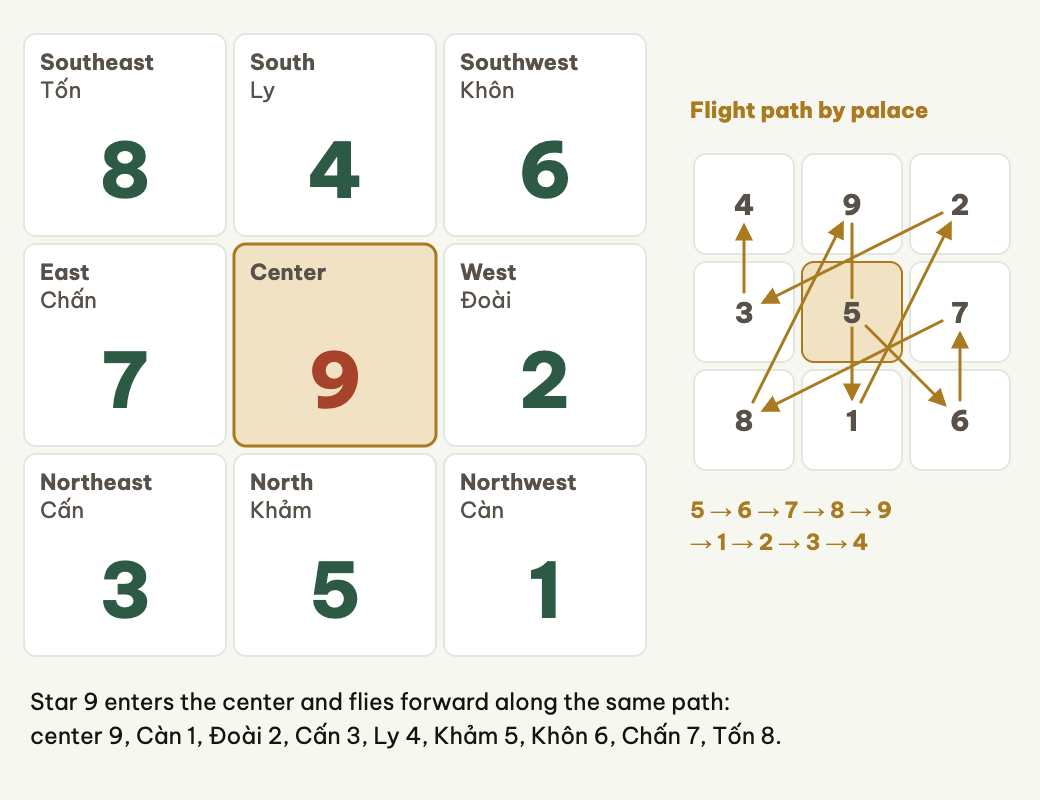
Nine Star Flying Star feng shui divides time into periods (each period lasting 20 years), and space into palaces (directions). The stars fly to different palaces along a set path known as the "lường thiên xích". The starting point of each period is that the star of the period sits in the central palace. For example, in period 8 (2004-2023), star number 8 sits in the central palace. The Ngũ Hoàng star will fly to a specific palace, depending on the period and the facing direction of the house.
The role of Ngũ Hoàng in each period
The Ngũ Hoàng star has no period of its own. It is a permanent inauspicious star, changing position only with time. However, the degree of its influence can vary depending on the period. In period 5 (1944-1963), Ngũ Hoàng was in command, and its power was at its greatest. In other periods, its power is still very significant, especially when it combines with other inauspicious stars or when it meets activating factors such as ground breaking, renovations, or strong activity in the area where it sits.
How does Ngũ Hoàng combine with other stars?
The meaning of Ngũ Hoàng does not stand alone; it also depends on its combination with other stars in the palace. These combinations create different levels of auspiciousness and inauspiciousness:
| Combination | Description |
|---|---|
| Ngũ Hoàng meets Nhị Hắc (the illness star) | This is an extremely bad combination, known as "nhi hac ngu hoang" or "benh phu ngu hoang". This combination multiplies many times over the risk of illness, disaster, and even problems related to mental health, security and criminal matters. It is one of the most feared combinations in feng shui. |
| Ngũ Hoàng meets Tam Sát | Tam Sát is another inauspicious star; when combined with Ngũ Hoàng, its destructive power becomes even more intense, especially in terms of finances and health. This area needs particular attention and ground breaking activity should be avoided. |
| Ngũ Hoàng meets Thất Xích (the Po Jun star) | This combination brings disputes, lawsuits, theft and problems related to the law. It can cause major losses of property and reputation. |
| Ngũ Hoàng meets Cửu Tử (the You Bi star) | Cửu Tử belongs to the Fire element, and Fire generates Earth, which makes Ngũ Hoàng stronger. However, because Cửu Tử is a favourable star, this combination can somewhat reduce the killing energy of Ngũ Hoàng, but care is still needed, especially regarding health and matters related to fire. |
What does the Ngũ Hoàng star mean in each palace?
When the Ngũ Hoàng star flies to a particular palace, it brings specific effects. Below is a detailed analysis of its impact in each palace of the home:
Ngũ Hoàng in the Kham palace (North, Water element)
The Earth element of Ngũ Hoàng overcomes the Water element of the Kham palace. The Kham palace represents the second son, career, intellect and social relationships. When Ngũ Hoàng arrives, the household may face obstacles in career and advancement, be easily disturbed by petty people, and encounter gossip and lawsuits. The health of the men in the house, especially the second son, may be affected, with a tendency toward kidney and urinary tract illnesses.
Ngũ Hoàng in the Khon palace (Southwest, Earth element)
The Khon palace belongs to the Earth element; when Ngũ Hoàng (Earth element) arrives, the two Earth elements together make the killing energy stronger. The Khon palace represents the mother, the older woman in the house, as well as family relationships. This area meeting Ngũ Hoàng will increase health problems for women, especially digestive and stomach illnesses. In addition, it causes conflict and discord in the family, making it hard to keep the peace.
Ngũ Hoàng in the Chan palace (East, Wood element)
The Wood element of the Chan palace overcomes the Earth element of Ngũ Hoàng. The Chan palace represents the eldest son, growth and starting a business. When Ngũ Hoàng arrives here, it obstructs development and creates risks in work and business. The eldest son in the house may face health problems such as headaches, illnesses related to the liver and gallbladder, or sudden accidents. Careers tend to stagnate and encounter many difficulties.
Ngũ Hoàng in the Ton palace (Southeast, Wood element)
Similar to the Chan palace, the Wood element of the Ton palace overcomes the Earth element of Ngũ Hoàng. The Ton palace represents the eldest daughter, wealth and intelligence. Ngũ Hoàng arriving here can cause financial losses, failed business and difficulty accumulating wealth. The eldest daughter may face health problems, be prone to stress and anxiety, or illnesses related to women's health.
Ngũ Hoàng in the Can palace (Northwest, Metal element)
The Earth element of Ngũ Hoàng generates the Metal element of the Can palace (Earth generates Metal). The Can palace represents the father, the head of the household, as well as power and reputation. Although Earth generates Metal, this is a draining generation for Ngũ Hoàng, so its killing energy can be partly transformed, but it is not entirely good. The father or head of the household may face great pressure at work, be prone to fatigue and stress. Relationships with superiors, or matters related to legal issues and paperwork, may run into trouble.
Ngũ Hoàng in the Doai palace (West, Metal element)
Similar to the Can palace, the Earth element of Ngũ Hoàng generates the Metal element of the Doai palace. The Doai palace represents the youngest daughter, joy, good fortune with children and social relationships. When Ngũ Hoàng arrives here, good fortune with children may decline. The youngest daughter may face health problems, be prone to respiratory and skin illnesses. Friendships and colleague relationships may encounter much gossip and envy.
Ngũ Hoàng in the Can palace (Northeast, Earth element)
The Can palace belongs to the Earth element; when Ngũ Hoàng (Earth element) arrives, the killing energy is strengthened. The Can palace represents the youngest son, education, knowledge and stability. Ngũ Hoàng arriving here causes obstacles in children's studies, with a tendency to decline and lose focus. The youngest son may face health problems such as stomach aches and digestive tract illnesses. In addition, it affects the sustainable development of the family.
Ngũ Hoàng in the Ly palace (South, Fire element)
The Fire element of the Ly palace generates the Earth element of Ngũ Hoàng (Fire generates Earth). The Ly palace represents the middle daughter, fame, reputation and intelligence. When Ngũ Hoàng arrives here, the Fire element generating Earth makes the killing energy of Ngũ Hoàng stronger. This can cause problems with reputation, gossip and scandal. The middle daughter may face health problems such as cardiovascular and blood pressure illnesses, or accidents related to fire and electricity.
How can the Ngũ Hoàng star be neutralised effectively?
Neutralising Ngũ Hoàng sat is extremely important in order to minimise its negative influences. The most basic principle is to weaken the power of the Earth element, because Earth generates Metal; therefore, using objects belonging to the Metal element is the most common and effective method to "drain the energy" of Ngũ Hoàng.
How are Metal element objects used?
Objects belonging to the Metal element work to consume some of the killing energy of Ngũ Hoàng. Some commonly used objects:
- Tỳ Hưu, Ngọc Tỷ or metal auspicious creatures: Place these auspicious creatures in the area where Ngũ Hoàng sits to neutralise the killing energy.
- Metal wind chimes: The sound of the chime activates the Metal element, helping to transform bad energy. Choose wind chimes with 5 or 6 tubes to correspond to the Metal element.
- Metal clocks, or decorative items made of metal (bronze, steel, silver): These items work to drain the energy of Ngũ Hoàng.
- Metal spheres (usually yellow quartz or gold plated metal): The sphere symbolises completeness; placed in the Ngũ Hoàng area it can help stabilise and reduce the killing energy.
Why should ground breaking and renovations be avoided?
One of the most important principles is to absolutely avoid ground breaking, renovations, drilling, or hammering nails in the area where the Ngũ Hoàng star sits during the year or the month. This is likened to "waking" a sleeping dragon, which will activate the killing energy of Ngũ Hoàng and cause serious consequences. If such activities must be carried out, an auspicious day and month should be chosen and special neutralising measures taken.
Limit strong activity in the Ngũ Hoàng area
Besides avoiding ground breaking, strong or frequent activity in this area should also be limited, for example:
- Do not place a bedroom, main workspace, or altar in the Ngũ Hoàng area. These are places where people are active a great deal and for long periods; placing them in this area makes it easy to be affected badly.
- Do not place a stove, or high power electronic devices (refrigerator, microwave, television) in this area. The Fire element of the stove and these devices will generate Earth, adding to the strength of Ngũ Hoàng.
- Limit sitting to work, study, or rest for long periods in this area.
Use other supplementary feng shui measures
- Use of colour: White, grey and silver (the colours of the Metal element) are good colours for neutralising. Avoid using yellow and earth brown (the colours of the Earth element) because they will increase the strength of Ngũ Hoàng. Red, pink and purple (the colours of the Fire element) should also be avoided because Fire generates Earth.
- Place an incense bowl or other feng shui objects: Some schools use an incense bowl or objects such as a convex bagua mirror (placed outdoors) to neutralise, but care is needed and a specialist's advice should be sought.
- Keep the area clean and open: A clean, tidy space will help reduce the stagnation and gloom of the Earth element.
What should you note when interpreting the Ngũ Hoàng star?
Although the Ngũ Hoàng star is regarded as a star of great misfortune, it does not always cause bad things. The degree of influence also depends on many factors such as:
- The energy of the house: If the house has good energy, with other prosperous stars in command, the influence of Ngũ Hoàng can be lessened.
- The structure and use of the space: How rooms are arranged, the direction of the door, the position of the altar and kitchen can increase or decrease the impact of Ngũ Hoàng.
- Human behaviour: Living positively and healthily, and avoiding negative behaviour, can also somewhat reduce the bad influences.
You should not worry or be too afraid when you learn that your home has the Ngũ Hoàng star. What matters is understanding it correctly, having an objective view, and applying neutralising measures in a scientific and reasonable way. Feng shui is an art and science of energy balance; understanding and adjusting your living environment is a way to improve the quality of life, not blind superstition.


