


Lễ ăn hỏi (betrothal ceremony)
Also called: Đám hỏi, Lễ đính hôn, Lễ nạp cát, Lễ hỏi
- Life-cycle rites
Culture and belief A record of custom.
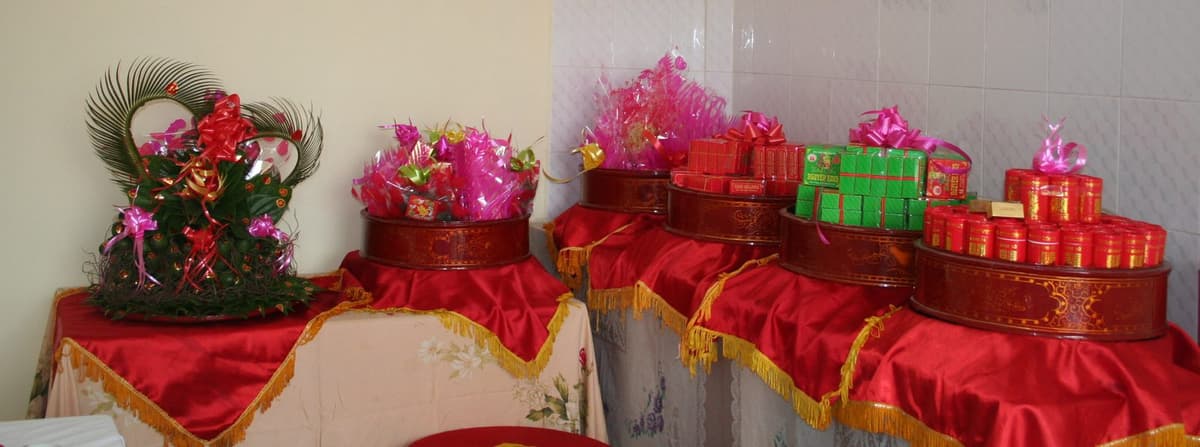
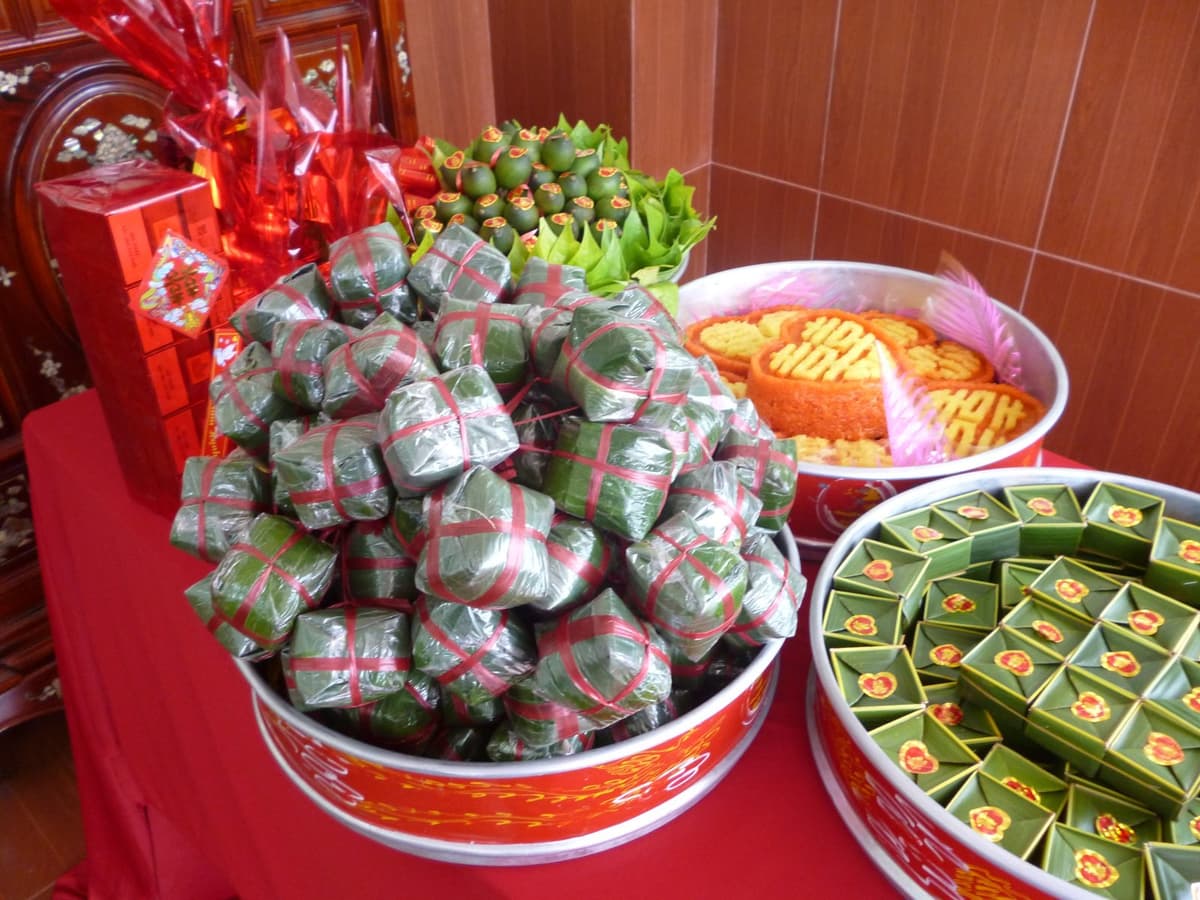
In the lễ ăn hỏi (betrothal ceremony), the bride's family receives the offering trays from the groom's family and then places a portion on the altar, praying to report to the ancestors the betrothal of their child. According to sources, the North carries an odd number of trays, the South uses an even number of fruit trays, and the Central region keeps four main offerings: betel leaves and areca nuts, bánh phu thê (husband-and-wife cake), tea and wine, and red silk candles.
At a glance
- When it is held
- An auspicious day chosen by the two families, after the lễ chạm ngõ (meeting ceremony) and before the wedding ceremony
- For whom
- The household deities and ancestors of the bride's family
- Where
- Ancestral altar
- Who makes the offering
- The bride's father or grandfather
Each family and each region may do it differently.
The offering tray


Nationwide
- When
- An auspicious day chosen by the two families, after the lễ chạm ngõ (vấn danh, meeting ceremony) and before the wedding ceremony
| Offering | Vegetarian or not | Notes |
|---|---|---|
| Betel leaves and areca nuts | ||
| betel leaves and areca nuts | Vegetarian | Required |
| Tea, rice wine, water | ||
| Tea, wine, cigarettes | Vegetarian | |
| Xôi (steamed sticky rice) and cakes | ||
| Bánh cốm (green rice flake cake), bánh phu thê (xu xê, husband-and-wife cake), lotus seed jam | Vegetarian | |
| Xôi gấc (steamed sticky rice with gấc fruit), roast pig | Meat or fish | Optional. Old custom, later gradually reduced |
| Objects | ||
| Lễ đen (black offering): envelopes of money for burning incense on the altars of the bride's family | The number of envelopes follows the number of altars in the bride's family | |
North
Hà Nội, Folk practice
- When
- A carefully chosen day and hour, before the wedding
| Offering | Vegetarian or not | Notes |
|---|---|---|
| Other | ||
| Odd number of trays: 3, 5, 7, 9, 11 | Required. The offerings in each tray are even in number | |
| Betel leaves and areca nuts | ||
| Cơi trầu (betel tray), bánh cốm (green rice flake cake), fruit tray | Vegetarian | Required. Báo Pháp luật Việt Nam: indispensable for a Hà Nội betrothal ceremony |
| Xôi (steamed sticky rice) and cakes | ||
| Bánh phu thê (husband-and-wife cake), lotus seed jam, chè (sweet soup), wine, cigarettes, xôi gấc (steamed sticky rice with gấc fruit), roast suckling pig | Meat or fish | |
Central
- When
- A day and hour chosen by the two families; some guides note that if the families do not live far apart, the betrothal and the wedding may be held on the same day
| Offering | Quantity | Vegetarian or not | Notes |
|---|---|---|---|
| Betel leaves and areca nuts | |||
| Betel leaves and areca nuts | 105 areca nuts (VOH) | Vegetarian | Required |
| Xôi (steamed sticky rice) and cakes | |||
| Bánh phu thê (husband-and-wife cake) | Vegetarian | Required | |
| Tea, rice wine, water | |||
| Chè (tea), rượu (wine) | Vegetarian | Required | |
| Incense, lamps, candles | |||
| Nến tơ hồng (red silk-thread candles) | Required | ||
| Other | |||
| The black offering tray placed on the bride's family altar | According to some guides | ||
South
- When
- A day and hour chosen by the two families; some families hold the betrothal and the bride's welcoming on the same day
| Offering | Quantity | Vegetarian or not | Notes |
|---|---|---|---|
| Other | |||
| Even number of fruit trays: 4, 6, 8, 10; usually 6 | Required | ||
| Tray with an áo dài and earrings that the mother-in-law prepares for the daughter-in-law | 1 tray | ||
| Tea, rice wine, water | |||
| Tray of 6 fruits: betel leaves and areca nuts; tea, wine and candles carved with dragon and phoenix; bánh phu thê (husband-and-wife cake); xôi gấc (steamed sticky rice with gấc fruit); flowers and fruits; roast pig | Meat or fish | ||
| Xôi (steamed sticky rice) and cakes | |||
| Square bánh phu thê (husband-and-wife cake) wrapped in pineapple leaves | Vegetarian | ||
Steps of the rite
Used across Vietnam, Folk practice
- PreparationThe groom's family carries the trays to the bride's house at the chosen time; the two tray-carrying teams hand over the offerings
- The two families introduce themselves, the groom's representative speaks, the bride's family receives the offerings; the two mothers open the trays
- The bride comes out to greet, offering water to the two families
- Reciting the prayerThe bride's mother takes a portion of the offerings and the lễ đen and places them on the altar; the bride's father or grandfather lights incense and prays to the ancestors
- The bride and groom bow together before the altar
- The two families discuss the wedding date and time
- The bride's family returns gifts to the groom's family: tearing by hand, the number of returned offerings is even, returning the trays with the lids facing up
- After the ceremony, the bride's family distributes the betrothal offerings to relatives along with wedding invitations
Northern Vietnam, Hà Nội, Folk practice
- Keep all three ceremonies: lễ chạm ngõ (formal meeting ceremony), lễ ăn hỏi (betrothal ceremony), lễ rước dâu (bride procession); the lễ ăn hỏi is held at least a few days before the wedding
- PreparationTrays arranged in a pyramid shape, covered with red cloth
- Lighting incenseThe bride's family receives the offerings and places a portion on the ancestors' altar and burns incense.
Central Vietnam, Folk practice
- The groom's family presents the offerings, and the two families talk things over.
- Lighting incenseThe bride's parents offer a portion of the offerings on the ancestors' altar; the young couple burns incense.
Southern Vietnam, Folk practice
- Some families skip the lễ dạm ngõ (preliminary meeting ceremony) and hold the lễ ăn hỏi (betrothal ceremony) and the bride-picking ceremony on the same day.
Good to know
- Housing (apartments, rented homes)According to VnExpress, a cramped house or one without a large altar sets up a stand-in altar in the living room (a backdrop with the double-happiness character, couplets, a bronze censer, a pair of dragon-and-phoenix fruit trays) for the ancestor rite
What is avoided
Used across Vietnam, Folk practice
- ConductDo not use scissors to cut the returned offerings
- OfferingsWhen giving areca nuts, do not give two fruits (an old custom, according to some guides)
Northern Vietnam, Hà Nội, Folk practice
- TimingIn the past the betrothal and the wedding were not held on the same day, so the two families had time to prepare the feast and invite guests
The custom
Phan Kế Bính (1915) describes the old way of asking for a bride: once the matchmaker had spoken, the groom's family brought areca and tea for the giạm (first visit); some time later came the lễ ăn hỏi, when the groom's family brought areca, tea, pork and xôi to the bride's house for the ancestor rite, simpler families bringing only areca, tea and candied fruit; in Quảng Nam a pair of gold earrings was usually added. In his view the six rites of the old books (proposal, asking the name, divination, betrothal gifts, setting the date and fetching the bride) roughly match our giạm, hỏi, sêu and wedding rites.
In the old South, according to an exhibition recreating weddings reported by Thanh Niên newspaper, the groom's family brought an even number of trays, from 2 to 12, as a wish for completeness; earrings were the most important token of the engagement, with 'bông bút' (closed bud) earrings given at the betrothal and 'bông nở' (open flower) earrings at the wedding.
Where the sources differ
- How long before the wedding the betrothal is held: Pháp luật Việt Nam newspaper says at least a few days; VnExpress says at least one week to 10 days
- Number of trays: VOH records a tray of 5 fruits or 6 fruits, with the number of carriers matching the words sinh or lão; one guide records 5 trays (betel leaves and areca nuts, tea and wine, cakes, nem chả, five-fruit tray).
Questions
How long is there between the betrothal and the wedding?
In the North, the betrothal is held at least one week to 10 days before the wedding (VnExpress), or at least a few days before (Pháp luật Việt Nam newspaper); in the past the two rites were not held on the same day. In the South the betrothal and the bride's welcoming can be held on the same day; one guide notes that in the Central region, if the families do not live far apart, the betrothal and the wedding can also be on the same day.
What trays are there in a betrothal?
The offerings usually include betel and areca, tea, wine, cigarettes, bánh cốm (green rice cake), bánh phu thê (husband-and-wife cake), candied lotus seeds, xôi gấc and roast pork, plus the lễ đen, an envelope of money for burning incense on the bride's family altar. In the North the number of trays is odd, such as 3, 5, 7, 9 or 11; in the South the trays are even in number, from 2 to 12 according to an exhibition on old southern weddings.
How do the lễ dạm ngõ and the lễ ăn hỏi differ?
The dạm ngõ (or chạm ngõ) is the first formal contact between the two families; according to Phan Kế Bính (1915), the groom's family brought areca and tea for it. Only some time later comes the lễ ăn hỏi: the groom's family brings larger offerings to the bride's house, which receives them and makes the ancestor rite.
How is the ancestor rite done at the betrothal?
After the bride is introduced, her mother takes part of the offerings and the lễ đen envelope to the altar, and the bride's parents lead the couple to burn incense and report to the ancestors. In the South, the lễ lên đèn with the pair of dragon-and-phoenix candles brought by the groom's family can be held at the betrothal itself or left until the bride's welcoming day.
Communities and regions
Sources
- Trình tự nghi thức trong lễ ăn hỏi (vankhan.vn)
- Văn khấn lễ ăn hỏi (voh.com.vn)
- Văn khấn khi cưới gả (vankhan.vn)
- Việt Nam phong tục, Thiên I, mục XIII. Giá thú, Phan Kế Bính 1915 (vi.wikisource.org)
- Mâm quả cưới của ba miền Bắc, Trung, Nam gồm những gì? (voh.com.vn)
- Những nét khác biệt đáng yêu trong gia đình Việt (baophapluat.vn)
- Khác biệt trong lễ cưới ba miền (ngoisao.vnexpress.net)
- Nghi thức cưới hỏi ở miền Trung bao gồm những gì (mytour.vn)
- Lưu ý trong lễ gia tiên ở đám cưới hai miền (ngoisao.vnexpress.net)
- Đám cưới Nam bộ qua nhiều thập niên: Những lễ vật ít người còn thấy (thanhnien.vn)
Part of the open datasets Types of Vietnamese offering rites and Vietnamese offering procedures, licensed CC BY 4.0.
More ritesDeath anniversaries, Tết, the home, business, the life cycle, village and ethnic rites.Open