


Cúng rằm tháng Bảy (seventh-month full moon: ancestors and wandering souls)
Also called: Tết Trung nguyên, Vu Lan, Xá tội vong nhân, Lễ Vu Lan, Cúng chúng sinh, Cúng cô hồn, Cúng thí thực, Văn khấn rằm tháng Bảy
- Festivals through the year
Culture and belief A record of custom.
By custom, on the full moon of the seventh lunar month families make offerings to the deities and to their ancestors, and set a table outdoors for wandering souls (called cúng chúng sinh in the North, cúng cô hồn in the South). The offering to wandering souls differs clearly between the two regions in date, food and procedure.
At a glance
- When it is held
- Full moon of the seventh lunar month; the offering to wandering spirits can be done from the first day to the fifteenth; in the South, traders also offer to wandering spirits on the 2nd and 16th of every month
- This year (2026)
- Next year (2027)
- For whom
- Deities; ancestors; wandering spirits, sentient beings without refuge
- Where
- Buddha altar, Ancestral altar, Courtyard or outdoors, In front of the house, Place of work
Each family and each region may do it differently.
The offering tray
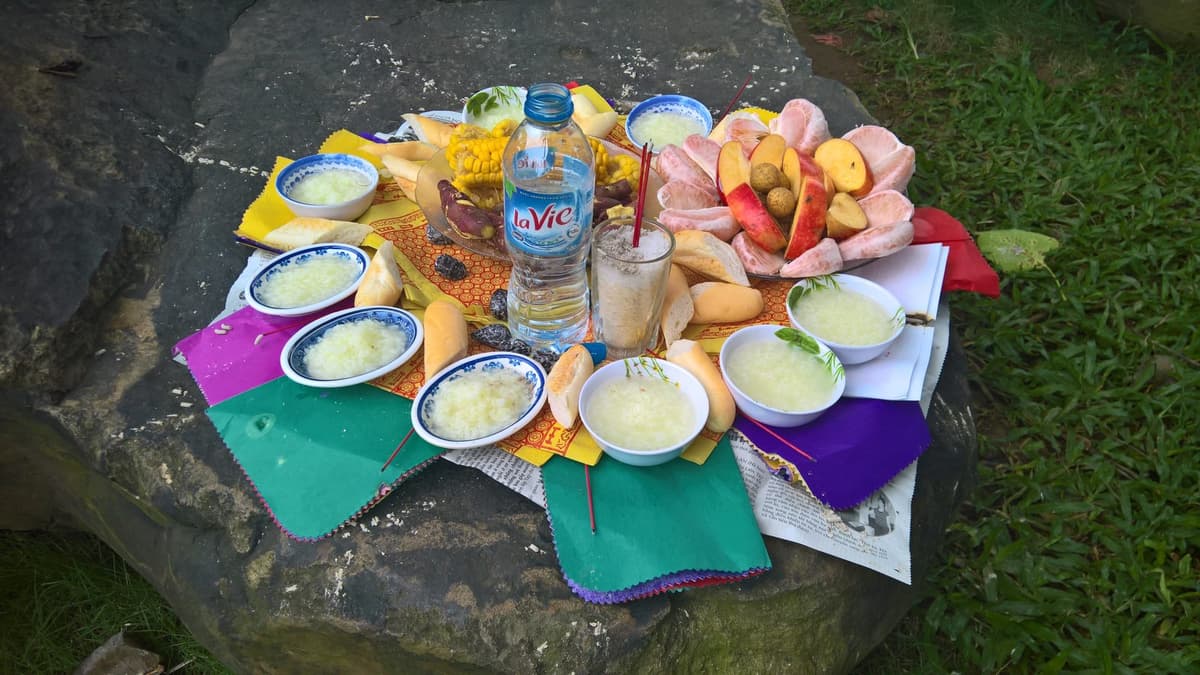
.jpg)
Nationwide
- When
- Full moon of the seventh lunar month; the offering to sentient beings can be done from the 1st to the 15th, after 12 noon
- Where the offerings are set
- Indoors: altar of Buddha, deities, ancestors; the offering to sentient beings is set outside
- Who makes the offering
- head of the household
| Offering | Quantity | Vegetarian or not | Notes |
|---|---|---|---|
| Vegetarian dishes | |||
| Vegetarian meal tray or five-fruit tray offered to Buddha | Vegetarian | ||
| Popcorn, boiled sweet potato, boiled corn, boiled cassava, cakes and candies | Vegetarian | ||
| Other | |||
| Offering tray to deities and ancestors | Many households offer savory food | ||
| Votive paper | |||
| votive paper and paper money | from 15 offerings | ||
| Clothes for sentient beings | 20 to 50 sets | ||
| Flowers | |||
| Flowers, fruit | 5 types, 5 colors | Vegetarian | |
| Rice and salt | |||
| Porridge, tray of rice and salt | 5 bowls, 5 pairs of chopsticks or spoons | Vegetarian | If offering porridge |
North
- When
- Concentrated on the full moon of the seventh lunar month, sometimes the first day of the seventh lunar month
- Where the offerings are set
- In front of the house, outdoors
- Who makes the offering
- head of the household
| Offering | Vegetarian or not | Notes |
|---|---|---|
| Xôi (steamed sticky rice) and cakes | ||
| Thin porridge (plain rice porridge) | Vegetarian | Required |
| Phẩm oản (steamed rice cakes) | Vegetarian | |
| Cơm vắt (compressed rice balls), popcorn, cakes and candies cut small | Vegetarian | |
| Vegetarian dishes | ||
| Boiled sweet potato, boiled corn, a few pieces of sugarcane | Vegetarian | |
| Votive paper | ||
| Tiền trần (worldly money), paper clothes for sentient beings | ||
South
- When
- In the seventh lunar month: any day from the 2nd to before the full moon; traders also make offerings on the 2nd and 16th of each month, after 12 noon or in the evening
- Where the offerings are set
- Outside in the yard, on the sidewalk, in the corridor in front of the house or in front of the shop; the person praying faces the street
- Who makes the offering
- The head of the household, the shop owner
| Offering | Quantity | Vegetarian or not | Notes |
|---|---|---|---|
| Meat and savoury dishes | |||
| Roast pig | Meat or fish | Seventh lunar month offering tray | |
| Xôi (steamed sticky rice) and cakes | |||
| Thinly cooked plain rice porridge | 12 small bowls or 1 large bowl | Vegetarian | |
| Rock sugar | 12 lumps | Vegetarian | |
| Cakes, candies, popcorn, xôi (steamed sticky rice), chè (sweet soup), fruit | Vegetarian | ||
| Tea, rice wine, water | |||
| water | 3 small glasses | Vegetarian | |
| Incense, lamps, candles | |||
| Incense, candles | 3 incense sticks, 2 candles | ||
| Rice and salt | |||
| Coarse salt, rice | Vegetarian | Required | |
| Fruit | |||
| Sugarcane | Vegetarian | Left whole or cut into pieces about 15 cm | |
| Objects | |||
| Small change | Scattered together with salt and rice | ||
Steps of the rite
Used across Vietnam, Folk practice
- Reciting the prayerOffering to Buddha
- Reciting the prayerOffering to deities
- Reciting the prayerOffering to ancestors
- Reciting the prayerOffering food to wandering spirits (offering to sentient beings) outside
- Releasing living creatures, depending on the household
Northern Vietnam, Folk practice
- Laying out the offeringsArrange offerings on a nong, nia, mẹt, or tray
- Reciting the prayerPrayer
- Burning votive paperWhen the incense burns out, burn votive paper and scatter rice and salt far away
Southern Vietnam, Folk practice
- Laying out the offeringsSet up the offering tray outdoors
- Reciting the prayerLight incense first, then read the prayer text
- Burning votive paperWhen the incense burns out, burn votive paper and scatter rice and salt in eight directions
- Children and people nearby "snatch the wandering spirits' offerings" (take things from the tray)
- After praying, go straight into the house
What is avoided
Used across Vietnam, Folk practice
- OfferingsThe tray for sentient beings does not include xôi (steamed sticky rice) or chicken (according to sources)
- ConductDo not release red-eared slider turtles
Southern Vietnam, Folk practice
- PlaceDo not make the offering indoors
- ConductDo not bring the offered items into the house
- Do not look back after scattering salt and rice
The custom
The full moon of the seventh lunar month is also called Tết Trung nguyên. Phan Kế Bính (1915) notes that, following Buddhist books, Vietnamese people regard it as the day when the souls of the dead are pardoned; many households buy votive paper to offer to their ancestors, and families with a recent death burn votive paper and hold a vegetarian rite that day.
The day coincides with the Buddhist Vu Lan festival. Besides the offering to ancestors, many families set out a feast in the yard for wandering spirits (popularly called cúng cháo, the rice-porridge offering) as alms for souls with no one to worship them.
Questions
When is the offering of the seventh-month full moon made?
The main rite falls on the full moon (the 15th) of the seventh lunar month, also called Tết Trung nguyên, coinciding with the Buddhist Vu Lan festival. The outdoor offering to wandering spirits can be made any time from the 1st to the 15th of the seventh month.
What is prepared for the offering to wandering spirits?
Buddhist guidance lists: votive paper money of 15 sets or more, 20 to 50 paper clothes for the spirits, fruit of 5 kinds and 5 colours, popcorn, boiled sweet potato, maize and cassava, sweets, small coins; if rice porridge is offered, a tray of rice and salt is added. The tray for wandering spirits usually holds incense, lamps, rice, salt, water and thin rice porridge.
How many bowls of porridge are offered to the wandering spirits?
Buddhist guidance for the home offering says that if porridge is offered, a tray of rice and salt is added with 5 bowls and 5 pairs of chopsticks or spoons; its guidance for the monthly offering on the 16th lists 12 small bowls of thin white porridge or 1 large bowl.
What is the offering to wandering spirits on the 2nd and 16th?
It is the monthly offering to wandering spirits: according to Pháp Luật TP.HCM, traders and drivers make it on the 2nd and 16th of every lunar month, and the biggest such offering of the year is on the full moon of the seventh month.
What are the taboos when making an offering to wandering spirits?
Buddhist guidance says: the tray for wandering spirits is set outdoors or in the front corridor, never inside the house; after the rite, the offered food is not brought into the house; xôi (steamed sticky rice) and chicken are not put on the tray.
Communities and regions
More about Cúng rằm tháng Bảy (seventh-month full moon: ancestors and wandering souls)
Sources
- Bài cúng rằm tháng 7 âm lịch tại nhà (phatgiao.org.vn)
- Văn khấn Tết Trung nguyên, ngày 15 tháng 7 (vankhan.vn)
- Vì sao lại phải cúng cô hồn? (Pháp Luật TP.HCM, đăng trên tuoitre.vn)
- Văn khấn, văn cúng cô hồn ngày 16 âm lịch hàng tháng (phatgiao.org.vn)
- Cúng cô hồn miền Nam và miền Bắc (docungtamlinh.com.vn)
- Cúng cô hồn hàng tháng, bài văn khấn (docungtamlinh.com.vn)
- Việt Nam phong tục, mục XII Tứ thời tiết lạp, Phan Kế Bính, 1915 (vi.wikisource.org)
Part of the open datasets Types of Vietnamese offering rites and Vietnamese offering procedures, licensed CC BY 4.0.
More ritesDeath anniversaries, Tết, the home, business, the life cycle, village and ethnic rites.Open