What is the Rising Sign and how is it determined?
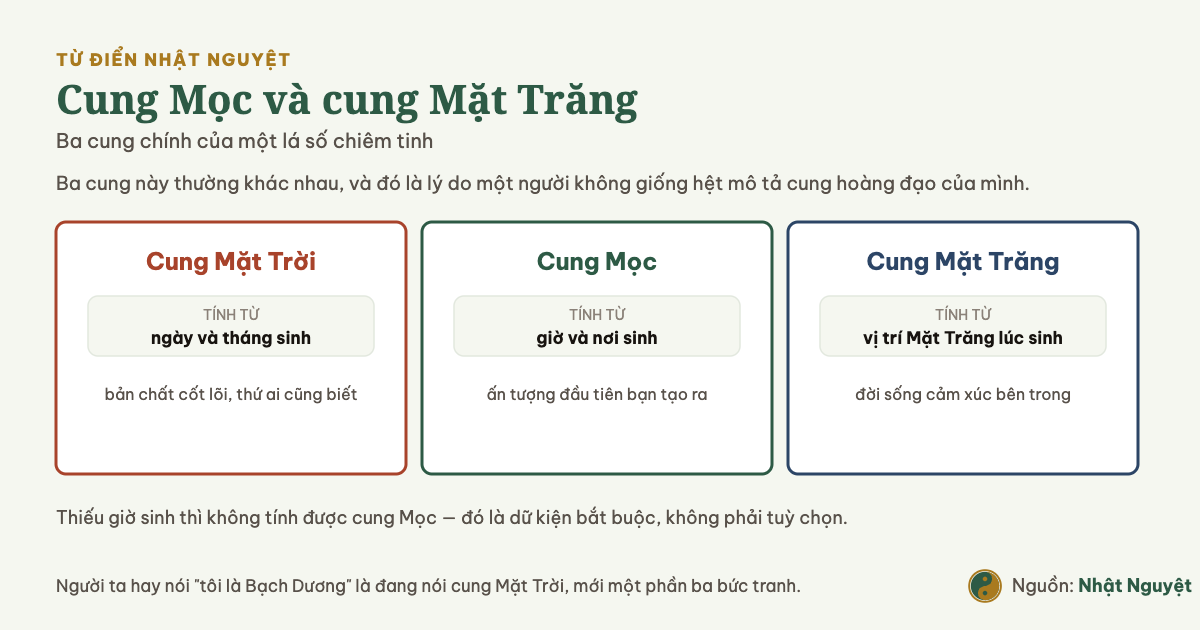
The Rising Sign, also called the Ascendant, is the zodiac sign sitting on the eastern horizon at the exact moment of your birth. Because the Earth rotates, this horizon shifts roughly one sign every two hours, so the Rising Sign depends heavily on birth time and birth place, unlike the Sun sign which only needs the birth date.
How does the Rising Sign differ from the Sun sign and Moon sign?
The Sun sign reflects your core essence, central self, and life purpose. The Moon sign speaks to your emotional life, need for safety, and instinctive reactions. The Rising Sign is the outer layer, the mask you wear when entering a new environment, how others perceive you in the first few seconds. These three factors can differ and coexist within one person.
How is the Rising Sign tied to the 1st House?
In a birth chart, the Rising Sign marks the starting point of the 1st House, the house of self, appearance, and how you show up in the world. The planet ruling the Rising Sign (the Ascendant ruler) also becomes the chart ruler, indicating the main direction of your life. That is why astrologers often read the Rising Sign first to grasp the "entry point" of the chart.
Why is birth time so important?
A difference of a few dozen minutes can shift the Rising Sign to another sign, especially for people born near the boundary between two signs. This is why many people feel that descriptions of their Sun sign do not fit them: they may be looking at the expression layer of the Rising Sign instead. To determine the Rising Sign accurately, you need birth time, birth date, and birth place to cast a birth chart.
What should be kept in mind when exploring?
Western astrology is a traditional body of knowledge for reference, not scientifically verified. Descriptions of the Rising Sign should be read as a way of self-reflection, not as conclusions about a person's character or destiny.