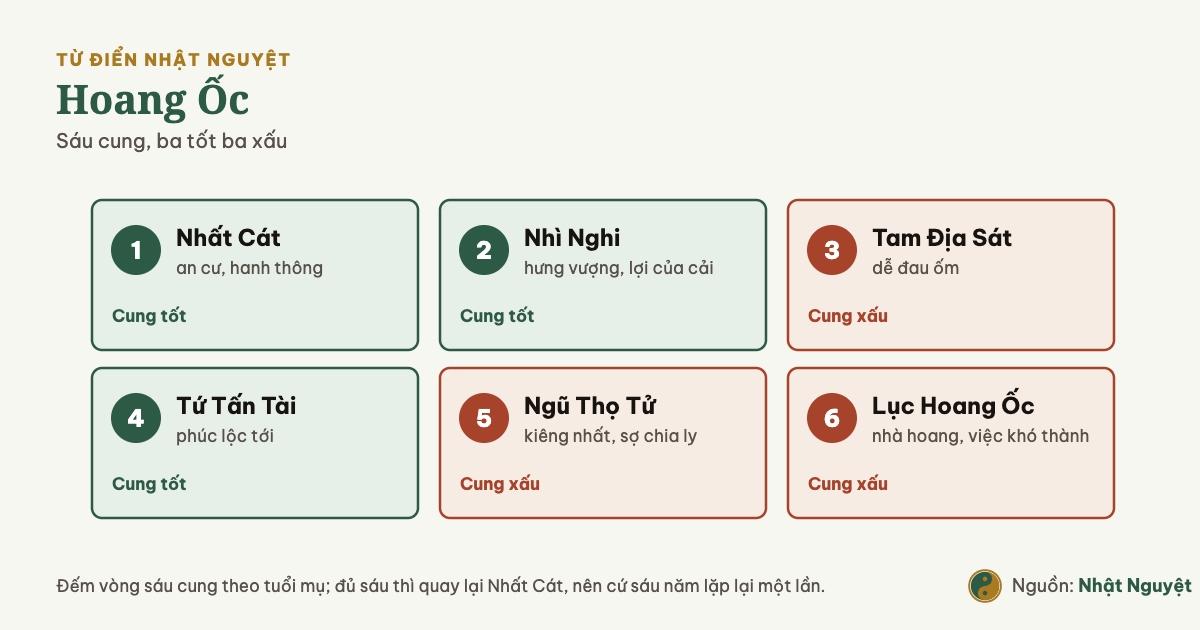
What is Hoang Ốc?
Hoang Ốc is one of three taboos checked before breaking ground on a house in Vietnam, alongside Kim Lâu and Tam Tai. The name literally means "abandoned house", which is also the name of the least favourable position in its cycle.
The six positions
The cycle runs through six positions, fixed by a rhyme: first Cát, second Nghi, third Địa Sát, fourth Tấn Tài, fifth Thọ Tử, sixth Hoang Ốc. Three are considered favourable: Nhất Cát, a settled home; Nhì Nghi, a thriving household; and Tứ Tấn Tài, fortune arriving. Three are considered unfavourable: Tam Địa Sát, linked to illness; Ngũ Thọ Tử, the most avoided, linked to separation; and Lục Hoang Ốc, an empty house and thwarted plans.
How it is counted
Hoang Ốc reads lunar age: the build year minus the birth year, plus one. The cycle anchors at age 10 as Nhất Cát, 20 as Nhì Nghi, 30 as Tam Địa Sát, 40 as Tứ Tấn Tài, 50 as Ngũ Thọ Tử, 60 as Lục Hoang Ốc, then 70 back to Nhất Cát. From your decade mark, count on by the units digit, one position per step.
Age 37, for instance, starts at Tam Địa Sát for the thirties and counts on seven steps to Tứ Tấn Tài, a favourable position.
Some texts teach a shortcut of summing the two digits and dividing by six. It gives the same answer for every two-digit age, because the digit sum equals tens plus units.
Affected ages
From 12 to 75 the ages landing on an unfavourable position are 12, 14, 15, 18, 21, 23, 24, 27, 29, 30, 32, 33, 36, 38, 39, 41, 42, 45, 47, 48, 50, 51, 54, 56, 57, 60, 63, 65, 66, 69, 72, 74 and 75.
How to read it
Hoang Ốc is a six-step count on an age number, using no stems and branches, no five-element analysis and no birth chart. It is folk knowledge without scientific basis, and everyone born in the same year gets the same answer.