



TL;DR: Home feng shui is the art of arranging space so that energy flows well, bringing a feeling of safety and comfort. It is important to distinguish true Bát Trạch (which considers a person's cung phi and the eight du niên, giving four favorable and four unfavorable directions that differ for each person) from the fixed assignment of one matter to each corner according to directional bát quái, which is the same for everyone. Basic principles include keeping the home well ventilated and with enough natural light, paying attention to the main door and the three areas of kitchen, bedroom, and altar, placing the sofa in a solid position, balancing ngũ hành through colors and materials, and choosing plants or objects according to the household owner's mệnh. Apply small changes one at a time, observe, and adjust gradually to achieve the best effect.
Residential Feng Shui: Basic Layout Principles
What are the basic layout principles of residential Feng Shui?
Feng Shui, in the East Asian view, is not merely a system of belief or superstition, but an art of arranging living space to optimise the flow of "khi" (Vietnamese: khí): the invisible energy that surrounds all things. When khi flows well, people feel healthy, clear-minded, and their relationships and work go smoothly. Conversely, if khi is stagnant or blocked, it easily leads to feelings of unease, fatigue, and obstacles in life. This article will go into the basic Feng Shui principles for homes, based on knowledge drawn from reliable sources, to help readers understand and apply them practically, without extremism.
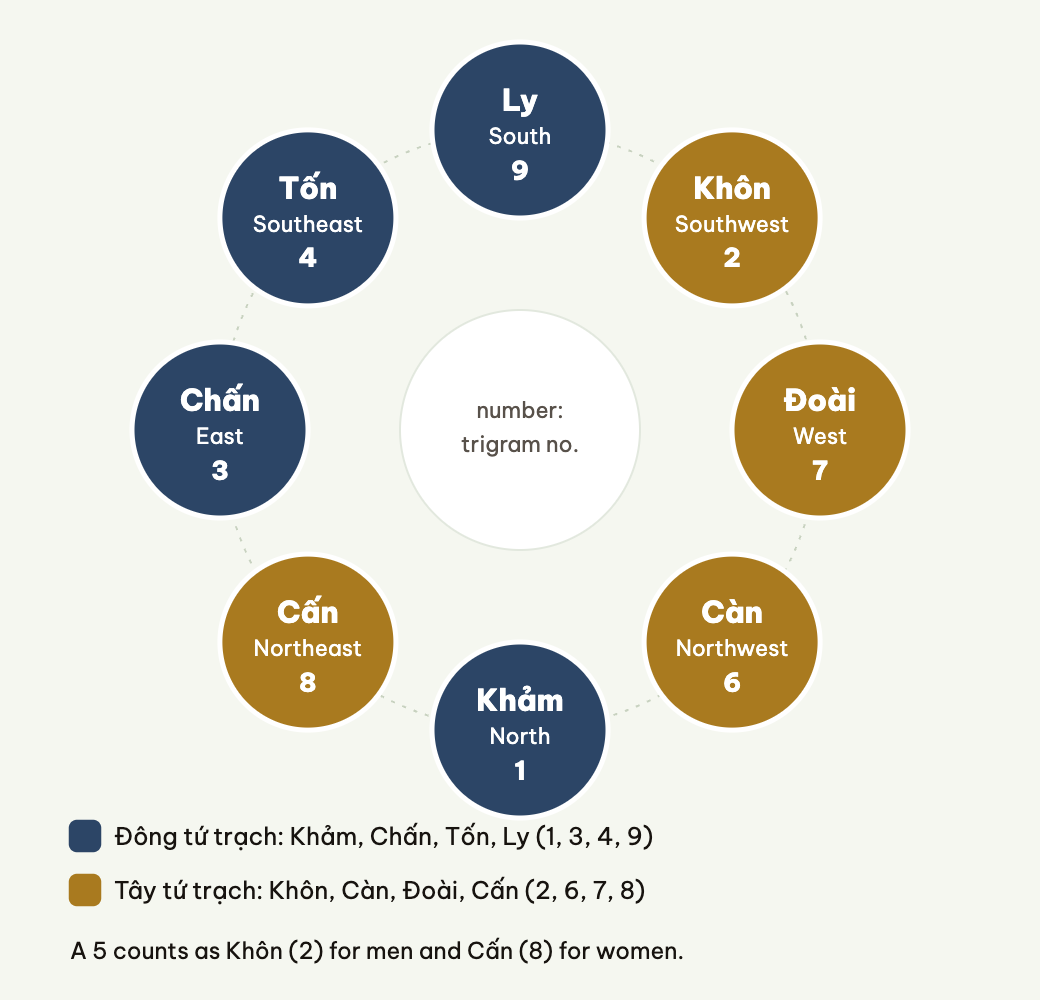
What is Bát Trạch? The eight palaces and four directions that suit one's destiny
One of the most important foundations of residential Feng Shui is the Bát Trạch (Vietnamese: Bát trạch) doctrine. According to it, each house has 8 palaces (corresponding to 8 directions: East, West, South, North, Southeast, Southwest, Northeast, Northwest), and each person belongs to one of two groups: East Four Destinies (Đông tứ mệnh) or West Four Destinies (Tây tứ mệnh), based on birth year and gender. People of East Four Destinies are compatible with the directions East, Southeast, South, North; people of West Four Destinies are compatible with West, Southwest, Northwest, Northeast. Determining one's palace destiny helps the householder choose a suitable house direction, bedroom direction, and kitchen direction to attract prosperity.
You can look up the four good directions for each person in the house and land viewing utility. For details on how to classify East Four Destinies, West Four Destinies and the eight du nien, please see the article East Four Mansions and West Four Mansions and the article the eight du nien.
It is necessary to distinguish two different things that are often lumped together under the name "Bát Trạch". The first is true Bát Trạch, which considers a person's palace phi and the eight du nien, giving four good directions and four bad directions that differ from person to person. The second is the way of fixedly assigning one matter to each corner (Southeast for wealth, Southwest for love, Northeast for education, etc.), which is actually the trigrams by compass position of modern Feng Shui, the same for everyone, and is not Bát Trạch. This article follows the compass method when assigning the eight corners, that is, taking the fixed geographical direction as the standard; another method defines the eight corners according to the entrance, in which the farthest left corner counted from the door is considered the wealth corner.
What do the important palaces in the house mean?
According to the fixed assignment of positional trigrams, each corner of the house carries its own meaning, and understanding this clearly will help the householder know how to arrange and remedy.
Wealth palace (Southeast)
The Southeast palace belongs to the Wood element, representing money, wealth and prosperity. To activate this palace, you can place Feng Shui items such as green plants (money plant, prosperity plant), a small aquarium, or items in green or purple. In an apartment building or shopping centre, apartments or shops located at the Southeast corner of the building are often considered to have an advantage in wealth compared to other positions.
Love palace (Southwest)
The Southwest palace belongs to the Earth element, representing love, marriage and relationships. The symbolic colours are yellow, cream, and earthy pink. To improve marital affection or attract love, you can hang pictures of mandarin ducks, pairs of birds, or paired items. Placing a rose quartz crystal in the Southwest corner is also a popular choice. Fame is the South, not the Southwest.
Education palace (Northeast)
The Northeast palace, also called the Can palace, belongs to the Earth element, with symbolic colours of cream, pale yellow, and earth brown. This is the palace of knowledge, study, and examinations. When you need to support your children's studies or are yourself pursuing education, you can place a bookcase, bookshelf, or computer in the Northeast corner. Items made of ceramic, clay, or pottery will support this palace well because they belong to the Earth element.
Health palace and other palaces
The central palace (or the remaining palaces such as Northwest for benefactors, East for family matters, West for children, North for career) also need attention. However, within the scope of this article, we focus on the main palaces that are commonly mentioned.
How should the living room be arranged according to proper Feng Shui?
The living room is the heart of the house, where the family gathers and receives guests. Therefore, arranging the living room in accordance with Feng Shui plays a key role.
Sofa position: the "throne" of the householder
According to modern Feng Shui experts, the sofa should be placed with its back against a solid wall, facing the main door or the open space in front. This creates a feeling of safety and active observation, helping the householder grasp every movement in the house. If it is unavoidable to have one's back to the door (due to the architecture of a tube house or a small apartment), a suitable mirror can be hung to reflect the space behind, reducing the feeling of passivity.
Clear walkways: the flow of khi
A cramped, cluttered living room will obstruct the flow of khi, causing stuffiness and heaviness. Make sure the walkway is wide enough, not blocked by tables and chairs, low shelves, or tangled wires. A tidy, easy-to-move space is not only good for Feng Shui but also makes daily life more convenient.
Layered lighting: balancing yin and yang
Lighting is an important factor in Feng Shui. A living room that is too dark makes people tired and sluggish; light that is too harsh causes stress. Instead of using only a single light source, combine multiple layers: ceiling lights for overall illumination, floor lamps and table lamps for accents. In the evening, soft yellow light brings a cosy feeling. During the day, make the most of natural light by opening the curtains.
Green plants: bringing life energy into the home
Green plants represent the Wood element, bringing growth and positive energy. With Vietnam's climate, you can choose plants with round leaves that grow well, such as pothos, money plant, jade plant, and lucky bamboo. Avoid placing thorny plants such as cacti in the living room because they easily create a feeling of tension and lack of softness.
Balancing the five elements through colour and shape
A harmonious living room is one where the five element factors are skilfully combined. You can apply the following suggestions:
| Element | Representative colours | Suggested items |
|---|---|---|
| Metal | White, grey, metallic | Metal photo frames, metal table lamps |
| Wood | Green | Green plants, green cushions |
| Water | Blue, black | Dark blue floor rugs, glass vases |
| Fire | Red, orange, pink | Wall art in red/orange tones, candles |
| Earth | Yellow, brown, cream | Wooden floors, cream cushions, ceramic items |
This balance helps the space be harmonious and pleasant, avoiding energy imbalance.
Paintings and mirrors: visual accents
Paintings and mirrors directly affect emotions. When hanging paintings, they should be placed a little above eye level to create a feeling of openness and elevate the space. The content of the painting should lean towards gentleness and positivity, such as natural landscapes, peaceful seas and skies, or family images. A large mirror, if placed in the right position, will help the living room look larger, reflect light, and create a bright feeling.
Tidiness: the golden rule
Finally, the most important thing is tidiness. A cluttered living room is not only visually distracting but also makes the spirit heavy and hard to relax. Develop the habit of cleaning regularly, removing unnecessary items and putting everything in its proper place. A tidy living room will bring a pleasant feeling, helping the whole family fully enjoy moments of togetherness.
What are the general principles for the whole house?
Besides each individual area, there are a few principles that apply to the entire house that the householder should grasp before going into details.
Ventilation and natural light. A house considered to have good Feng Shui often prioritises airy space, enough natural light, and limits dark, damp and cluttered corners. These are places where Feng Shui holds that bad khi easily accumulates, causing a heavy feeling for the occupants. Keeping the house tidy, opening windows to welcome sun and wind when the weather allows, and dealing with mould early are simple tasks but have a clear impact on daily living.
The main door is the "mouth" that receives khi. The main door is considered the place where khi enters the house, so it is necessary to avoid having the main door directly face a staircase, a toilet, or the sharp corner of another structure. This is one of the most frequently mentioned points when talking about residential Feng Shui, and is also the easiest place to check when you have just received a house or are renovating. For more detail on how to handle each case, you can see the article Main door Feng Shui: principles for proper arrangement.
The three most important areas in the house. Folk experience and Feng Shui documents often emphasise three areas: the kitchen, the bedroom and the altar. The kitchen is tied to the wealth and health of the whole family, so it should be placed in a dry place, avoiding directly facing the entrance or a toilet; you can refer further to the article Kitchen Feng Shui: principles for proper arrangement. The bedroom affects health and the marital relationship, so priority should be given to a quiet position, with a wall supporting behind the head of the bed, avoiding directly facing the entrance; see more in the article Bedroom Feng Shui: principles for proper arrangement. The altar is the place of connection with ancestors, and needs to be placed in a solemn, quiet place, not facing a toilet or a noisy walkway; details in the article Altar Feng Shui: principles for proper arrangement. The common point of all three areas is choosing a quiet place, with a point of support, avoiding directly facing the entrance or a toilet.
Green plants, Feng Shui stones, aquariums. These items are often used to supplement life energy or to balance an element still lacking in the living space. However, there is no general formula for every house: you should choose the type suitable for the householder's destiny rather than applying it mechanically. If you are considering choosing stones or items according to destiny and age, the article What are Feng Shui stones? An overview of how to choose stones compatible with destiny and age will be more useful than a fixed list.
Other palaces and how to remedy them
Besides the living room, other spaces such as the bedroom, kitchen, and workspace also need attention. However, in this article, we focus on the general principles that apply to the whole house.
Wealth palace in the Southeast corner
As mentioned, the Southeast corner is the wealth palace. If this corner is obstructed by a toilet or a cluttered storage room, the wealth energy will be defiled and diminished. The remedy is to clean it thoroughly, add green plants or lighting to increase yang energy.
Love palace in the Southwest
If the Southwest corner is a bedroom or living room, you can hang a picture of a pair of mandarin ducks or place a pair of statues. If this corner is a toilet, the door should be kept closed, hygiene maintained, and a metal wind chime hung to reduce killing energy.
Education palace in the Northeast
Placing a study desk or bookshelf in the Northeast corner helps enhance study energy. If this corner is a busy walkway, a small table lamp can be placed to gather khi.
What is the "one palace at a time" principle?
According to advice from experts, when applying Feng Shui to the home, you should not change everything at once. Act on one palace at a time, change gradually so it is easy to follow what happens and to adjust as desired. Effectiveness may be fast or slow depending on the experience and sensitivity of each person to the surrounding environment. This helps you avoid being overloaded and makes it easy to identify which factor brings positive change.
Overview article on the topic: What is Feng Shui? Foundational principles and how to apply them


