What is an astrological aspect?
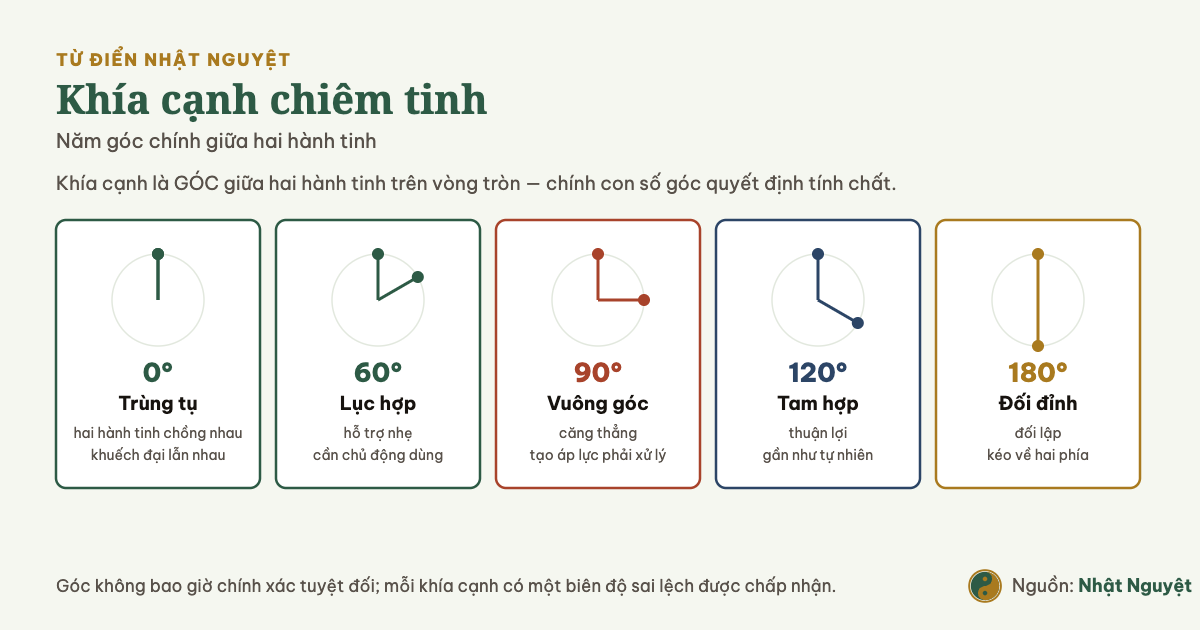
An astrological aspect is the angular distance between two planets or two important points on a chart, such as the Sun and the Moon. When two celestial bodies sit at a certain angle, the interpreter holds that their energies interact in either a harmonious or a tense way. This is one of the core factors in Western astrology, alongside a planet's sign and house placement.
Origin and classification
The Western astrological tradition recognizes major aspects such as the Sextile (about 60 degrees), the Trine (about 120 degrees), the Square (about 90 degrees) and the Opposition (about 180 degrees). There is also the Conjunction (about 0 degrees), meaning two planets sit close together in the same sign. Each aspect carries its own quality: Sextile and Trine are usually seen as harmonious, while Square and Opposition are usually seen as challenging.
How it is used in interpretation
When reading a chart, the interpreter looks at pairs of planets that form aspects to understand how they support or hinder each other. For example, a Trine between Venus and Jupiter is often read as a sign of good fortune and enjoyment. A Square between Mars and Saturn often suggests conflict between the urge to act and limits. The strength of the influence also depends on how exact the angle is (the orb), which planets are involved, and which signs they occupy.
Distinguishing it from easily confused terms
An astrological aspect differs from the zodiac sign and the house in a chart. The sign shows a planet's style of expression, the house shows the life area it affects, while the aspect shows the relationship between planets. It is also worth distinguishing an aspect from an "angle" in the purely geometric sense: in astrology, the angle only matters when tied to symbolic interpretation.
A note on its reference status
Astrology in general, and astrological aspects in particular, belong to traditional knowledge and esoteric study. Conclusions drawn from aspects have not been scientifically verified and should not replace medical, financial or legal advice.