


What is Tứ Hành Xung?
Four conflicting zodiac signs are four Earthly Branches forming two opposing pairs, including Rat-Horse-Cat-Rooster, Tiger-Monkey-Snake-Pig, and Dragon-Dog-Ox-Goat, traditionally believed to be prone to conflict in marriage or partnership.
Also called: Four Elements Clash

What is Tứ Hành Xung?
What is Tứ Hành Xung?
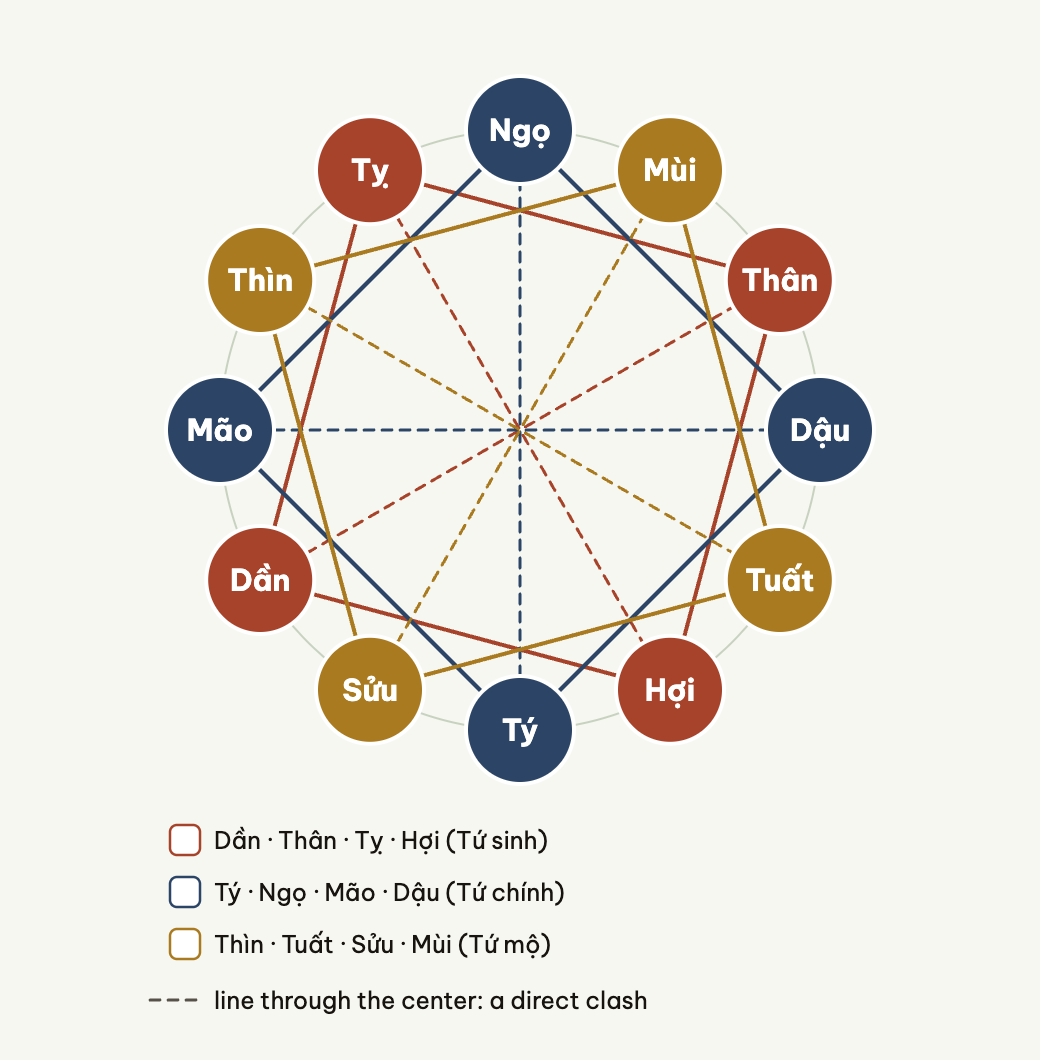
Tứ Hành Xung is the name for four zodiac animals within the system of 12 Earthly Branches (Tý, Sửu, Dần, Mão, Thìn, Tỵ, Ngọ, Mùi, Thân, Dậu, Tuất, Hợi) when they form two pairs directly opposed to each other on the Earthly Branch circle. Each group consists of four zodiac animals, divided into two directly clashing pairs, commonly regarded in folk tradition as prone to friction and difficult to harmonise when combined in business, marriage or long-term collaboration.
What is the origin and basis of Tứ Hành Xung?
In the Eastern view, the Earthly Branch circle has 12 positions, each corresponding to one zodiac animal. Two zodiac animals sitting opposite each other through the centre of the circle are called clashing. From this, earlier generations grouped four zodiac animals belonging to two opposing pairs into one Tứ Hành Xung group. This is traditional knowledge of a reference nature, not verified by science, and should not be treated as a binding rule in modern life.
Which zodiac animals make up the three Tứ Hành Xung groups?
The first group consists of Tý, Ngọ, Mão, Dậu, in which Tý clashes with Ngọ and Mão clashes with Dậu. The second group consists of Dần, Thân, Tỵ, Hợi, with Dần clashing with Thân and Tỵ clashing with Hợi. The third group consists of Thìn, Tuất, Sửu, Mùi, with Thìn clashing with Tuất and Sửu clashing with Mùi. Each group has two opposing pairs, forming four zodiac animals regarded as clashing with one another.
How is Tứ Hành Xung applied in daily life?
In folk practice, Tứ Hành Xung is often mentioned when choosing ages for marriage, choosing business partners, choosing collaborators, or looking at ages for having children. However, this view is only a small part of the stem-branch system and does not reflect the entire relationship between two people. Many other factors such as personality, circumstances, mutual understanding and shared effort still play the decisive role.
How is Tứ Hành Xung distinguished from easily confused terms?
Tứ Hành Xung differs from Tam Hợp (three zodiac animals that harmonise), Lục Hợp (six harmonising pairs) and Lục Xung (six clashing pairs). While Lục Xung lists each opposing pair individually, Tứ Hành Xung gathers four zodiac animals into one group for easier memorisation and application. It should also be distinguished from Tứ Hành (Metal, Wood, Water, Fire) in the five elements, as these are two entirely different concepts.
How do different schools understand Tứ Hành Xung?
- The common folk understanding: Tứ Hành Xung refers to four zodiac animals prone to clashing, so marriage or business partnership should be avoided to limit friction in life.
- The Earthly Branch theoretical understanding: Tứ Hành Xung is simply a way of grouping four zodiac animals from two opposing pairs on the Earthly Branch circle, systematic and mnemonic in nature, carrying no implication of absolute good or bad.
- The modern reconciled understanding: Tứ Hành Xung is only one small reference factor and does not determine a relationship; personality, circumstances and shared effort are what matter.
Related articles
- What are the 12 zodiac animals? Meaning and how to calculate age by Earthly Branch
- The meaning of Tứ hành xung Thìn - Tuất - Sửu - Mùi in Eastern folk belief
- The meaning of Tứ hành xung Tý - Ngọ - Mão - Dậu in Eastern folk belief
- The meaning of Tứ hành xung Dần - Thân - Tỵ - Hợi in Eastern folk belief
Which zodiac animals make up the three Tứ Hành Xung groups?
| Branch group | Zodiac animals |
|---|---|
| Dần, Thân, Tỵ, Hợi | Tiger, Monkey, Snake, Pig |
| Tý, Ngọ, Mão, Dậu | Rat, Horse, Cat, Rooster |
| Thìn, Tuất, Sửu, Mùi | Dragon, Dog, Buffalo, Goat |
Each group consists of four branches three positions apart on the 12-branch circle; the two branches opposite each other within a group form a directly clashing pair.
The data in the table matches the results of the lookup tools on Nhật Nguyệt.


