Why do the Earthly Branches within the same chart interact with one another?
Ba Tu takes the four pillars of year, month, day, and hour as its base. Each pillar consists of one Heavenly Stem and one Earthly Branch. Those four Earthly Branches do not stand still; they interact in pairs and sets long established by convention in the sexagenary calendar. This is an internal matter of a single chart, different from the phrase "zodiac animal compatibility," which only compares birth-year pairs. In the same person, the day pillar's Earthly Branch may combine with the hour pillar, clash with the month pillar, and punish the year pillar, creating a network of relationships rather than a single pair.
These relationships are fixed data of the Earthly Branches that can be laid out in a reference table. When reading, a student does not invent new pairs but only checks the table, then weighs strength and position.
Table of commonly used Earthly Branch relationship groups
| Group | Sets | Elemental transformation / basic meaning |
|---|---|---|
| Luc hop | Ty Suu, Dan Hoi, Mao Tuat, Chen Dau, Ty Than, Ngo Mui | Ty Suu and Ngo Mui transform to Earth; Dan Hoi to Wood; Mao Tuat to Fire; Chen Dau to Metal; Ty Than to Water |
| Tam hop | Than Ty Chen (Water), Hoi Mao Mui (Wood), Dan Ngo Tuat (Fire), Ty Dau Suu (Metal) | Forms a strong frame, leaning toward one element |
| Ban hop | Hoi Mao, Dan Ngo, Ty Dau, Than Ty | Half frame, only complete when the third branch appears in a luck cycle |
| Tam hoi | Dan Mao Chen (Wood), Ty Ngo Mui (Fire), Than Dau Tuat (Metal), Hoi Ty Suu (Water) | Seasonal gathering, the strongest among combination types |
| Luc xung | Ty Ngo, Suu Mui, Dan Than, Mao Dau, Chen Tuat, Ty Hoi | Opposition, can open or break a storehouse |
| Tam hinh | Dan Ty Than; Suu Tuat Mui; Ty Mao | Punishment, internal friction |
| Tu hinh | Chen, Ngo, Dau, Hoi | A branch punishing itself |
| Luc hai | Ty Mui, Suu Ngo, Dan Ty, Mao Chen, Than Hoi, Dau Tuat | Hidden harm, usually milder than a clash |
| Luc pha | Ty Dau, Ngo Mao, Than Ty, Dan Hoi, Chen Suu, Tuat Mui | Disruption, dropped entirely by many modern books |
The table above is a lookup tool. The difficulty lies not in memorizing it but in knowing which group dominates the chart and which is obscured.
In what priority order are combination, gathering, and clash ranked?
When multiple relationships occur at once, books usually rank strength as: tam hoi strongest, then tam hop, then ban tam hop, then luc hop. Luc hop is considered weaker, affecting only the surface, while tam hoi and tam hop can change the Five Elements situation of the chart.
The book San Ming Tong Hui records that when the four branches Chen, Tuat, Suu, and Mui gather fully, an Earth frame has already formed, because Earth inherently stores all things. This case shows that sometimes one does not need all three branches of a tam hoi or tam hop set for a separate elemental block to appear.
Another important point is the adjacency condition. Tam hoi consists of three consecutive branches by season, for example Dan Mao Chen, so adjacency is nearly part of its definition. Tam hop consists of three branches spaced one apart, for example Than Ty Chen, so pillar positions can be far apart. Ban hop only completes when the third branch appears in Dai Van or Luu Nien; otherwise it is only potential.
Does combination resolve clash or does clash break combination, and which side wins?
This is the most important practical question. Books record many situations: luc xung can break luc hop, and conversely luc hop can resolve luc xung. For example, in a chart with the Dan Ngo Tuat Fire tam hop, meeting a Than Dai Van means Than clashes Dan, breaking the tam hop; but when a Ty Luu Nien appears, Ty combines Than, the clash is resolved, and the tam hop is restored. So a clash does not act in a fixed way but depends on the Five Elements layer and the time sequence.
According to Tuyen tap bai viet Kinh Dich chon loc so 16, when discussing a luc hop hexagram changing to luc xung, one can understand combination as cause and clash as effect: the immediate situation is solid, but that very solidity will be broken. This interpretation emphasizes the inevitability of change, not necessarily an absolute misfortune. In Ba Tu, a similar principle is used: a combining pair can be interrupted by a clash, and a clashing pair can be softened by a combination.
However, when ban tam hop meets a clash, books note that ban tam hop cannot fully control the clash unless the element of the combination transformation is strong enough to block the clash force. In other words, combination does not automatically beat clash; one must consider which element is prosperous by seasonal generation.
How do tam hinh, tu hinh, luc hai, and luc pha differ?
Tam hinh includes two main groups: Dan Ty Than and Suu Tuat Mui, plus the pair Ty Mao. Tuyen tap bai viet Ba Tu chon loc so 4 explains the Dan Ty Than group as follows: Dan Wood generates Ty Fire, Ty Fire controls Than Metal, so Than is damaged. If only two of the three branches appear, their relationship shifts to another rule: the Dan Ty pair is dominated by mutual harm, the Dan Than pair by luc xung, and the Than Ty pair by luc hop. The punishment is truly clear only when all three appear together.
Tu hinh is a special case: Chen punishes Chen, Ngo punishes Ngo, Dau punishes Dau, Hoi punishes Hoi. In luc nham, tu hinh is described as holding a knife to wound oneself, an image of self-inflicted disaster. In Ba Tu, tu hinh is usually understood as bringing disadvantage on oneself, being arrogant, or acting against one's own interests.
Luc hai includes Ty Mui, Suu Ngo, Dan Ty, Mao Chen, Than Hoi, Dau Tuat, usually considered milder than a clash, leaning toward hidden harm that is hard to notice. Luc pha includes Ty Dau, Ngo Mao, Than Ty, Dan Hoi, Chen Suu, Tuat Mui. Many modern books drop luc pha entirely, arguing it overlaps with other relationships and causes confusion in reading. This is a point where schools disagree and should be stated clearly.
How are these relationships read by the year, month, day, and hour palaces?
The four pillars are assigned to four palaces: the year is ancestral foundation and family root, the month is parents and siblings, the day is self and spouse, and the hour is children and later fortune. When a pair of combination, clash, punishment, or harm falls on which two pillars, its meaning is read according to those palaces.
For example, if Ty is in the day pillar and Mao in the hour pillar, forming Ty Mao mutual punishment, according to Tuyen tap bai viet Ba Tu chon loc so 4, a recorded case is a woman with this structure who faced disadvantage in marital and mother-child relationships. This is an example illustrating palace-based reading, not a hard rule for every chart.
If luc hop falls on the day and hour pillars, it is usually seen as a bond between spouse and children. If luc xung falls on the year and month pillars, it may suggest upheaval in the family root or relations with parents. However, books all note that one must consider the Ten Gods and Useful God before concluding fortune or misfortune.
How are Earthly Branch relationships read when they meet Dai Van and Luu Nien?
Relationships within the four pillars are called inner combination and inner clash. Relationships between the four pillars and Dai Van or Luu Nien are called outer combination and outer clash. Because they occur at the luck cycle layer, outer combination does not necessarily affect the person directly; one must see which Ten God represents which subject: sometimes parents, spouse, or children.
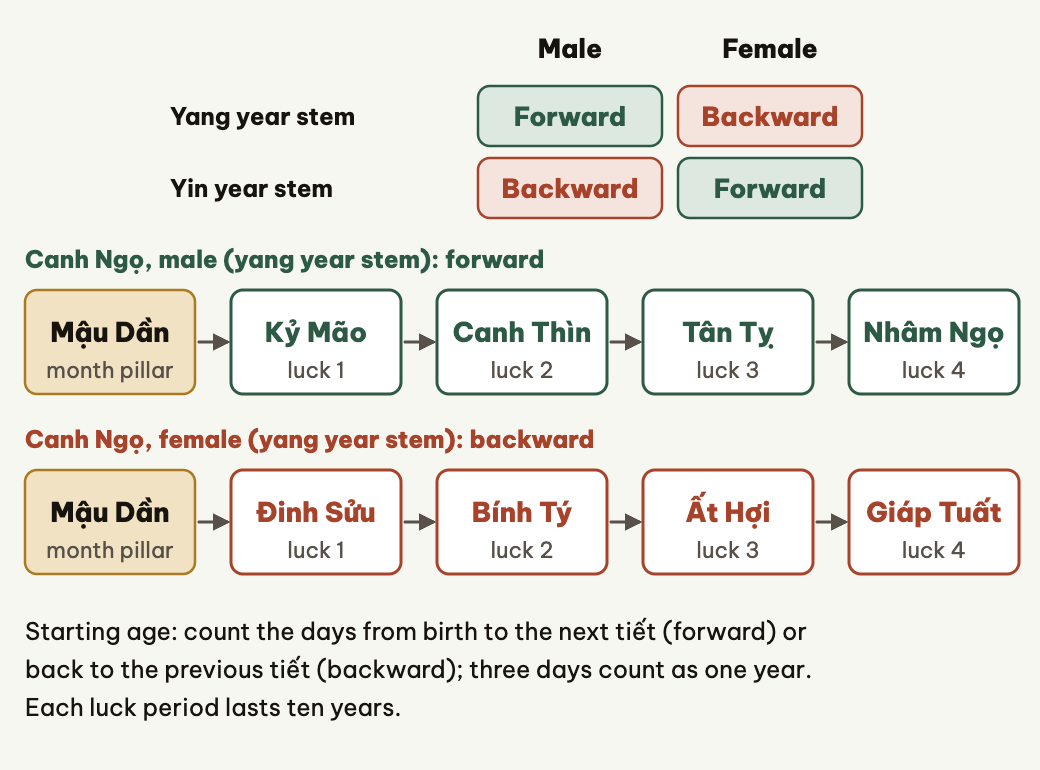
Tuyen tap bai viet Ba Tu chon loc so 5 cites an example: a male chart with four pillars Nham Thin, At Ty, Giap Dan, At Suu, when entering the Mau Than cycle, the Seven Killings appears, tam hinh controls the Seven Killings, and the book records that the native thereby made great wealth in coal mining. This is a case where tam hinh brought no disaster but became useful, showing one cannot rigidly hold that punishment is bad.
Tuyen tap bai viet Ba Tu chon loc so 5 also states the rule for reading tam hinh: "there is both good and bad, one cannot be rigid in reading; good or bad is determined entirely by the structure. If it enters the pattern, read as good; if it breaks the pattern, read as bad." This is a general principle for all Earthly Branch relationships, not only tam hinh.
Points on which schools disagree
First, whether tu hinh requires two adjacent characters. Some schools hold that Chen only self-punishes when there are two or more Chen, or when Chen meets Chen again in a luck cycle, meaning repetition is needed. Others hold that a single Chen in the four pillars already carries tu hinh, especially when Chen controls the day stem. There is no clear consensus.
Second, whether luc pha should be used or dropped entirely. Many classical books still list luc pha, but many modern materials drop it entirely, arguing it overlaps with other relationships and easily causes confusion. Students should know both views, and if using it, must be consistent throughout the chart.
Third, whether the Chen Tuat Suu Mui clash opens or destroys the storehouse. Tuyen tap bai viet Ba Tu chon loc so 4 records that Chen Tuat and Suu Mui are pairs of tomb storehouses clashing each other, implying opening or controlling the storehouse. Some schools hold that a tomb storehouse clash opens the storehouse, exposing hidden stems, which can be good if the hidden stem is the Useful God. Others hold that it destroys the storehouse, scattering qi, which can be bad. There is no general conclusion.
So when reading a chart, where should one begin?
A reasonable sequence is: list all Earthly Branch relationships in the four pillars, identify the strongest group in the order tam hoi, tam hop, ban hop, luc hop, clash, punishment, harm, disruption. Then consider palace position to assign meaning. Next, compare with Dai Van and Luu Nien to see which relationships are activated or resolved. Finally, place everything in the context of the Useful God and the chart's prosperity or decline, because the same clash pair can be bad or good depending on which element is needed.
Reading Earthly Branch relationships cannot be separated from identifying the Useful God and assessing prosperity or decline. Those two topics have been presented separately in the articles on Useful God and on prosperity and decline, so here we only restate the principle: Earthly Branch relationships are one layer of information, not the whole chart.


