What is tuổi mụ?
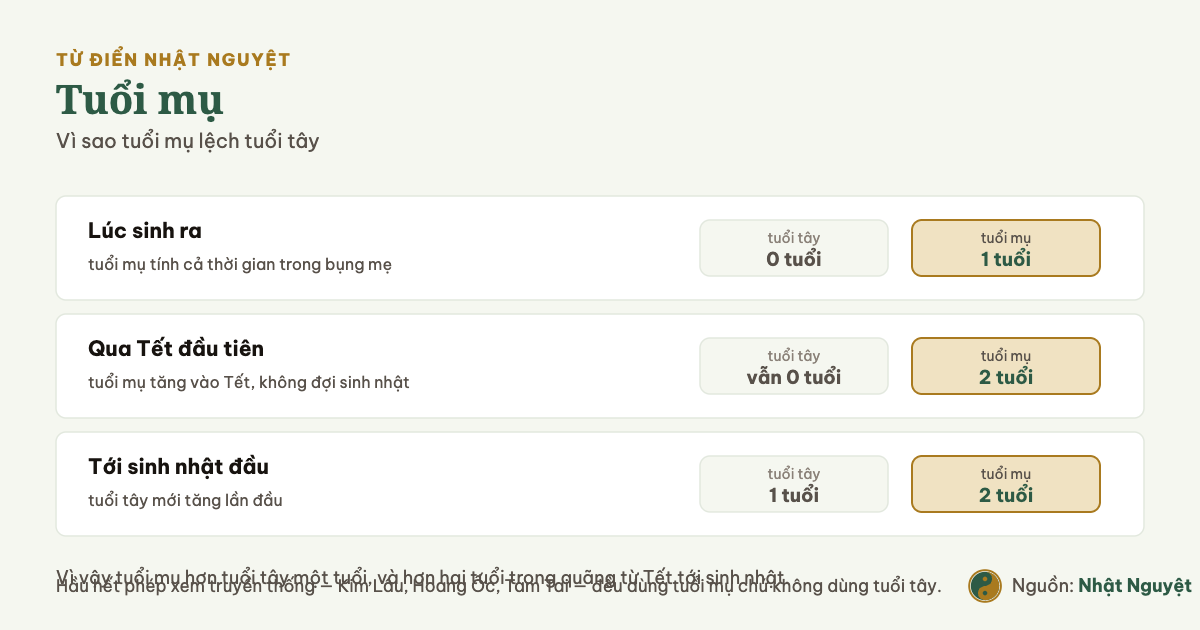
Tuổi mụ, also called lunar age or East Asian age, is the traditional Vietnamese way of counting age, shared with several neighbouring cultures. The formula is simple: the current year minus the birth year, plus one.
Someone born in 1990 is 37 by this count in 2026, while their Gregorian age might still be 35 or 36 depending on whether their birthday has passed.
Why the extra year
The count reflects a view that time in the womb is part of a life: a newborn is already considered one year old. Age then increases at the turn of the year rather than on a birthday, so everyone born in the same year shares the same lunar age throughout that year.
Where it is used
Lunar age, not Gregorian age, is the number most folk calculations take: Kim Lâu divides it by nine; Hoang Ốc counts six positions from it; the Nine Luminaries star reading looks it up alongside gender; and it appears in longevity celebrations and marriage-year customs.
This is why confusing lunar and Gregorian age is the most common slip when people check these taboos themselves. Being one year out can flip a result from unaffected to affected.
One caveat
A stricter method adjusts for the Lunar New Year so that people born just before and just after Tết are not lumped together. The folk tables in circulation, however, all use the simple subtraction above, so when comparing results across sources, make sure both sides use the same convention.