The Vietnamese and Chinese lunar calendars differ on 2,814 days: the data and how to check it
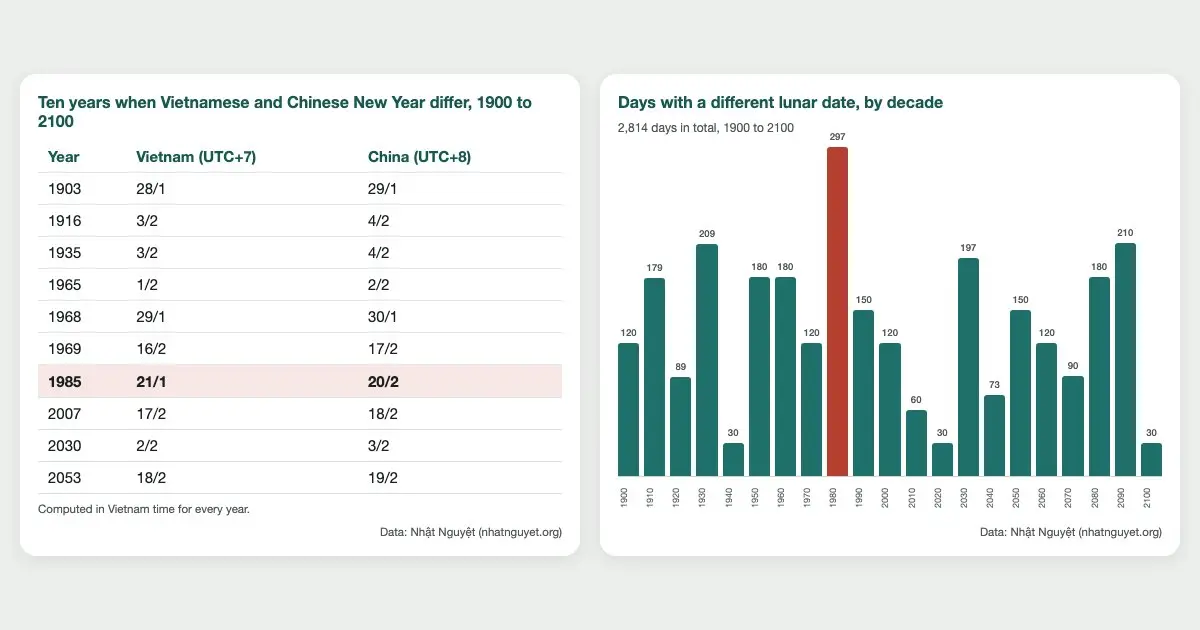
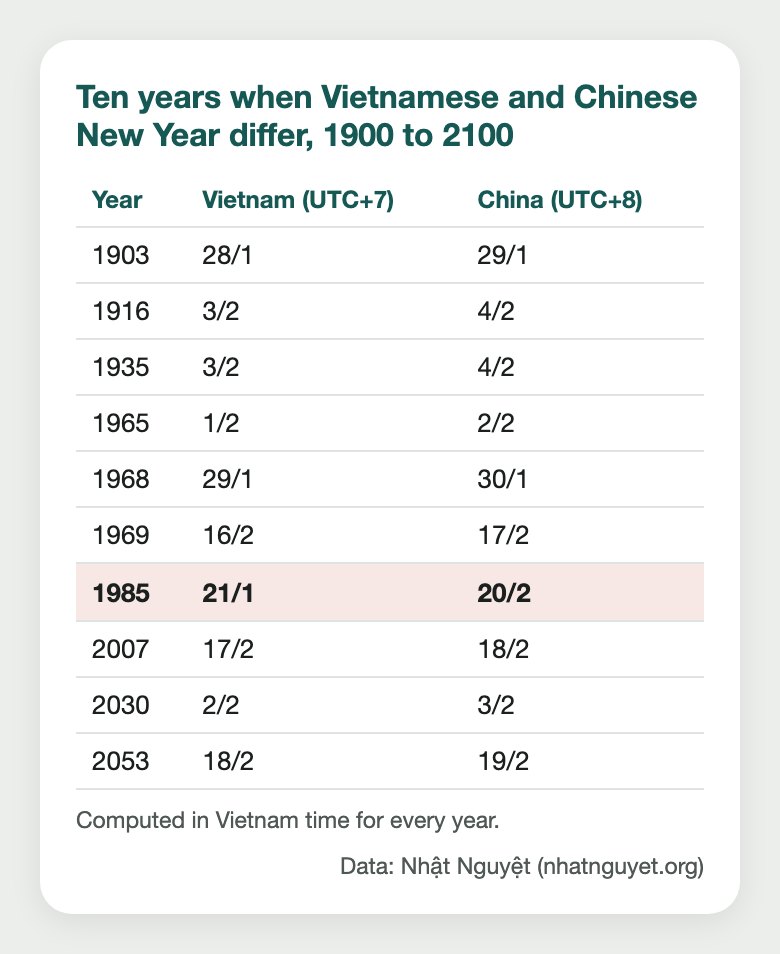
From 1900 to 2100, computed in Vietnam time (UTC+7) and Beijing time (UTC+8), the two lunar calendars differ on 2,814 days, and the New Year falls on different days in 10 years: 1903, 1916, 1935, 1965, 1968, 1969, 1985, 2007, 2030 and 2053. The biggest gap is 1985: Vietnamese Tết on 21 January, Chinese New Year on 20 February. This guide shows how to recompute it with the open library.
Why do the same rules give two calendars?
Both calendars use the same rules: a month starts on the day of the new moon, the 11th month contains the winter solstice, and the leap month is the first month without a principal term. Only the local time used to decide the day differs. A new moon between 23:00 and midnight in Hanoi is already the next day in Beijing, so the first of the month is a day apart. Now and then a new moon or principal term close to midnight puts the leap month in different places, and the calendars are a whole month apart.
Steps to check
- Install the library:
pip install nhatnguyet(ornpm i @nhatnguyet/am-lich). - Loop over every day from 1900 to 2100 and convert it to lunar at UTC+7 and UTC+8 with
am_lich.solar_to_lunar. - Count the days that differ, split them into different lunar month or year versus day number only, and group them into runs.
- Compare the first day of the first month each year with
am_lich.lunar_to_solar.
from datetime import date, timedelta
from nhatnguyet import am_lich

VN = am_lich.MUI_GIO_LICH["viet_nam"]    # 7
TQ = am_lich.MUI_GIO_LICH["trung_quoc"]  # 8

khac, khac_thang, doan = 0, 0, []
ngay = date(1900, 1, 1)
while ngay <= date(2100, 12, 31):
    a = am_lich.solar_to_lunar(ngay.day, ngay.month, ngay.year, VN)
    b = am_lich.solar_to_lunar(ngay.day, ngay.month, ngay.year, TQ)
    if a != b:
        khac += 1
        if (a["month"], a["year"], a["leap"]) != (b["month"], b["year"], b["leap"]):
            khac_thang += 1
        if doan and doan[-1][1] == ngay - timedelta(days=1):
            doan[-1][1] = ngay
        else:
            doan.append([ngay, ngay])
    ngay += timedelta(days=1)

print(f"Different lunar dates: {khac:,} days in {len(doan)} runs")
print(f"  different lunar month or year: {khac_thang}; day number only: {khac - khac_thang}")
dai = max(doan, key=lambda d: d[1] - d[0])
print(f"  longest run: {dai[0]} to {dai[1]}, {(dai[1] - dai[0]).days + 1} days")

print("Years when the New Year differs:")
for nam in range(1900, 2101):
    vn, _ = am_lich.lunar_to_solar(1, 1, nam, False, VN)
    tq, _ = am_lich.lunar_to_solar(1, 1, nam, False, TQ)
    if vn != tq:
print(f" {nam}: Vietnam {vn['day']}/{vn['month']}, China {tq['day']}/{tq['month']}")Different lunar dates: 2,814 days in 86 runs
different lunar month or year: 465; day number only: 2349
longest run: 1984-11-23 to 1985-04-19, 148 days
Years when the New Year differs:
1903: Vietnam 28/1, China 29/1
1916: Vietnam 3/2, China 4/2
1935: Vietnam 3/2, China 4/2
1965: Vietnam 1/2, China 2/2
1968: Vietnam 29/1, China 30/1
1969: Vietnam 16/2, China 17/2
1985: Vietnam 21/1, China 20/2
2007: Vietnam 17/2, China 18/2
2030: Vietnam 2/2, China 3/2
2053: Vietnam 18/2, China 19/2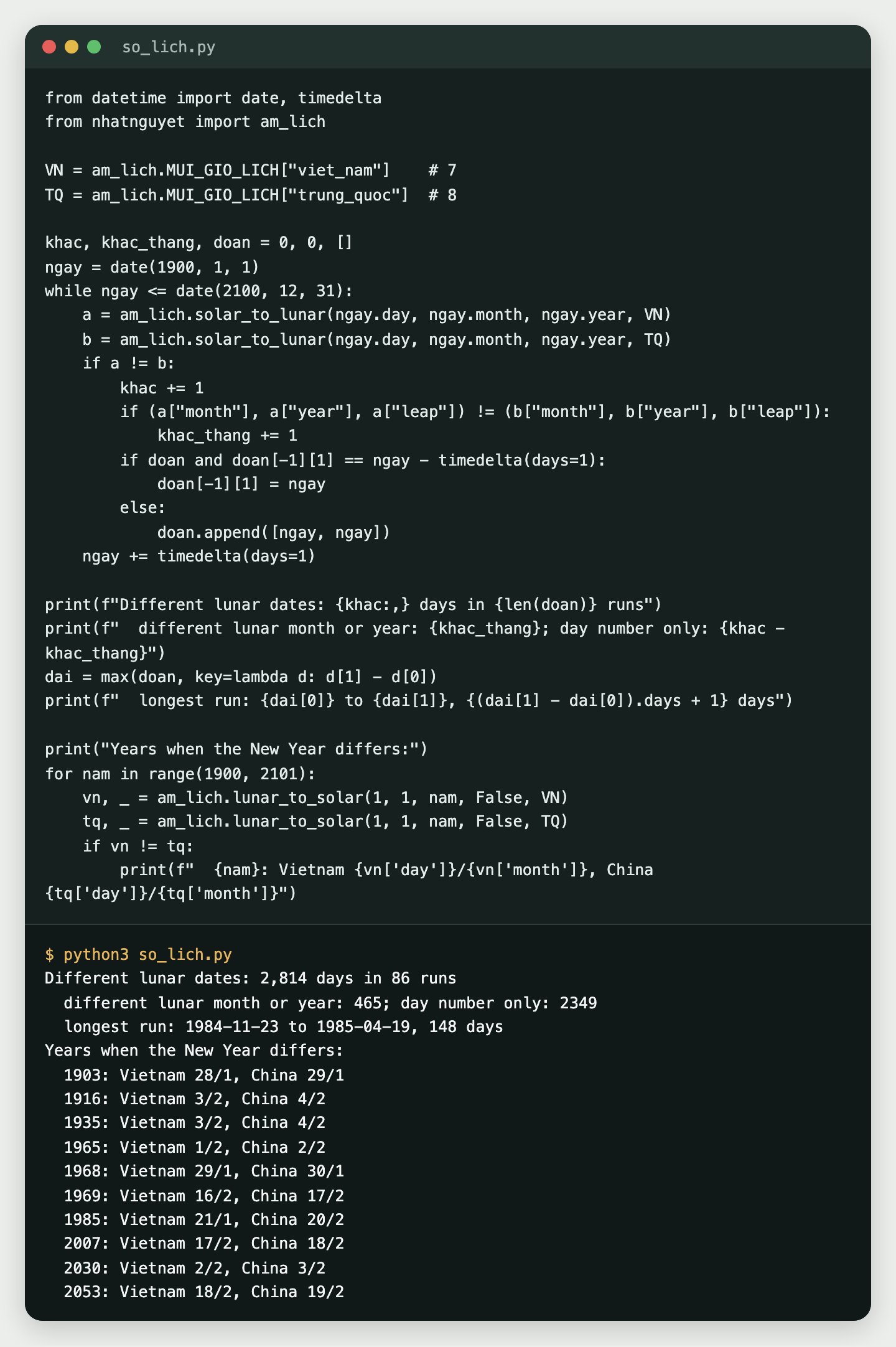
Results
- 2,814 days differ, in 86 runs.
- On 2,349 days only the day number differs; on 465 days the lunar month or year differs too.
- Longest run: 23 November 1984 to 19 April 1985, 148 days. The Vietnamese calendar puts a leap 2nd month in 1985 and the Chinese one a leap 10th month in 1984, so through the New Year season the two are a full month apart.
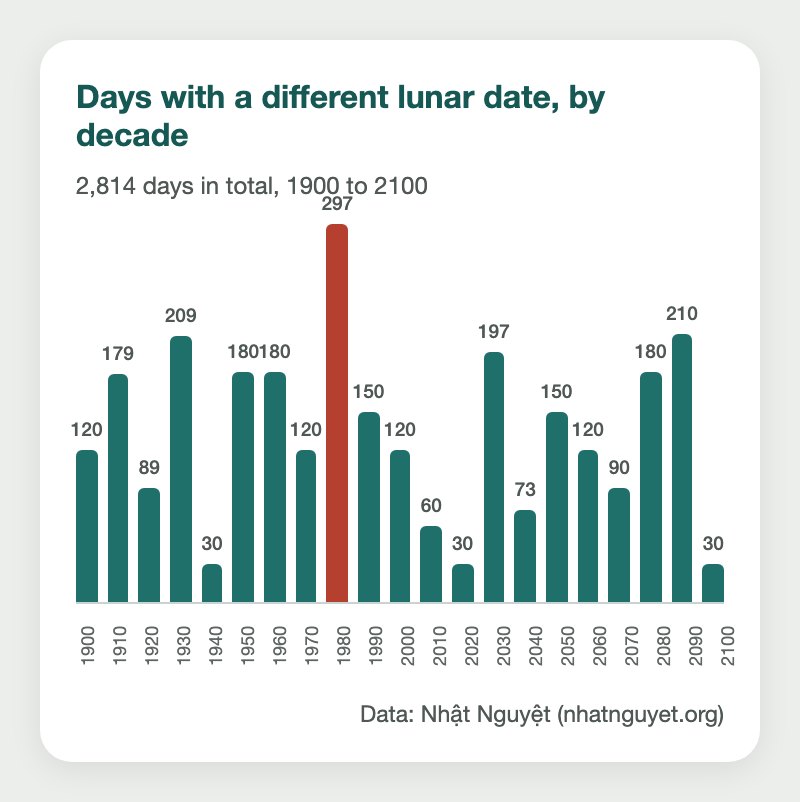
From 2020 to 2035 there are five runs: 14/12/2020 to 12/1/2021, 2/2 to 3/3/2030, 21/4 to 20/5/2031, 11/3 to 9/4/2032 and 12/9 to 11/10/2034. A calendar app that uses the Chinese calendar shows the wrong lunar date for Vietnam on those days.
What about calendars printed in the past?
The accurate phrase is "computed in Vietnam time", not "the Vietnamese calendar of that year said". Vietnamese calendars followed Beijing time, UTC+8, until 8 August 1967 in the North and until 1975 in the South. By the calendar of the day, Tết 1965 fell on 2 February; Tết 1968 was 29 January in the North and 30 January in the South; Tết 1969 in the South was 17 February. For dates in the South before 1975, also check a UTC+8 calendar: pass MUI_GIO_LICH["trung_quoc"] to compute it.
The library's calendar is astronomical computation: new moons checked against NASA and the 24 solar terms against IMCCE (Paris Observatory) from 1900 to 2100.
Data and credit
The 1900 to 2100 lunisolar dataset is on the open data page under CC BY 4.0; the code is MIT. If you quote these numbers, credit "Data: Nhat Nguyet (nhatnguyet.org)". The code repository is on the open source page.