How Nhat Nguyet computes numerology, and why it is not Pythagoras's
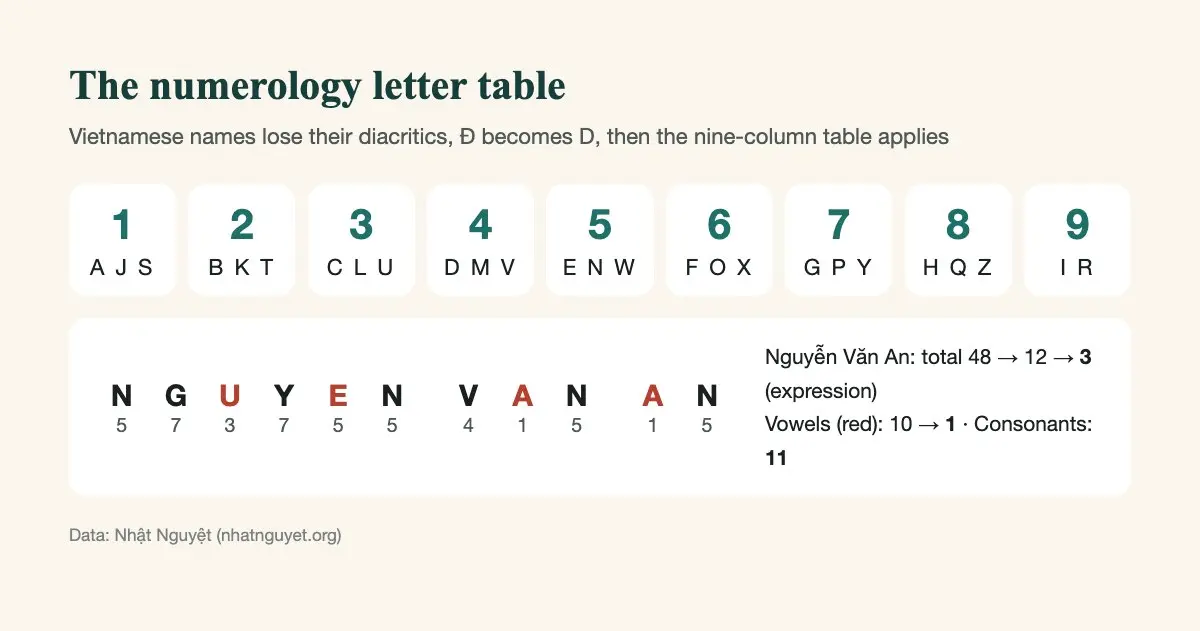
Numerology by name and birth date is a modern system, formed from the late 19th century through the books of L. Dow Balliett; it borrows Pythagoras's philosophy of number, not a calculation he left behind. Nhat Nguyet uses the nine-column letter table, strips Vietnamese diacritics and turns Đ into D. Every step can be added up by hand, and where the books disagree we say so.
Numerology is not scientifically verified. The numbers in this post are the result of conventional addition, not statements about anyone's character or fate.
Where does numerology come from?
Tradition links the art to Pythagoras, but the calculation from names and birth dates belongs to authors of the late 19th and early 20th centuries. Eight public-domain books in Nhat Nguyet's library, 245 segments, show the system taking shape in that period:
| Author | Book | Year | Segments in the library |
|---|---|---|---|
| L. Dow Balliett | How to Attain Success Through the Strength of Vibration | 1905 | 24 |
| L. Dow Balliett | The Philosophy of Numbers; Their Tone and Colors | 1908 | 24 |
| W. Wynn Westcott | Numbers: Their Occult Power and Mystic Virtues | 1890, 1911 edition | 8 |
| Sepharial | The Kabala of Numbers | 1911 | 22 |
| Roy Page Walton | Names, Dates, and Numbers | 1914 | 22 |
| Clifford W. Cheasley | What's in Your Name? | 1916 | 51 |
| Cheiro | Cheiro's Book of Numbers | 1926 | 33 |
| Ariel Yvon Taylor | Numerology Made Plain | 1926 | 61 |
How does a Vietnamese name become numbers?
- Strip diacritics: "Nguyễn" becomes "Nguyen"; Đ becomes D.
- Look up the nine-column table: A, J, S are 1; B, K, T are 2; and so on to I, R as 9.
- Vowels are A, E, I, O, U; Y counts as a consonant.
Example: Nguyễn Văn An, born 1 October 1960:
| Number | How | Result |
|---|---|---|
| Life Path | add every digit of the birth date: 1 + 1 + 0 + 1 + 9 + 6 + 0 = 18, reduce | 9 |
| Expression | add every letter of the full name: 48, then 12 | 3 |
| Soul Urge | vowels only, U, E, A, A: 10 | 1 |
| Personality | consonants only: 38, then 11, kept as a master number | 11 |
Reducing means adding the digits until one digit remains, unless the total is a master number, 11, 22 or 33.
Where do the books differ, and what does Nhat Nguyet choose?
| Point | Nhat Nguyet's choice | Other books |
|---|---|---|
| Adding the Life Path | add all digits in one run, then reduce, as modern popular numerology does | Balliett (1917 printing) and Taylor (1926) reduce month, day and year separately before adding: 9/9/1955 gives 11 on Nhat Nguyet, 2 by the two books |
| Master numbers | keeps 11, 22 and 33 | Balliett and Taylor keep only 11 and 22; some reduce master numbers to 2, 4 and 6 |
| The letter Y | consonant | some books count Y as a vowel when it sounds like one, as in the name Vy |
| The letter Đ | becomes D | some Vietnamese tools turn it into DD, which changes the numbers entirely |
| Letter table | the nine-column table for the main numbers | the table Cheiro printed in 1926 and called Chaldean, not in alphabetical order and without the number 9; Nhat Nguyet publishes it alongside |
Cheiro only wrote that the table was "believed" to come from the Chaldeans; its ancient origin is a claim with no surviving record.
Are Life Path numbers spread evenly over birth dates?
No. Over 73,414 birth dates from 1900 to 2100, the numbers 1, 3, 5, 7, 8 and 9 each take about 11.1%, but 2 gets only 4.5%, 4 only 6.0% and 6 is 8.1%. The reason: totals of 11, 22 and 33 are kept as master numbers instead of reducing to 2, 4 and 6.
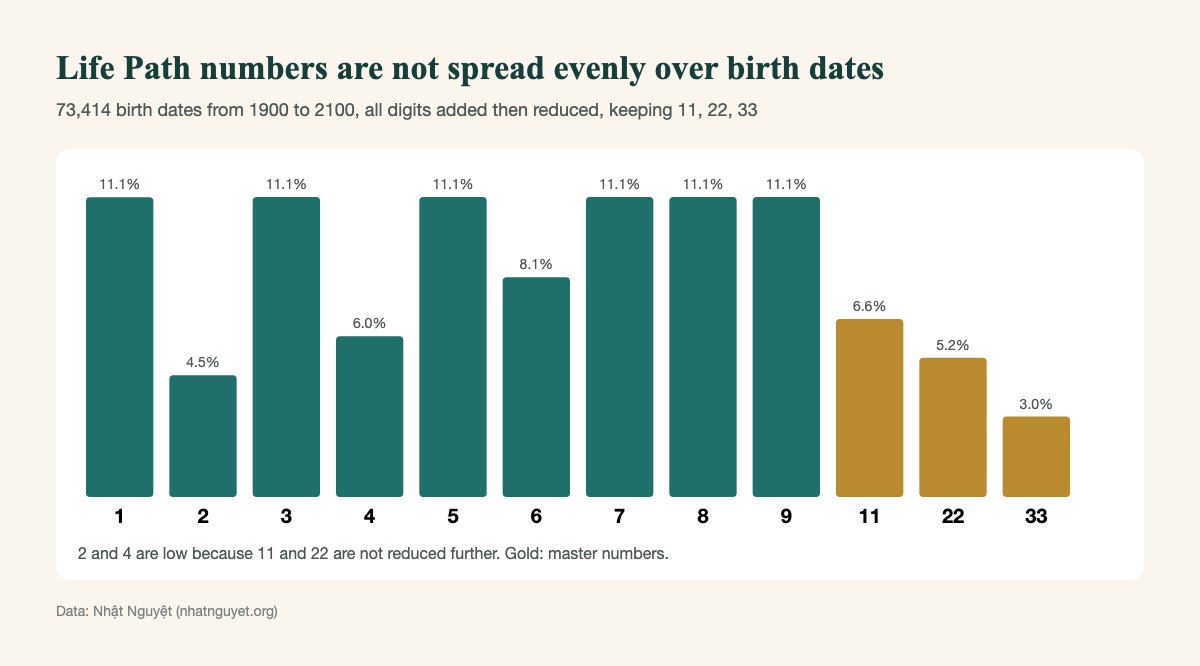
This is a property of the addition and says nothing about the people who carry the number.
How are the results checked?
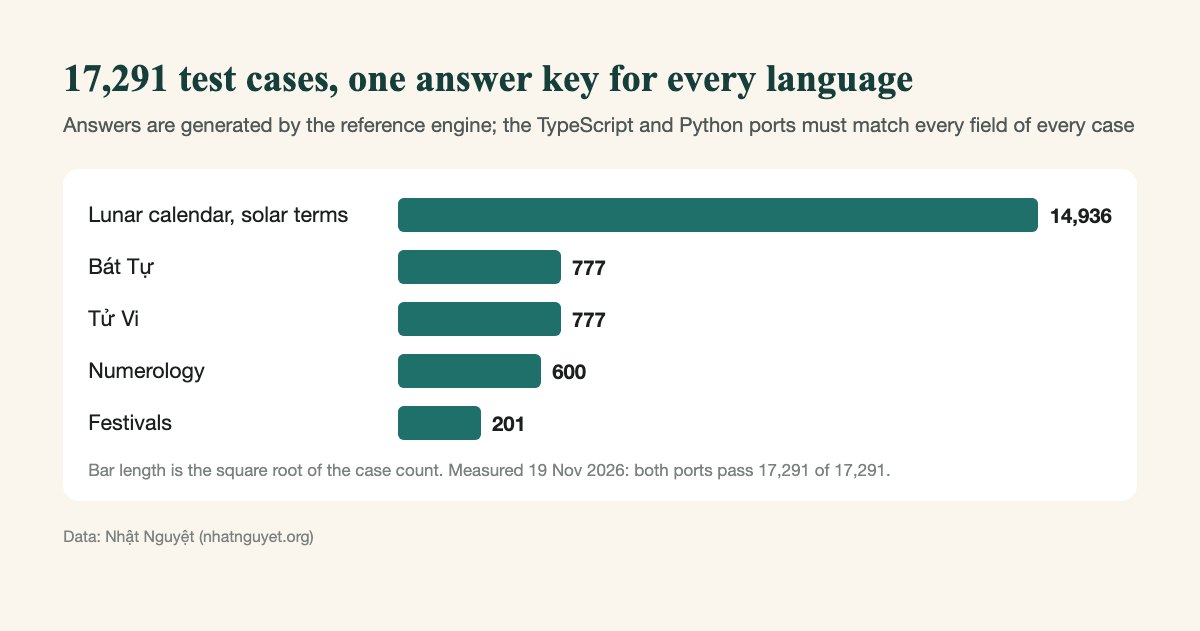
- The numerology test set has 600 profiles by name and birth date, for the year 2026. The TypeScript and Python ports match the reference engine on every number, including Vietnamese diacritic stripping.
- The test suite also feeds in deliberately wrong answers to make sure the comparison catches a mismatch instead of letting it slip by.
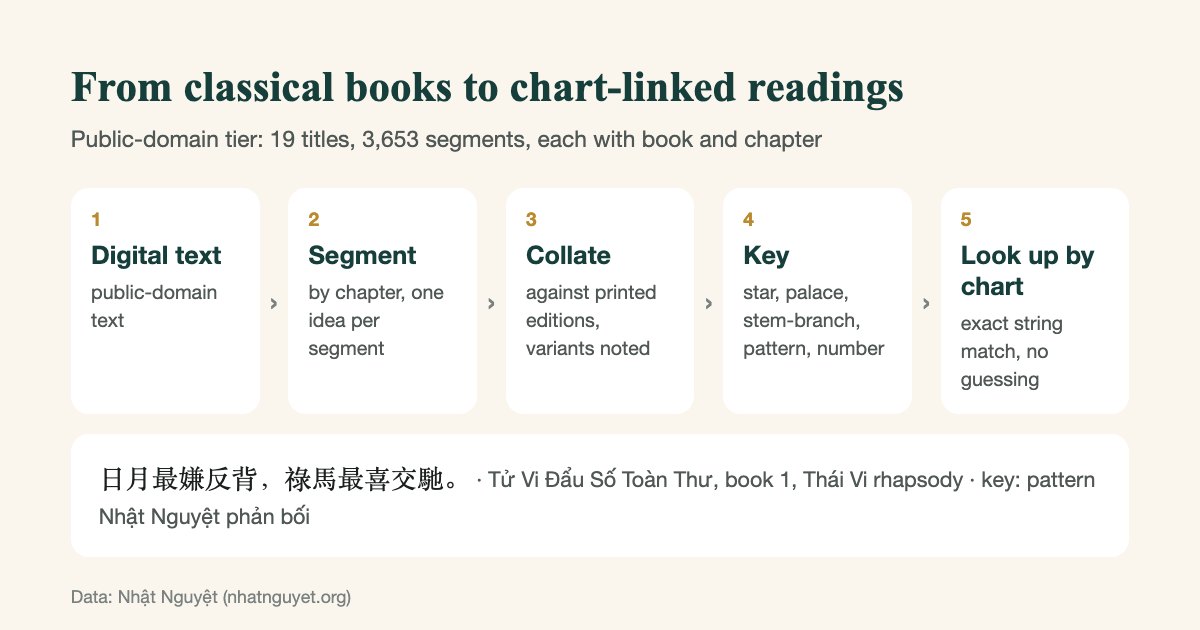
The library and test cases are on the Open code and data page; to check your own library against the test cases, see the post on testing a library with the test cases. How passages from the eight authors above feed into readings: the post on classical books and readings.

If you reuse these figures, please credit: Data: Nhat Nguyet (nhatnguyet.org).