
How classical books are digitised, collated and linked to charts, and whether AI writes the readings
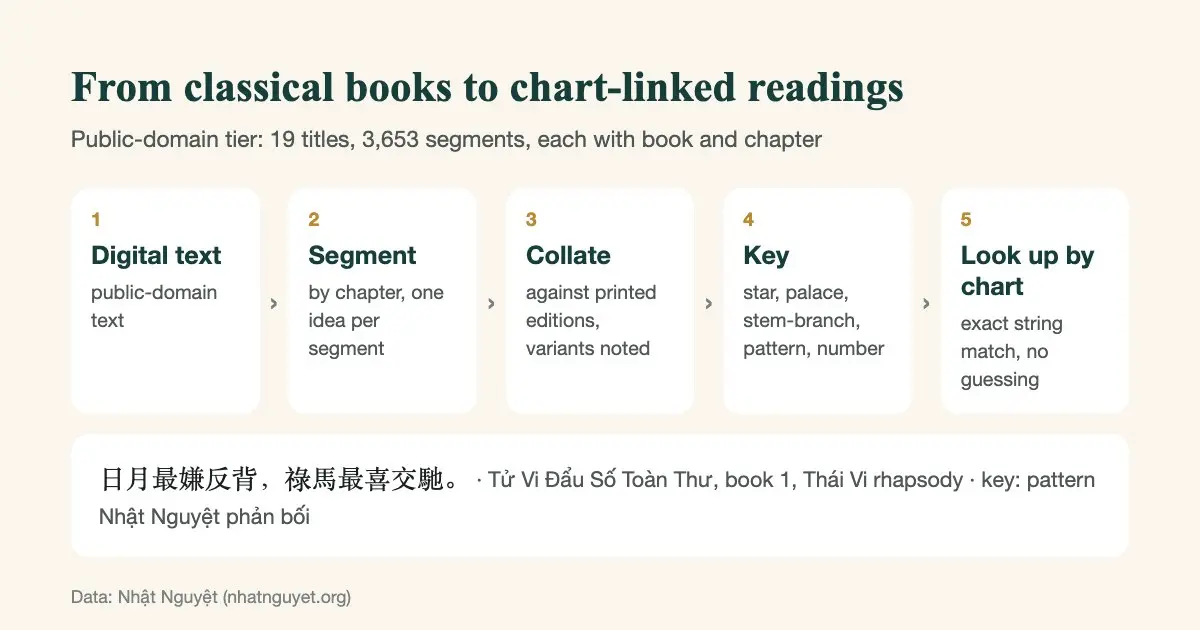
Every classical passage reaches a chart in five steps: a public-domain digital text, segmented by chapter, collated against printed editions, keyed to chart features, then looked up by exact string match. The public-domain tier now holds 19 titles and 3,653 segments, each recording its book and chapter. Readings are assembled from these segments by fixed rules; no AI model writes the sentences.
Book passages are the rules of traditional schools and are not scientifically verified. Quoting a passage correctly does not make it true of anyone's life.
Which books are in the library?
| Subject | Books | Segments | Largest book |
|---|---|---|---|
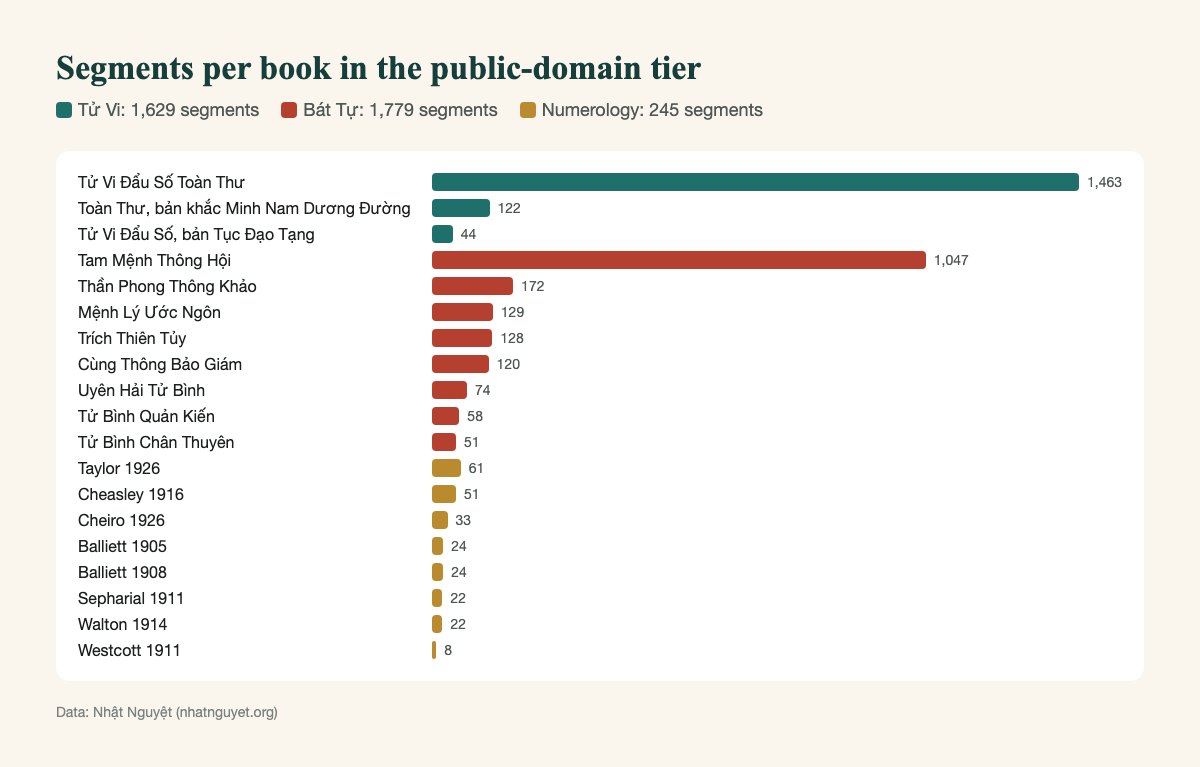
| Tử Vi | 3 | 1,629 | Tử Vi Đẩu Số Toàn Thư (1,463 segments) |
| Bát Tự | 8 | 1,779 | Tam Mệnh Thông Hội (1,047 segments) |
| Numerology | 8 | 245 | Ariel Yvon Taylor's Numerology Made Plain, 1926 (61 segments) |
| Total | 19 | 3,653 |
Beyond this chart-linked tier, the open library also ships a full-text set of 373 public-domain classical texts (about 350 works), 72.7 million characters.
How are passages segmented and collated?
- By chapter, one idea per segment: one line of verse, one entry on a star, one passage on a birth day and hour. Each segment carries its chapter, such as 「卷一 · 太微赋」 (book 1, the Thái Vi rhapsody).
- Collated against printed editions, with variants recorded on the segment itself:
- Tử Vi Đẩu Số Toàn Thư: 31 segments compared by eye on 9 scanned pages of the Ming woodblock edition (Nam Dương Đường): 13 match, 18 differ, mostly by a single character. At those 18 points a third, modern typeset edition reads like the digital text at 15, like the woodblock at 2 (the library now follows the woodblock there), and is mixed at 1. A modern vernacular sentence inserted into the digital text, absent from the woodblock, was removed.
- Trích Thiên Tủy: variants corrected against the 1947 printed edition.
- English numerology books: compared with a second scan by the share of matching three-word sequences; Cheiro 1926 averages 0.856.
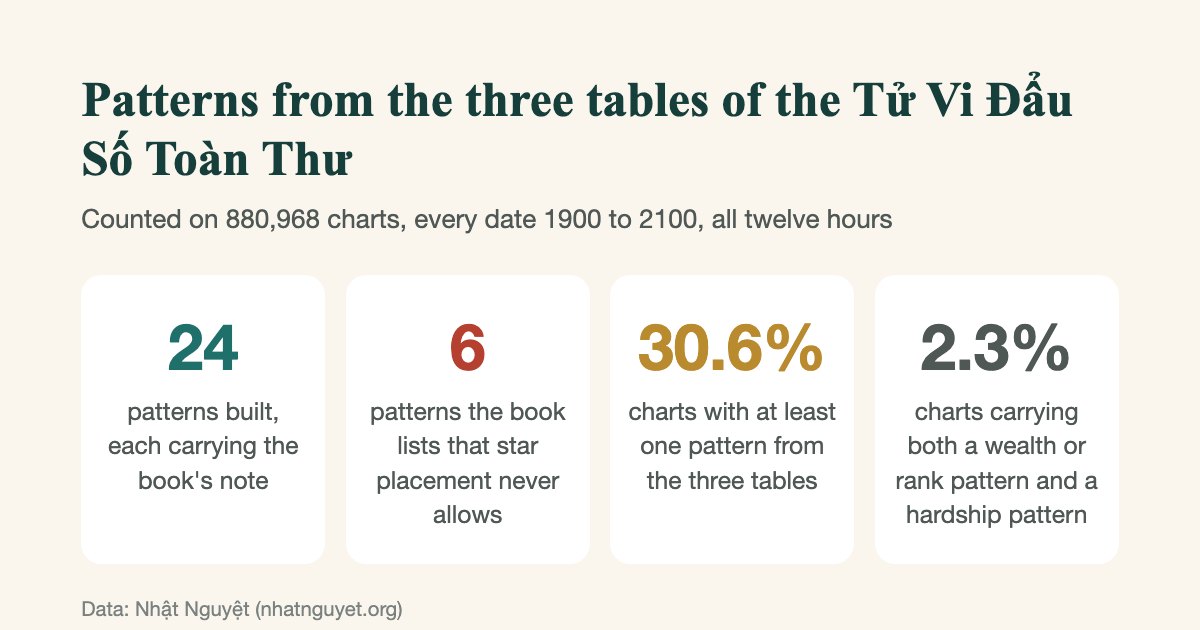
- Segments never quoted: 124 segments stay in the library for completeness but are flagged never to be quoted: passages on illness, early death and punishment, and all 44 segments of the Supplement to the Daoist Canon edition (1607), which uses an eighteen-star system unlike the Toàn Thư's.
How is a passage linked to a chart?
By structured keys, looked up by exact string match. A chart already gives the exact stem, branch, star names, patterns and numbers, so segments are chosen by exact matching that anyone can verify by eye; there is no "find a passage with similar meaning" step.
| Book | Main key types | Segments |
|---|---|---|
| Tử Vi Đẩu Số Toàn Thư | each star; star in each palace; periods; star at each branch; patterns; transformations | 382; 340; 338; 220; 142; 19 |
| Tam Mệnh Thông Hội | birth day and hour; nạp âm | 826; 119 |
| Cùng Thông Bảo Giám | climate balancing by day stem and month | 120 |
| Eight numerology books | by number; by topic | 163; 82 |
An example segment: 「日月最嫌反背,祿馬最喜交馳。」 (Nhật Nguyệt tối hiềm phản bối, Lộc Mã tối hỉ giao trì), Tử Vi Đẩu Số Toàn Thư, book 1, the Thái Vi rhapsody; key: the pattern Nhật Nguyệt phản bối.
How are readings assembled, and does an AI model write them?
No AI model writes the readings in the open dataset. They are assembled entirely by code from three reviewed sources:
- Text Nhat Nguyet wrote into the engine, in all three languages.
- Public-domain book segments chosen for the chart by the same lookup our readings use; copyrighted books, reference-only books and flagged segments never enter.
- Summaries and Q&A from published Nhat Nguyet articles linked to concepts present in the chart.
Rerunning with the same parameters gives identical bytes: no clock reads, a fixed reading year of 2026, sampling with a fixed seed. The result is readings for about 3.6 million Tử Vi, Bát Tự and numerology charts, every birth date from 1900 to 2100.
How are passages credited?
- Every segment records its book and chapter, with the original Chinese kept as is.
- Uncertain authorship is stated: tradition attributes the Toàn Thư to Chen Tuan; modern research does not consider that proven.
- Machine-rewritten anthologies are never used as a quoted source.
What are the limits?
- Collation against printed editions covers only part of the segments (for example 31 Toàn Thư segments against the woodblock), not all of them.
- Several digital copies of one book descend from the same electronic text, so comparing them with each other is no substitute for a printed edition.
- Readings of the classical Chinese and their translations need review by someone versed in it; if you find an error, write to [email protected] so we can fix it and log it on the Corrections page.
Using this library for an assistant with citations: the post on an AI assistant that cites classical books; using the readings to train models: the post on training AI with Tử Vi data. Code and data are on the Open code and data page.
If you reuse these figures, please credit: Data: Nhat Nguyet (nhatnguyet.org).