Why Is Reading Your Own Palm So Prone to Error?
Palmistry (or chiromancy) is one of the oldest surviving divination arts, with traces appearing almost independently in many civilizations: ancient India through the Samudrik Shastra tradition, China, Egypt, and ancient Greece. From India, this knowledge spread along trade routes to China, Tibet, Egypt, Persia, and Mesopotamia. By the Victorian era, Cheiro (William John Warner, 1866-1936) systematized palm reading into a strict, accessible framework, and his influence remains clear in popular palmistry today.
Because it has passed through many cultures and centuries of oral transmission, palmistry exists alongside many schools with different, even contradictory conventions. Beginners easily take a piece of knowledge from one place and combine it with another, then draw wrong conclusions. The seven misconceptions below are the most common points of friction.
Misconception 1: A Long Life Line Means a Long Life
This is perhaps the most common misconception. Many documents emphasize that the Life Line, curving around the thumb mound, is usually interpreted as related to vitality, overall health, and major life changes, rather than lifespan as popularly but inaccurately believed. In many schools, this line does not reflect length of life but represents vitality, physical health, and major turning points.
Even when a Life Line is short, palmistry researchers say it simply reflects a person with less abundant energy or a tendency toward introversion and focus on the inner world, not a sign of early death. Anatomically, the Life Line is actually just a fold around the base of the thumb, helping the thumb extend, flex, and grip flexibly. Its length, depth, or curvature varies randomly among people, depending on each hand's anatomical structure.
Misconception 2: Palm Lines Are Immutable, One Reading Lasts a Lifetime
Many believe palm lines are fixed from birth to death. In fact, according to some folk beliefs, palm lines can change every six months, reflecting changes in a person's thoughts and lifestyle, with the exception of thumb lines, which are said to hardly change. Because of this change, many readers say palmistry should only be done when a person is 18 or older, when the lines are nearly stable and unlikely to change greatly. The ideal time is said to be morning, after waking and before breakfast, when the body and mind are most natural.
This creates a paradox: if lines change over time, one reading cannot be a lifetime sentence; if lines are fixed, choosing a reading time becomes meaningless. Folk schools do not agree on this point.
Misconception 3: Reading the Dominant Hand Is Always Most Accurate
One of the most discussed issues in palmistry is which hand to read, and this is where books clearly contradict. Two main views are passed down. First: the left hand represents past life (previous incarnation), while the right hand speaks of current life and future. Second: the convention depends on each person's dominant hand. Specifically, left-handed people have the left hand representing the past, right-handed people have the right hand representing the past. In other words, the non-dominant hand shows what is innate, while the dominant hand shows what a person has created in this life.
Meanwhile, traditional Western practice often identifies the dominant hand as the main hand, reflecting the current person and what is being actively shaped, while the non-dominant hand is secondary, reflecting innate potential and inherited traits. Thus the same hand can be called the main hand in one school and the past hand in another. This difference shows palmistry has no absolute standard, depending much on the school and the reader's viewpoint.
Misconception 4: The Longer the Head Line, the Smarter
The Head Line lies horizontally across the middle of the palm, seen as representing thinking ability, intelligence, learning capacity, information processing, and problem-solving. In folk belief, the clearer and longer the Head Line, the sharper the thinking and better the analytical ability. A long line extending near the palm edge or under the little finger is often said to indicate deep, analytical, far-sighted thinking.
However, correct reading is not based only on length. A short line ending early around under the ring finger may suggest a person inclined to practical thinking, solving problems directly rather than abstractly. A straight line is judged as logical, pragmatic thinking, going straight to the point. A line curving slightly downward toward the Mount of Moon is considered by some schools to show creativity, good intuition, and artistic talent. An overly curved line touching the Mount of Moon may show rich imagination, creativity, and ability to lead one's own business. One must also consider depth, clarity, breaks, small islands, and correlation with other lines.
Scientifically, palm lines are actually skin folds formed by the hand's flexion and extension. They can differ between people due to genetics and randomness, but no scientific evidence proves a link between palm line shape and a person's fate or intelligence. Assessing a person's ability and intelligence should be based on actual behavior, academic and work results, and standardized psychological tests.
Misconception 5: The Heart Line Accurately Tells Your Love Life
The Heart Line is the horizontal line in the upper palm, just below the fingers, usually starting below the index or middle finger and running across toward the palm edge under the little finger. This line is said to reflect the inner world, how a person loves, emotional state, and ability to connect with others.
Many read that a broken Heart Line with many small islands is a sign of separation and breakup. In fact, in folk belief, downward branches may indicate disappointments, wounds, or broken romances, but this does not mean fate is sealed, only difficult periods to overcome. Small islands on the line are often seen as signs of an emotional crisis or a period of torment and suffering, not a permanent condemnation. Broken or overlapping lines may show major upheavals in love life, separations and reunions, or changes in how one views love through life stages.
A subtle point few notice: the meaning of the Heart Line also depends on its relation to the Head Line. Two lines close together are often understood as the heart dominating reason, acting more on emotion than thorough thought. Two lines far apart suggest a rational person who separates emotion from thought. Two lines connected by a small branch is a good sign, showing balance between reason and heart.
Misconception 6: Looking at the Three Main Lines Is Enough
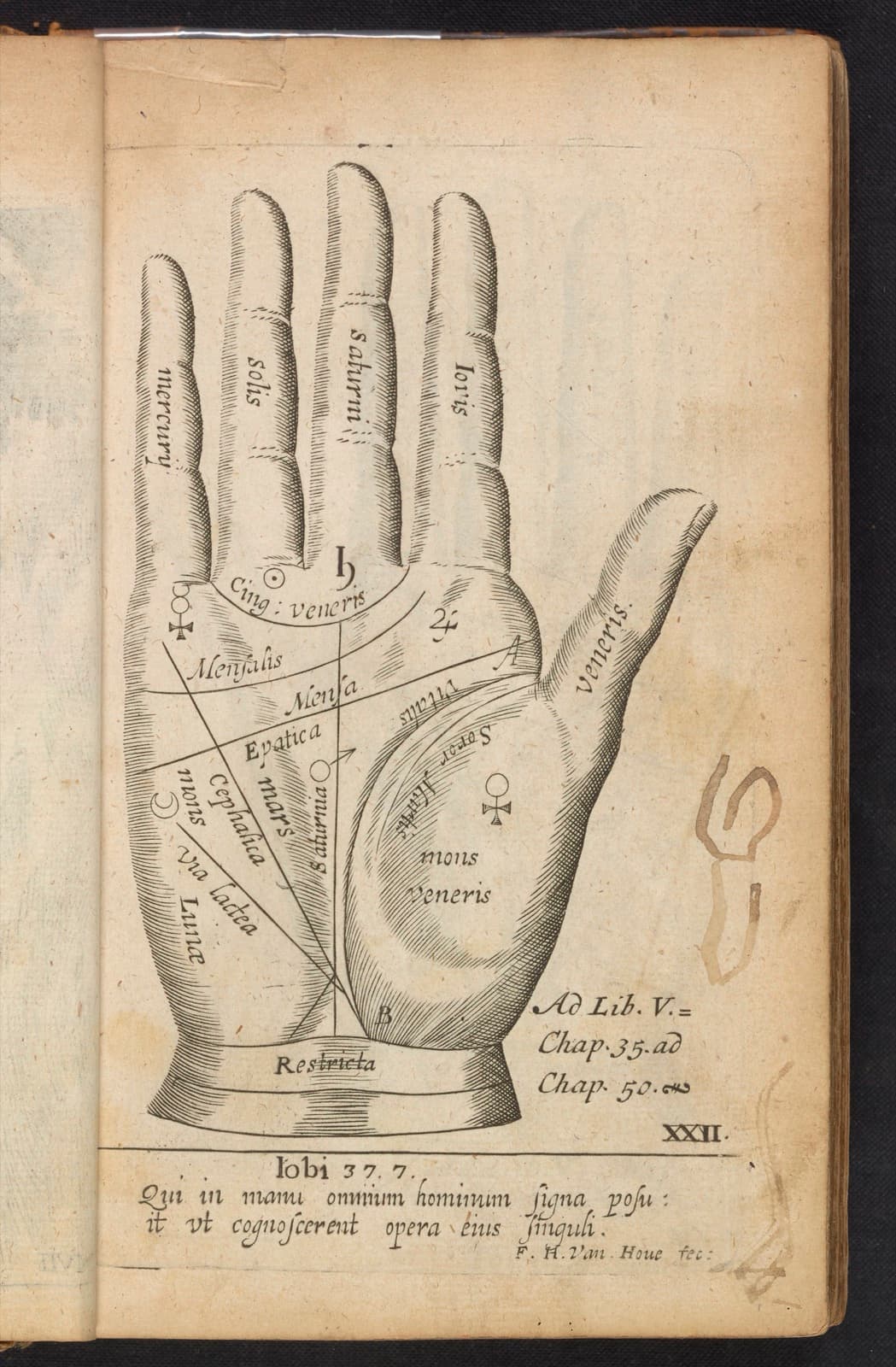
The three main lines often mentioned are the Life Line, Head Line, and Heart Line, forming the core analytical framework. But on the hand, according to folk belief, there are up to 12 palm lines, and a traditional reading must also observe overall hand shape, finger length, skin texture, and fleshy mounts named after planets such as Mount of Venus, Mount of Jupiter, Mount of Saturn, and Mount of Moon.
The Fate Line is a typical example of an important secondary line not among the three. It starts near the wrist, runs straight up toward the middle finger, and is said to relate to career and success. A clear, deep Fate Line combined with a long Head Line is said by many documents to indicate a person who will achieve financial success through hard work and persistence. A short Fate Line ending in the middle of the palm is linked to the belief that this person may face financial difficulties in youth, work hard early, but from middle age onward may attain social status and wealth through relentless effort.
Hand and finger shapes are also used to supplement interpretation. A wide, large hand is often linked to a person who spends much time thinking and carefully considering before acting. A small hand is often said to be an active, spontaneous, restless person who prefers action to sitting and thinking. Long fingers suggest a perfectionist, liking perfection, easily bored and wanting to quit when work becomes too simple. Short fingers are often linked to impulsive character, liking to start new things even before finishing old tasks.
Misconception 7: Applying One School to Every Hand
This is a systemic misconception covering the six above. Palmistry exists in many schools simultaneously: Eastern schools tied to Daoist philosophy and traditional medicine, where the hand is seen as an extension of the flow of qi and blood; Western schools tied to astrology, where mounts are named after planets; and local folk variants. Each school has its own conventions about the dominant hand, priority order of lines, and interpretation of curvature and depth.
An example of contradiction between sources: the single transverse palmar crease (simian line) in Western palmistry is said to belong to learned and successful people, while in medicine this feature is often seen in people with Down syndrome. This shows the contradiction and lack of scientific basis of these theories.
Even hand shape classification is not consistent: some sources divide into four basic types linked to the four elements Earth, Water, Fire, Air, while others divide by rough shape such as wide large hand and small hand. When a self-reader takes a rule from one school and applies it to a hand originally read by another school, the result is almost certainly distorted.
So How Should We View Palmistry?
The most important thing is to distinguish between reading hand morphology and reading palm lines. While palm lines have no scientific value in predicting fate, hand shape, color, and flexibility can provide some useful information about a person's health and physical characteristics.
For example, a hand with 10 long, slender, flexible fingertips is often linked to a person with dexterity, meticulousness, and patience, qualities needed for the arts. Pale, purplish fingers may be a sign of respiratory or circulatory problems, requiring medical examination. Red, spotted palm skin may be a sign of high blood pressure, requiring blood pressure measurement rather than palmistry interpretation.
From a cultural and psychological perspective, palmistry can be seen as a tool for self-reflection and self-review. Personality descriptions based on palm lines are often quite general, applicable to many people, so they should be seen as reference suggestions rather than absolute judgments. It is important not to let palmistry interpretations govern important life decisions such as finance, health, or career. Positive thinking and right action are the factors that truly shape each person's fate. If curious, try observing your hand as a way to understand yourself better, but always keep an open and scientific spirit.
FAQ
1. Is a short Life Line a sign of early death? No. In many schools, the Life Line does not reflect lifespan but vitality, physical health, and major turning points. A short line is said to reflect less abundant energy or introversion, not early death.
2. When reading your own palm, should you look at the left or right hand? There is no consensus. One view: left hand for past life, right for present and future. Another: the non-dominant hand shows innate traits, the dominant hand shows what one has created. Western tradition often uses the dominant hand as the main hand.
3. Does a long Head Line mean you are smarter than others? No. Length alone is not enough; depth, clarity, breaks, and relation to other lines matter. Scientifically, palm lines are skin folds with no proven link to intelligence; assessing intelligence requires actual behavior and standardized tests.