



Image: Wellcome Collection (Public Domain)
TL;DR: Reading faces is a method of observing features of the face, hands, and body to infer personality and destiny according to Eastern concepts. The main systems of facial positions include Ngũ Quan, Ngũ Nhạc, Lục Phủ, Tứ Độc, Tam đình, and Ngũ hành hình. This is traditional knowledge for reference, not scientifically verified; theories such as Lombroso's "born criminal" and machine learning models that predict criminality from face photos have been rejected or criticized.
What is face reading? The main features in physiognomy
What is face reading and where does it come from?
Face reading is the method of observing physical features, mainly the face and the hands, to infer a person's character, life tendencies and the phases of their life. In Eastern physiognomy, the face is seen as a mirror reflecting the inner self and destiny, while the hand is likened to a miniature map of a life. This is long-standing traditional knowledge, offered for reference, and it has not been verified by modern science.
In China, the art of face reading (physiognomy, Mian Xiang) dates back to ancient times, tied to the theory of Yin Yang and the Five Elements, and was once used to choose marriage partners and to assess candidates for official posts. To follow the cultural background and the place of physiognomy in Vietnamese life, you can read more in the article Where Does Physiognomy Come From: The History of Eastern Face Reading and Its Place in Vietnamese Culture. The ancients believed that "physiognomy arises from the mind", meaning that the inner self and one's way of living can gradually shape the facial features, the spirit and the outward appearance.
Comparison table of the main feature systems and theories in physiognomy according to the article.
| System | Number of features | Components | Main meaning |
|---|---|---|---|
| Ngũ Quan (Five Officials) | 5 | Eyebrows, eyes, nose, mouth, ears | Longevity, emotions, wisdom, wealth, blessings |
| Ngũ Nhạc (Five Peaks) | 5 | Forehead, bridge of the nose, chin, two cheekbones | Wisdom, middle age, later life, power |
| Lục Phủ (Six Palaces) | 6 | Two forehead bones, two cheekbones, two jawbones | Relations with superiors, power, endurance in later life |
| Tứ Độc (Four Rivers) | 4 | Ears (Giang), eyes (Hà), mouth (Hoài), nose (Tế) | Four "rivers" on the face, which should be open, deep and clear |
| Tam đình (Three Courts) | 3 | Upper, middle and lower parts of the face | Youth, middle age, later life |
| Ngũ hành hình (Five Element types) | 5 | Kim (Metal), Mộc (Wood), Thủy (Water), Hỏa (Fire), Thổ (Earth) | Character and career tendencies |
| Main palm lines | 3 | Sinh Đạo (Life Line), Trí Đạo (Head Line), Tâm Đạo (Heart Line) | Vitality, thinking, emotions |
| Ngũ âm (Five Tones) | 5 | Cung, Thương, Giốc, Chủy, Vũ | Timbre, pitch, rhythm |
What are the main features on the face?
The face is the centre of physiognomy, divided into many different systems of features. Each system has its own names and its own way of interpretation, but all aim to describe the connection between outward shape and aspects of life.
The commonly encountered groups of features include:
- Ngũ Quan (Five Officials): the five main organs, namely the eyebrows, eyes, nose, mouth and ears.
- Ngũ Nhạc (Five Peaks): the five raised areas of the face, namely the forehead, the bridge of the nose, the chin and the two cheekbones.
- Lục Phủ (Six Palaces): six bone areas and important positions, namely the two forehead bones, the two cheekbones and the two jawbones.
- Tứ Độc (Four Rivers): the four "rivers" on the face, namely the ears, eyes, mouth and nose.
- Tam đình (Three Courts): divides the face into three parts, upper, middle and lower, corresponding to the phases of youth, middle age and later life.
In addition, features such as moles, wrinkles, skin colour and the spirit of the eyes are also considered supplementary signs when interpreting a face.
What are the Ngũ Quan and the meaning of each feature?
Ngũ Quan (Five Officials) is the system of five features most often mentioned in physiognomy. Each feature is given a symbolic name and reflects a different group of aspects of life.
The eyebrows are called Bảo Thọ quan (the Official of Longevity), usually linked to longevity, emotions and social relationships. The eyes are Giám Sát quan (the Official of Inspection), representing wisdom, character and fortunes, in which the spirit of the eyes is valued more than their shape. The nose is Thẩm Biện quan (the Official of Judgement), tied to wealth, career and willpower. The mouth is Xuất Nạp quan (the Official of Intake and Output), reflecting speech and blessings. The ears are Thái Thính quan (the Official of Hearing), symbolising blessings, wisdom and longevity.
Reading each feature depends not only on size but also on balance, colour, lustre and harmony with the face as a whole.
How do Ngũ Nhạc and Lục Phủ differ?
Ngũ Nhạc and Lục Phủ are two systems for dividing the face that overlap in many points but are interpreted differently. Ngũ Nhạc emphasises the five raised areas, likened to five mountains on the face, each representing an aspect of life.
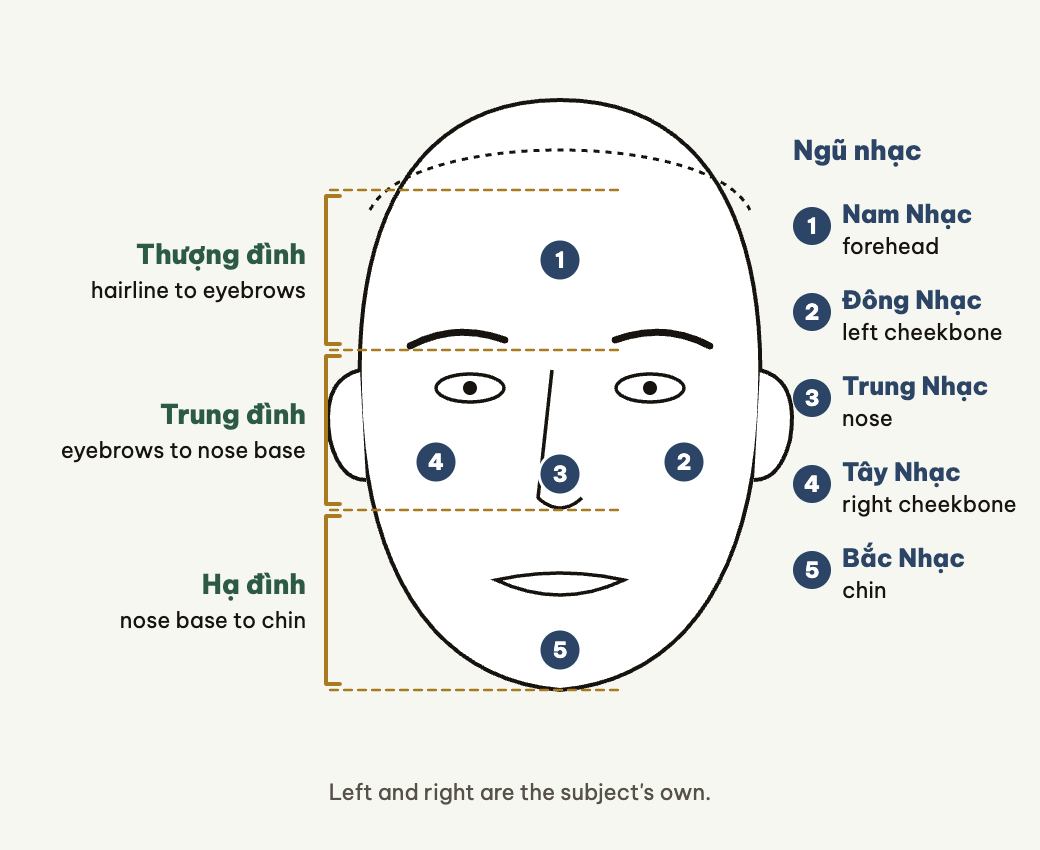
In Ngũ Nhạc, the forehead is Nam Nhạc (Southern Peak), symbolising wisdom and the fortunes of youth. The bridge of the nose is Trung Nhạc (Central Peak), representing middle age and career. The chin is Bắc Nhạc (Northern Peak), reflecting later life and stability. The left cheekbone is Đông Nhạc (Eastern Peak) and the right cheekbone is Tây Nhạc (Western Peak), linked to power, career and relationships.
Lục Phủ consists of the two forehead bones (Thượng Phủ), the two cheekbones (Trung Phủ) and the two jawbones (Hạ Phủ). This system is usually used to assess relations with superiors, personal power and endurance in later life.
Besides Ngũ Nhạc and Lục Phủ, physiognomy books also mention Tứ Độc. Tứ Độc are the four "rivers" on the face: the ears are Giang, the eyes are Hà, the mouth is Hoài, the nose is Tế. Physiognomy books require these four places to be open, deep and clear. One should distinguish the concept of Tứ Độc from the combined understanding of the four sides of the face (forehead, chin, two cheeks) that some folk materials confuse; according to old physiognomy books, the four "rivers" are the content of Tứ Độc.
How do Tam đình and the five element types influence face interpretation?
Tam đình is the way of dividing the face into three parts vertically: the upper part from the hairline to the eyebrows, the middle part from the eyebrows to the base of the nose, the lower part from the base of the nose to the chin. Each part corresponds to a phase of age and a group of aspects such as wisdom, career and later life. Balance among the three parts is considered a sign of harmony.
As for age, the upper court (from the hairline to the eyebrows) corresponds to roughly 15 to 30 years old; the middle court (from the eyebrows to the tip of the nose) to roughly 31 to 50 years old; the lower court (from the tip of the nose to the chin) from about 51 years old onward. For the period from 1 to 14 years old, physiognomy books usually look at the two ears. This is a common division in physiognomy books; some materials record slightly different transition points, so when reading one should compare with the specific source.
Ngũ hành hình (Five Element types) is the way of classifying people according to the five elements Kim (Metal), Mộc (Wood), Thủy (Water), Hỏa (Fire) and Thổ (Earth) based on physical features, face, skin colour and character. People of the Kim type are usually square and upright. People of the Mộc type are tall and slender, flexible. People of the Thủy type are full and gentle. People of the Hỏa type have sharp features and are quick. People of the Thổ type are solid and loyal. Each element type has its own interpretation of character and career tendencies.
What are the main lines in palm reading?
Palm reading is the branch of physiognomy that focuses on the crease lines on the palm. The three main lines usually mentioned are the Sinh Đạo (Life Line), the Trí Đạo (Head Line) and the Tâm Đạo (Heart Line). There are also secondary lines such as the Vận Mệnh (Fate Line), the Hôn Nhân (Marriage Line), the Tài Lộc (Wealth Line) and many other small branches.
The Sinh Đạo line is usually understood to reflect vitality and overall health, not simply a forecast of lifespan. The Trí Đạo line relates to thinking, logic and creativity. The Tâm Đạo line reflects the way one loves and connects emotionally. The Vận Mệnh line is tied to work and advancement. Each line is read based on length, depth, clarity, starting point and secondary branches.
It should be noted that palm lines can change over time due to habits, work and health, so the traditional way of reading also emphasises flexibility rather than fixity.
How are moles on the face and body interpreted?
Moles are one of the signs that folk physiognomy pays attention to. The position, size, colour and prominence of a mole are said to reveal different aspects of character and destiny. Moles on the face are usually tied to the phases of life and social relationships. Moles on the eyebrows, cheekbones, lips, chin, ear rim or the back of the neck all have their own interpretations.
Moles on the body, such as on the chest, the palm of the hand or the sole of the foot, are also considered special signs. However, this is a folk belief offered for reference, and it should not be taken as a firm statement about wealth, health or marriage. Many moles should be observed medically if there are unusual changes in colour or size.
What role do the voice and the five tones play in face reading?
Besides physical shape, the voice is also part of Eastern physiognomy. Ngũ âm (Five Tones) consists of five types of voice corresponding to the five elements: Cung (Thổ), Thương (Kim), Giốc (Mộc), Chủy (Hỏa) and Vũ (Thủy). Each type of voice is described by its own timbre, pitch and rhythm.
The Cung voice is deep, thick and far-reaching, usually linked to loyal and kind people. The Thương voice is clear and decisive, linked to a noble temperament. The Giốc voice is high, resonant and clear. The Chủy voice is high, quick and distinct. The Vũ voice is deep, melodious and gentle. The ancients held that the voice can reveal something of a person's character and temperament, but this remains a traditional belief that should be viewed with caution.
What does modern science say about face reading?
Modern science does not support inferring a person's character or destiny from facial features. In the late 19th century, the criminologist Cesare Lombroso used features such as a sloping forehead, high cheekbones, protruding ears and large incisors to identify "born criminals"; this theory was rejected as one-sided and discriminatory. In 2016, Wu Xiaolin and Zhang Xi (Shanghai Jiao Tong University) published a study using a machine learning model to predict "criminals" from face photos. In 2017, Blaise Agüera y Arcas and Margaret Mitchell (Google), together with Alexander Todorov (Princeton University), criticised this study as physiognomy in new clothes, with biased data and unreliable conclusions. Those rebuttals show that the connection between appearance and character is far more complex than a few facial features.
Therefore, when studying physiognomy, you should regard it as a cultural lens for reflection, not as a tool of certain prediction.
How should face reading be understood correctly?
Face reading is a branch of traditional Eastern knowledge, with cultural and reference value. The conclusions in physiognomy are based on observation and folk experience, and have not been verified by modern science. Therefore, those who study it should regard it as a cultural perspective, not as a tool of certain prediction about wealth, health or marriage.
What matters is keeping an open but clear-headed attitude, and not placing absolute faith in any interpretation. Each person's life also depends on effort, choices and specific circumstances, not only on the lines of the face or the hand.
Where does basic face reading begin?
According to the order usually found in physiognomy books: first look at the whole (whether the three courts are balanced, which element type the face belongs to), then at the five peaks, then at each part (eyes, nose, mouth, ears, eyebrows), and finally at the complexion at the time of reading. Each feature is read in relation to the whole face, not in isolation. This way of going from the whole to the details helps avoid looking at just one feature and jumping to a conclusion, because physiognomy books consider harmony among the features more important than a single trait.
Articles in the Face Reading topic
- The Chui (Fire) Voice in Chinese Face Reading - What Your Voice Reveals
- Earth Tone Voice in Chinese Face Reading - What Your Voice Reveals
- Jue (Wood) Voice in Chinese Physiognomy - What Your Voice Reveals
- The Shang (Metal) Voice in Chinese Physiognomy - What Your Voice Reveals
- Vu (Water) Voice in Chinese Face Reading - What Your Voice Reveals
- Lower Mansion (Jawbones) in the Six Mansions - Significance in Physiognomy
- The Mouth (Xuất Nạp Quan) in the Five Senses: Gateway of Fortune and Speech
- The Nose (Shen Bian Guan) in the Five Senses - Eastern Physiognomy
- The Eyes (Giám Sát Quan) in the Five Senses: Eastern Physiognomy
- Fire Physiognomy in Face Reading: Key Identifying Traits
- The Kim type person in physiognomy - identifying features
- Earth Shape People in Physiognomy: Identification Traits and In-Depth Interpretation
- Water Shape Physiognomy in Chinese Face Reading: Key Identifying Traits
- Moles on the cheekbones: meaning according to folk physiognomy
- Moles on the sole of the foot: meaning according to folk physiognomy
- Moles on the palm of the hand: meaning according to folk physiognomy
- Moles on the eyebrows: meaning according to folk physiognomy
- Moles on the lips and chin: meaning according to folk physiognomy
- Moles on the chest: meaning according to folk physiognomy
- Moles on the back of the neck: meaning according to folk physiognomy
- Moles on the ear rim: meaning according to folk physiognomy
- Upper Palace (Temporal Ridges) in the Six Palaces - Significance in Chinese Physiognomy
- Trung Nhạc (Nose Bridge) in the Five Peaks: Position and Meaning on the Face
- Trung Phủ (Cheekbones) in the Six Palaces - Significance in Chinese Physiognomy
- Western Mountain (Right Cheekbone) in the Five Mountains - Position and Meaning on the Face
- What is palm reading: how the palm lines are read and why they cannot predict the future
- Face reading through the chin according to physiognomy
- Face reading through the cheekbones according to physiognomy
- Face reading through the eyebrows according to physiognomy
- The map of moles on the face according to Vietnamese folk belief and the points where versions disagree
- Face reading through the ears according to physiognomy
- Face reading through the forehead according to physiognomy
- Reading destiny through the palm according to Eastern belief: decoding the main palm lines
- Đông Nhạc (Left Cheekbone) in the Five Peaks: Position and Meaning on the Face
- The Hôn Nhân (Marriage) line in palm reading: meaning and how to read it
- The Life Line in Palmistry: Meaning and How to Read It
- Career Line in Palmistry: Meaning and How to Read It
- What Is the Head Line in Palmistry? Where It Is and How to Read It
- The Money Line in Palmistry: Meaning and How to Read It
- The Tình Duyên (Love) line in palm reading: meaning and how to read it


