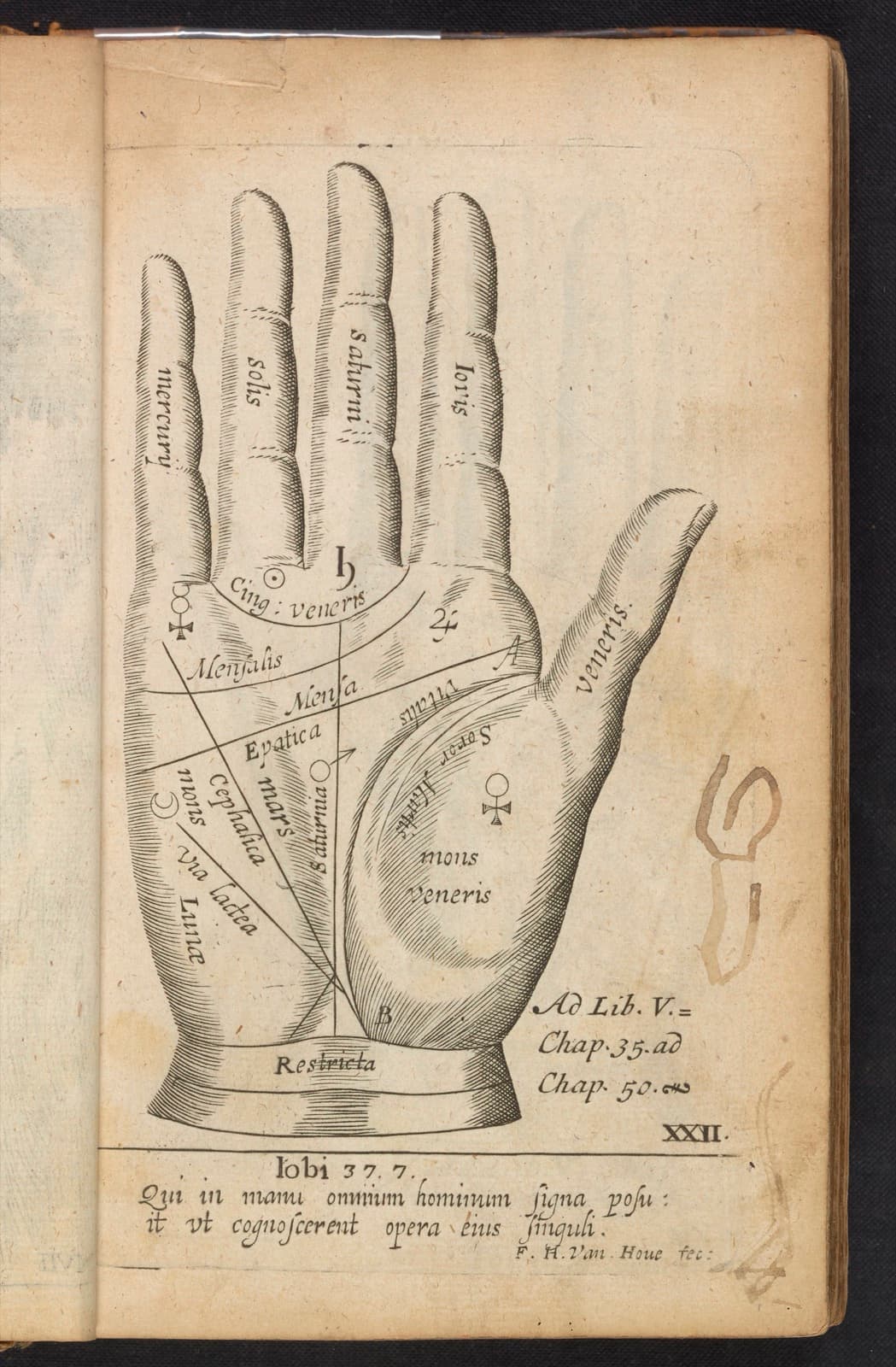
Why read the whole hand instead of individual lines?
In Eastern palmistry, the palm is likened to a miniature map of personality and destiny. Notably, both classical texts and modern articles stress one principle: no line stands alone. The Head Line only truly means something when placed beside the Life Line, Heart Line, Fate Line and Marriage Line. A long Head Line accompanied by a faint Life Line gives a very different picture than the same Head Line with a clear Life Line.
Reading holistically helps avoid two common traps. The first is the "one line decides everything" trap, looking at a single stroke and concluding about the whole person. The second is the "a nice line means good fortune" trap, ignoring that each line reflects only one aspect and those aspects interact. This is also the spirit repeated across references on the Head Line, Love Line, Career Line, Marriage Line and Wealth Line: read the whole, not just one line.
The five major lines and their basic positions
Before practicing, correctly identify the five lines to observe. This is the foundation; getting it wrong throws off every later step.
- Heart Line (Love Line): a horizontal line in the upper palm, just below the fingers, usually starting under the index or middle finger and running toward the edge of the hand below the little finger. It sits above the Head Line.
- Head Line (Wisdom Line): a horizontal line in the middle of the palm, starting between the index finger and thumb, extending toward the edge of the hand below the little finger.
- Life Line: a line curving around the base of the thumb, extending down to the wrist.
- Fate Line (Career Line): a vertical line running along the palm, usually starting near the wrist, the middle of the palm or from the Mount of Moon, heading up toward the middle finger.
- Marriage Line: a horizontal crease at the edge of the hand, below the base of the little finger, just above the Heart Line, usually crossing the Mount of Mercury.
Beyond the five major lines, practitioners should know a few supporting lines for cross-checking: the Sun Line (success line, under the ring finger), the Moon Line (intuition line) and branches from the Mount of Moon. These do not determine conclusions but help clarify the picture when the five major lines give conflicting signals.
Preparation before practicing
This is preparation, not an offering ritual. Palm reading is a cultural self-reflection activity; no offering tray, no incense needed. The list below is what helps a self-reading session go smoothly.
- Natural light or bright enough lighting, avoiding backlight that blurs skin creases.
- A clean flat surface to rest the hand, such as a tabletop, helping the hand relax rather than tense up.
- Paper and pen to note each line's features, avoiding relying on memory, which is easily confused.
- A magnifying glass if eyesight is poor, since many small creases and branches are only clear when enlarged.
- Photos or hand drawings of both your hands, taken under the same lighting, for later comparison.
- A quiet, uninterrupted stretch of time, since holistic observation needs continuous focus.
- A relaxed mindset: treat this as a cultural reference activity, not a fortune-telling session.
General safety note: if lighting candles or incense for atmosphere, place them away from flammable materials, keep children and pets away, and extinguish them completely before leaving the room. There is no mandatory requirement to burn candles or incense in this activity.
Steps for reading the whole hand
Step 1: Identify the dominant and non-dominant hand
In most palmistry schools, the dominant hand (writing hand) is read for what is happening and where things are heading, while the non-dominant hand shows potential and innate qualities. For the Marriage Line, the same rule applies: if the line on the dominant hand differs clearly from the non-dominant, older sources say the person is actively changing their romantic destiny rather than letting it take its course.
The first task is to photograph or draw both hands. Do not rush to conclude. The goal of this step is only to record the differences between the two sides.
Step 2: Observe each line by four fixed criteria
For each of the five major lines, record four features in the same order to avoid omissions:
- Length: how far the line extends, whether it reaches its target area.
- Depth and clarity: bold and clear or faint, continuous or broken.
- Curvature: straight, slightly curved, or strongly curved, and in which direction.
- Special marks: small islands, branches, breaks, cross lines, overlapping lines.
Example with the Head Line: a long, clear, straight line is often linked to logical, practical thinking that gets straight to the point. A line curving slightly toward the Mount of Moon is often linked to creativity and intuition. A line curving too far to touch the Mount of Moon suggests rich imagination. A broken line can symbolize a period of change in thinking. A small island is sometimes seen as a sign of temporary mental stress.
With the Heart Line: a long, clear line is often linked to a romantic, sincere person capable of deep commitment. A short line suggests someone who shows little emotion outwardly. A deep, bold line links to intense emotion. A thin, shallow line links to a tendency to suppress feelings. The starting point also matters: starting under the index finger links to high demands in love, under the middle finger to practicality, and between the index and middle fingers is considered the most balanced position.
With the Fate Line: a long, clear line is often linked to clear goals and hard work. A short line visible only in the middle of the palm is often linked to having to work hard from an early age. A faint, broken line links to interruptions, job changes or career redirection. Multiple parallel lines suggest diverse income sources. A line starting from the Mount of Moon suggests creativity, suited to art, media or independent business.
With the Marriage Line: a clear, deep, moderately long line is usually seen as a sign of a lasting relationship. A short, shallow, faint line suggests a relationship struggling to reach marriage or lacking deep bonding. A line curving up toward the little finger links to a tendency to marry late. A line curving down toward the Heart Line suggests a relationship heavily governed by emotion. A broken line links to interruptions in relationships. Multiple parallel lines are usually read with the clearest one as the main relationship.
With the Life Line: this is the line curving around the base of the thumb. Its clarity and length are important variables when compared with other lines, especially the Head Line and Fate Line.
Step 3: Cross-check pairs of directly interacting lines
This is the core step that turns reading individual lines into reading the whole hand.
- Head Line and Life Line pair: if the Life Line is clear and the Head Line long, many references say the person can achieve wealth through their own effort. If the Life Line is short and faint, the reader may conclude the person needs more effort in early life.
- Heart Line and Head Line pair: the two lines close together suggest a person tends to let the heart rule the head. Far apart suggests a rational person who separates emotion from thought. Connected by a small branch is seen as a good sign, showing balance between reason and heart.
- Fate Line and Heart Line pair: when the Fate Line crosses the Heart Line, this can show career and love life interact strongly. If the crossing is clear, the person may marry a colleague or have work affected by romance.
- Fate Line and Life Line pair: if the Fate Line originates inside the Life Line, the person tends to be influenced by family in career choices, or works in a family business. If the Fate Line is completely separate from the Life Line, they tend to be independent and take their own path.
- Marriage Line and Heart Line pair: if the Marriage Line extends and touches the Heart Line, some old books interpret that emotion and marriage are intricately intertwined, prone to conflict between reason and feeling. This is only a symbolic interpretation, not a prophecy.
Step 4: Bring in supporting lines to clarify the picture
When the five major lines give conflicting signals, supporting lines help clarify. For example, a slightly curved Head Line combined with a prominent Moon Line may suggest good intuition and creative ability at work. A clear Sun Line (success line) under the ring finger suggests the ability to gain renown in one's chosen field. Branches from the Mount of Moon running toward the middle of the palm are often linked to rich imagination and potential for leading one's own business.
Step 5: Compare both hands and record tentative conclusions
After observing each line, cross-checking line pairs and bringing in supporting lines, compare the two hands. The difference between dominant and non-dominant hand is important data, especially for the Marriage Line and Fate Line. Record tentative conclusions in descriptive language, avoiding absolute words like "certainly" or "destiny is fixed".
Step 6: Turn results into self-reflection questions
This step turns palm reading into a useful tool rather than fortune-telling. For example, if the Fate Line is broken, instead of concluding "career will break", ask yourself: am I going through a redirection phase, what have I prepared for the next phase. If the Head Line is long and clear, a fitting question is whether I am using my analytical strength in my current work. This shift keeps the spirit objective and avoids extreme superstition.
Summary table of line pairs and reference interpretations
| Line pair | Observed feature | Reference interpretation |
|---|---|---|
| Head Line and Life Line | Clear Life Line, long Head Line | Success through own effort |
| Head Line and Life Line | Short, faint Life Line | More effort needed in early life |
| Heart Line and Head Line | Two lines close together | Emotion rules reason |
| Heart Line and Head Line | Two lines far apart | Reason separate from emotion |
| Heart Line and Head Line | Connected by small branch | Balance between reason and heart |
| Fate Line and Heart Line | Fate Line crosses Heart Line | Work and love interact strongly |
| Fate Line and Life Line | Fate Line originates inside Life Line | Family influence in career choice |
| Fate Line and Life Line | Fate Line separate from Life Line | Independent, own path |
| Marriage Line and Heart Line | Marriage Line touches Heart Line | Complex intertwining of emotion and marriage |
Common mistakes when self-reading the hand
- Reading one line and concluding about the whole person: the most common mistake. References all stress the Head Line, Fate Line and Marriage Line do not stand alone but must be considered in relation to other lines.
- Treating long, bold lines as "good" and short, faint lines as "bad": with the Marriage Line, a long, deep line is not necessarily good; it simply reflects the degree of influence and importance of the relationship in that person's life.
- Ignoring the difference between the two hands: this is important data, especially when the dominant hand differs clearly from the non-dominant.
- Forgetting to take notes: memory is easily confused when observing many lines at once; notes help more objective comparison.
- Using absolute statements: references all note this is reference knowledge, without absolute scientific value.
Scientific perspective and staying objective
It must be stressed that from a scientific standpoint, palm lines are actually skin creases formed by the folding and extending of the hand. They can differ between people due to genetics and chance, but no scientific evidence proves a link between palm line shapes and a person's destiny or intelligence. Doctor Do Minh Tuan in an article in Tuoi Tre newspaper pointed out that palm lines are actually just skin creases of the knuckles, hand and wrist.
Therefore, reading the whole hand should be seen as a form of cultural self-reflection, a way to look back at oneself more consciously. Assessing a person's ability, intelligence or prospects should be based on actual behavior, study and work results, and standardized psychological tests. Palm reading articles in major newspapers like VnExpress also often end with a note that this fun quiz is for entertainment only and has no scientific value.
One more point to note: this activity can vary by region, family and school. No reading is "the only correct one". Practitioners should state the origin of the view they use and stay open to other interpretations.
Conclusion
Reading the whole hand instead of individual lines is the core principle of Eastern palmistry. The process has six steps: identify dominant and non-dominant hand, observe each line by four fixed criteria, cross-check directly interacting line pairs, bring in supporting lines to clarify, compare both hands and record tentative conclusions, and finally turn results into self-reflection questions. The whole process should only be seen as a cultural reference and self-reflection tool, not a prophecy deciding the future. The future lies in each person's actions, attitude and perseverance, not in a crease on the palm.