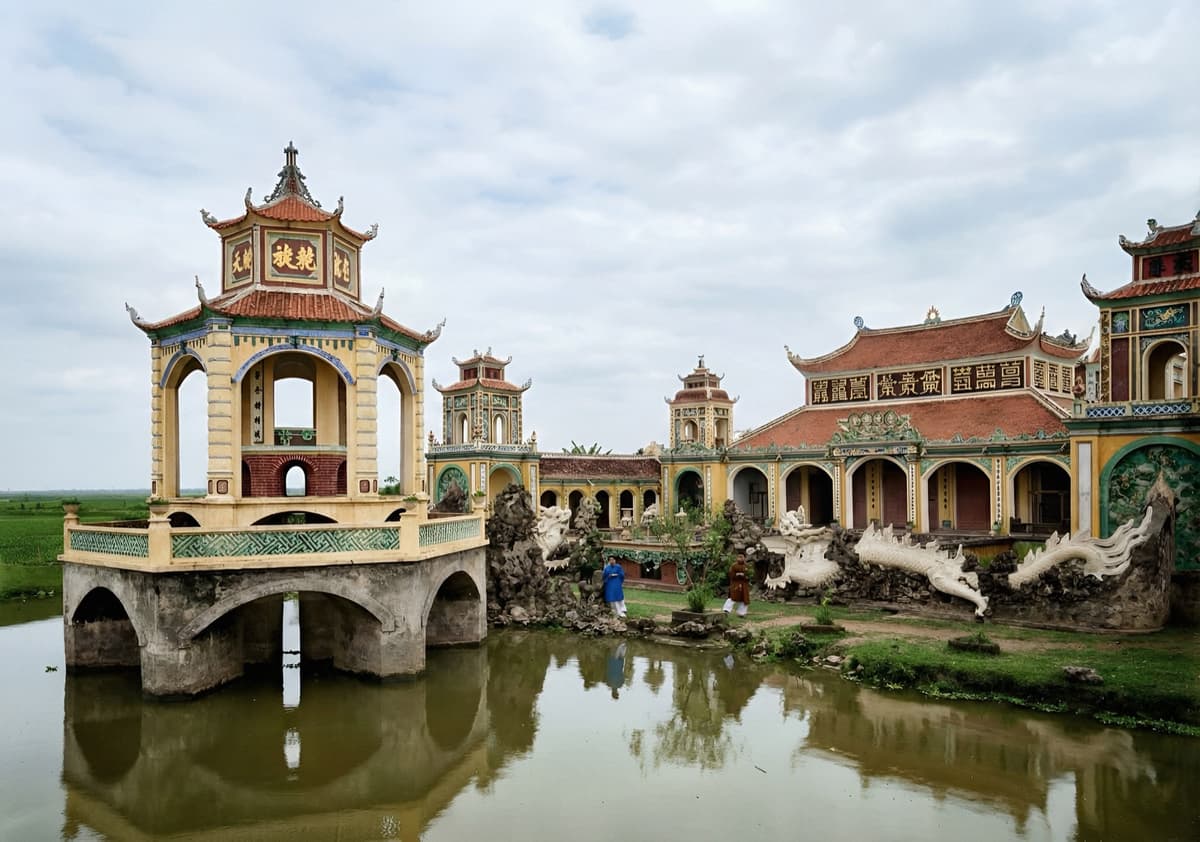
The Rain Praying Festival in Hung Yen: The Aspiration for Favorable Weather
The Rain Praying Festival, also known as the Tu Phap Festival, takes place in Lac Hong commune, Van Lam district, Hung Yen province. It is a representative intangible cultural heritage of wet-rice agricultural civilization in Vietnam's Northern Delta.
Origins and Legend of the Four Dharma Goddesses
The worship of the Four Dharma Goddesses (Tu Phap) in Lac Hong shares core elements with the legend from the Dau region in Bac Ninh. However, a unique version exists here. According to the legend, people from the Dau region cut a large branch from a Dung tree into four pieces for sale. Residents of Thai Lac canton bought three pieces and planned to buy the last one in the afternoon. At noon, when testing the carrying pole, the pole and the wood suddenly flew away to join the earlier group. People from Luy Lau chased after them, but wherever the carriers went, rain poured down. Seeing this as a divine sign, the Dau people allowed the Thai Lac residents to keep all four pieces.
The locals hired two craftsmen, Đao Kham and Đao Luong, to carve the four wood pieces into four small mother statues. Interestingly, the craftsmen carved during the day at Thai Lac pagoda but slept at night at Un pagoda (now in Dinh Du commune). Therefore, in ancient festivals, the procession had to stop at Un pagoda for one night. During the Mac dynasty, based on these models, villagers carved four larger statues from jackfruit wood, which are still worshiped today.
The four statues are enshrined in four separate pagodas: Phap Van at Thai Lac pagoda (called Ba Ca), Phap Vu at Hong Cau pagoda (Ba Que), Phap Loi at Nhac Mieu pagoda (Ba Hue), and Phap Dien at Pham Thai pagoda (Ba Tong). Each goddess represents a natural phenomenon: cloud, rain, thunder, and lightning.
Scale and Timing
Historically, the festival covered the entire Thai Lac canton. It was not held on a fixed schedule but depended on natural conditions, mainly during prolonged droughts. The festival continued until 1943 when it was interrupted by war and other reasons. In 2005, it was restored following ancient procedures and rituals. Today, it is held annually from the 6th to the 8th day of the third lunar month, centered at Thai Lac pagoda.
Key Rituals
#### Preparation Ceremonies
Before the festival, the four pagodas are cleaned and decorated. Strong young men from families without mourning obligations are chosen as palanquin bearers. They wear no shirts and loincloths woven from rope, decorated with fabric, chrysanthemum flowers, and beads. On the morning of the 5th day, the pagodas perform the opening ceremony and lower the statues for bathing (moc duc) and robing (phong y). Monks use fragrant five-flavor water and clean cloths to wipe the statues. The robes are then cut into small pieces and distributed as lucky charms. In the evening, elderly women and monks chant sutras praying for good weather.
An interesting detail: in the past, the pagoda opening ceremony lasted 3 days, followed by 3 days of closing, repeated three times for a total of 18 days. Only if rain still did not fall would the procession ceremony proceed.
#### The Palanquin Procession
On the morning of the 6th day, the procession starts from Nhac Mieu pagoda carrying Phap Loi statue to Thai Lac pagoda. The procession includes road-clearers, flag bearers, music troupes, incense altars, and the palanquin escorted by parasol and fan bearers. Sometimes the palanquin runners must sprint while shouting "Hue! Hue! Hue!" (Phap Loi's folk name).
When reaching Hong Cau pagoda, Phap Loi's palanquin retreats to wait for Phap Vu's palanquin. The two goddesses perform a greeting ritual (le ha thu) three times. Phap Vu's palanquin leads, followed by Phap Loi's. They pause to salute the communal house deity at Thai Lac dinh. Historically, Phap Loi's palanquin would leap over a symbolic 1-meter earth wall covered with grass in front of the pagoda.
When the three palanquins meet at Thai Lac pagoda's yard, they exchange greetings in order: Phap Vu first, Phap Loi second, and Phap Van last. They are then placed in position: Phap Van in the middle, Phap Vu in the east, and Phap Loi in the west.
#### The Danh Trang (Moon Beating) Game
In the afternoon, at the communal yard, the Danh Trang game takes place with 50-60 participants. A small drummer wearing a red ao dai and red turban leads, followed by a strong male bearer holding a red flag who shouts commands. The group runs in a snail-shell spiral clockwise, then reverses outward, symbolizing the cosmic rotation and the movement of clouds, rain, thunder, and lightning. They complete three full rounds.
Cultural Significance
The Rain Praying Festival is not merely a rain-praying ritual but a symbol of community solidarity in coping with nature. The processions, ceremonies, and folk games carry educational and entertaining value, preserving the cultural identity of Northern Delta farmers. The festival's restoration in 2005 has enabled traditional values to be preserved and promoted in contemporary life.
