
What is Mai Hoa Dich So and where do ti and yong sit in the reading?
Mai Hoa Dich So is an applied branch of the Zhou Yi (I Ching) that uses numbers or external scenes as material to cast a hexagram, then interprets a specific situation. According to HOROS, this method is associated with the name of Shao Kangjie of the Song dynasty, and its name comes from the anecdote of him watching two sparrows fight on a plum branch and reading an omen from it. What sets it apart from a purely philosophical reading of the I Ching is that it turns the I Ching into a tool for interpreting situations: there is a question, a hexagram is cast, and the trend of events is read through that hexagram.
An I Ching hexagram consists of six lines, built from two three-line trigrams: the inner trigram below and the outer trigram above. When casting, there is always one moving line. The position of the moving line determines which trigram is ti and which is yong. This is the key step, because the entire later reading of fortune or misfortune rests on this ti-yong pair.
The rule for identifying ti and yong
The rule is written exactly as follows: the trigram that does NOT contain the moving line is ti, representing the querent; the trigram that CONTAINS the moving line is yong, representing the matter asked about. If the moving line falls in the inner trigram (the lower three lines), then the inner trigram is yong and the outer trigram is ti. If the moving line falls in the outer trigram (the upper three lines), then the outer trigram is yong and the inner trigram is ti.
Note that some search summaries online state this rule in reverse, claiming the trigram containing the moving line is ti. That version does not match the body of the HOROS page itself, which clearly says ti is the trigram without the moving line. Readers should check the original page directly rather than trust a shortened summary, because simply swapping ti and yong flips every fortune or misfortune conclusion.
The eight trigrams with Xian Tian numbers and Five Elements
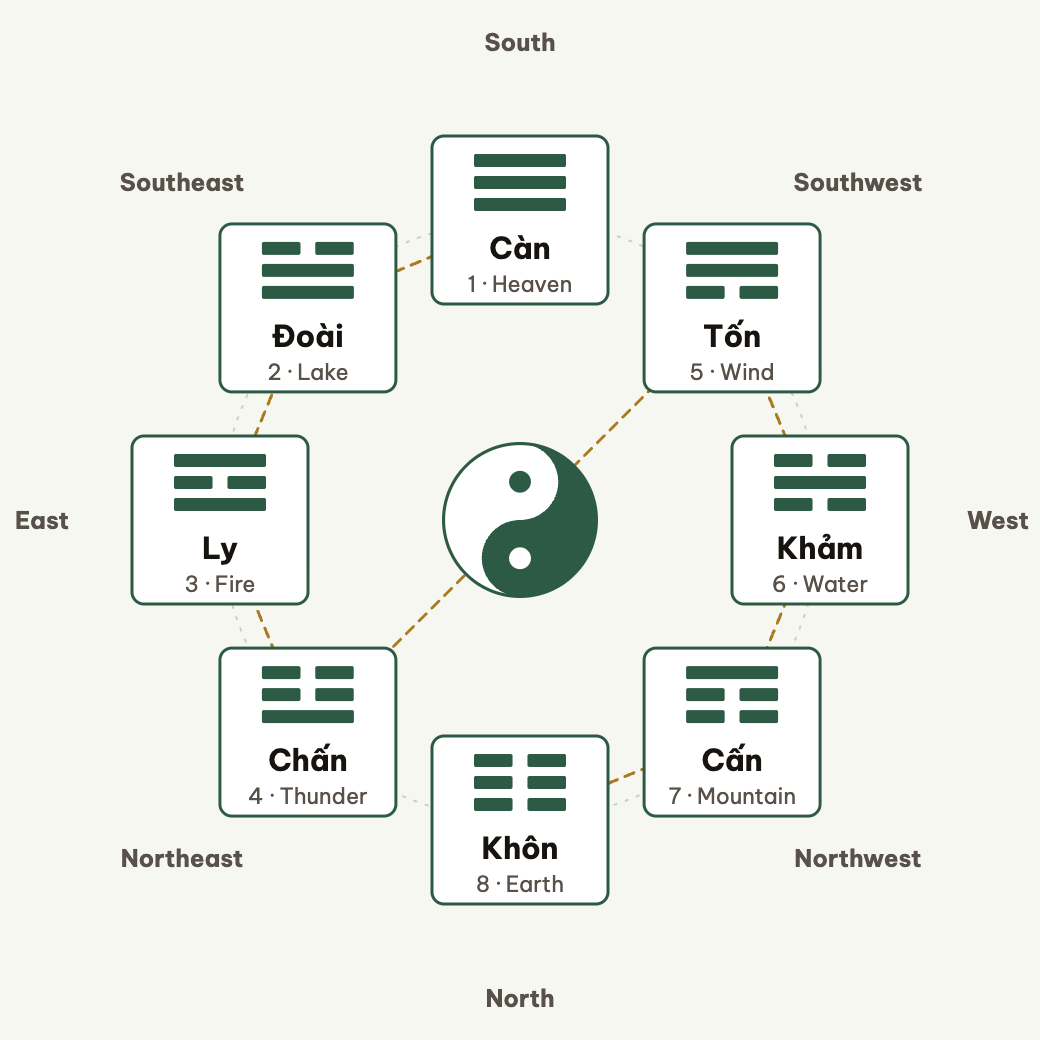
To discuss generating and controlling relations, you first need to know which element each trigram belongs to. Mai Hoa uses Xian Tian numbers to convert a number into a trigram, and the table below is the core the calculation relies on.
| Trigram | Xian Tian Number | Five Element | Direction |
|---|---|---|---|
| Qian | 1 | Metal | Northwest |
| Dui | 2 | Metal | West |
| Li | 3 | Fire | South |
| Zhen | 4 | Wood | East |
| Xun | 5 | Wood | Southeast |
| Kan | 6 | Water | North |
| Gen | 7 | Earth | Northeast |
| Kun | 8 | Earth | Southwest |
This table matches the presentation of the eight trigrams' directions in the I Ching: Kun governs the Southwest, Gen the Northeast, Zhen the East, Xun the Southeast, Li the South, Dui the West, Qian the Northwest, Kan the North. The Five Element assignment of the trigrams is a shared foundation, not exclusive to Mai Hoa; methods such as Liu Yao also use it. According to Kinh Dich tuyen tap volume 6, the Five Element attributes of the eight trigrams are the key to decoding hexagrams in Liu Yao, and identifying which trigram is upper and which is lower helps shape the overall picture before going into detail.
Why Xian Tian numbers matter
Xian Tian numbers are the bridge between the number the user enters and the trigram. The same set of numbers always yields the same hexagram, so repeatability is a feature of the method, not a bug. According to HOROS, if the same hexagram comes up repeatedly, it is a sign that the querent's mind is closely attached to the issue, not that the system is stuck. Besides entering numbers, Mai Hoa also allows casting from external scenes, taking an omen from the first sign appearing around the querent at the moment of arising the question. This is the spirit of the plum branch anecdote.
How do the five generating and controlling relations between ti and yong reveal fortune or misfortune?
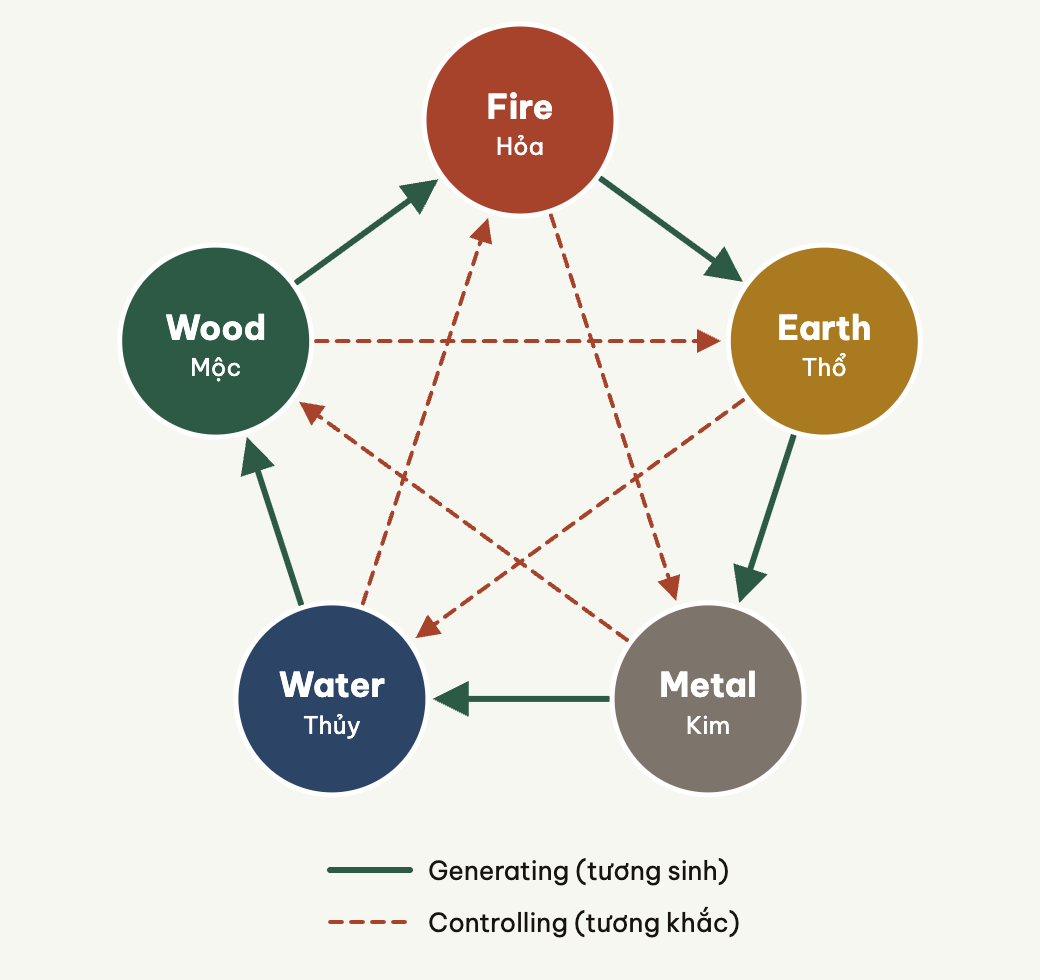
This is the central question of the ti-yong method. After identifying which trigram is ti and which is yong, the reader compares the Five Elements of the two trigrams. There are exactly five possibilities, and each gives a different implication. The table below summarizes the five relations with their commonly used fortune levels.
| Relation | Five Elements | Meaning | Fortune level |
|---|---|---|---|
| Yong generates ti | Yong generates into ti | The matter nourishes the person, external support exists | Favorable, smooth |
| Harmony of equals | Same element | Person and matter are in sync, no clash | Favorable, unobstructed |
| Ti controls yong | Ti controls out to yong | The person can master the matter, but must act | Conditionally favorable, requires initiative |
| Ti generates yong | Ti generates into yong | The person spends energy on the matter, gains little, loses much | Unfavorable, adverse |
| Yong controls ti | Yong controls into ti | The matter presses on the person, pressure from outside | Unfavorable, caution needed |
A concise way to remember is to look at the direction of the generating and controlling flows. When the flow goes into ti (yong generates ti), ti benefits. When both sides share an element (harmony of equals), the balance is even and unobstructed. When ti must control yong, ti wins but must expend effort, so a good result comes only when the querent actually acts. Conversely, when ti generates out to yong, ti is drained, and when yong controls ti, ti is suppressed from outside. This is the common reading and also how HOROS presents it to beginners.
Do not read fortune or misfortune as a verdict
It must be said clearly that the five relations above give a tendency, not a fixed outcome. The same ti-yong pair, placed at a different time or season, has different strength for the two elements. A Metal trigram in autumn is strong, in summer is weak, and the fortune level shifts accordingly. Sources are also not fully consistent on whether seasonal timing must be added. HOROS explicitly says timing must be combined to judge the trend, while many introductory texts stop at the ti-yong pair. Learners should know both approaches and know which one they are following.
What role do the mutual hexagram and the changed hexagram play in the three-stage reading?
A Mai Hoa hexagram is not only the original hexagram. The full reading is usually divided into three layers: the primary hexagram, the mutual hexagram, and the changed hexagram. The primary hexagram is the one initially cast, showing the current situation and the main ti-yong pair. The mutual hexagram is built from the middle lines of the primary hexagram, used to examine internal developments, what is not immediately visible. The changed hexagram is produced after the moving line changes, showing the direction of the ending and later consequences.
These three layers correspond to three stages: beginning, process, and outcome. When reading, experienced practitioners usually read the primary hexagram first to grasp the situation, then the mutual hexagram to understand why events unfold as they do, and finally the changed hexagram to judge the result. If the primary hexagram is good but the changed hexagram is bad, the start is smooth but caution is needed later. If the primary hexagram is bad but the changed hexagram is good, difficulties lie ahead but there is a way out later.
The mutual hexagram is not an arbitrary extra
Some treat the mutual hexagram as mere decoration, but in practice it has its own role. The mutual hexagram takes lines two, three, and four as the inner trigram and lines three, four, and five as the outer trigram, so it sits within the primary hexagram, reflecting the hidden part of the situation. In many cases the primary hexagram looks calm on the surface but the mutual hexagram reveals conflict, and that is where the reader should raise questions.
How do casting by number and casting by external scene differ?
According to HOROS, Mai Hoa has two common casting methods. The first is entering numbers, also called the number method, taking a random number and converting it into the upper trigram, lower trigram, and moving line. The second is observing external scenes, taking an omen from the first sign appearing around the querent at the moment of arising the question. The number source can be the current time, the serial number on the first bill drawn from a wallet, the license plate of the vehicle being ridden, or the page number of a randomly opened book.
The two methods differ in that the number method gives stable, easily verifiable results, while the external scene method depends heavily on the observer's skill and the caster's conventions. This is also a point of disagreement between schools: some read additional external responses around the casting moment, some ignore them entirely and use only the hexagram. There is no common standard forcing one side. Learners should know both exist and choose what suits them, as long as they stay consistent within a single reading.
Is the attribution to Shao Yong certain?
Mai Hoa Dich So is commonly attributed to Shao Yong, also known as Shao Kangjie, a Song dynasty scholar. He lived roughly from 1011 to 1077, with the courtesy name Yaofu, and was famous as a cosmologist, historian, philosopher, and poet with great influence on the development of Neo-Confucianism in the Song era. He was one of the most erudite men of his time, never took office his whole life, and left an important cosmological work, Huang Ji Jing Shi.
According to the English Wikipedia article on Shao Yong, he was a member of the intellectual group gathered in Luoyang during the last three decades of the 11th century, alongside names such as Cheng Yi, Zhang Zai, Cheng Hao, and Zhou Dunyi. The Song era had two main approaches to studying the I Ching. Most scholars followed the meaning-and-principle approach, based on textual and ethical concepts. The other approach, which Shao Yong pursued, leaned toward image and number. Notably, Wikipedia only says Mai Hoa is attributed to him, not that he is the true author. This is where one must be direct: there is no certain evidence that Shao Yong himself wrote the method known today as Mai Hoa Dich So. The attribution may be a later tradition, and readers should distinguish the real historical figure from the work attributed to him.
What should be combined with ti-yong reading to avoid error?
A common error is looking only at the ti-yong pair and concluding immediately, ignoring the mutual hexagram, the changed hexagram, and timing. That approach gives crude and easily wrong results. The full reading should follow this order: identify the moving line, separate ti and yong by the correct rule that the trigram without the moving line is ti, compare Five Elements to get the relation, then expand to the mutual and changed hexagrams to adjust the degree and timing.
Also remember that Mai Hoa is independent of Tu Vi Dau So. Tu Vi relies on birth date and time to examine a whole life, while Mai Hoa relies on the question and numbers at the exact moment of asking, answering only one specific situation. According to HOROS, these are two separate modules, one reading a birth chart, one casting an I Ching hexagram. So do not mix Tu Vi criteria into ti-yong reading, and do not use Mai Hoa results to assert anything about a whole life.
A caveat to keep
However rigorous the method, the result is still a way of reading tendencies based on cultural convention, not a scientific forecast. It should not be used to assert certainty about anyone's finances, health, or fate. Its value lies in helping the querent review the situation and consider before acting.


