What does Nhat Nguyet mean according to Sino-Vietnamese etymology?
Nhat Nguyet is a Sino-Vietnamese pair formed from two single characters: Nhat (日) meaning sun, and Nguyet (月) meaning moon. Combined, Nhat Nguyet refers to the two brightest celestial bodies in the sky, and in classical usage the pair also stands for day and night, light and dark, and the cyclical passage of time.
In modern Vietnamese, Nhat Nguyet is no longer an everyday term. Vietnamese speakers usually say "mat troi", "mat trang", "ong troi", or "chi Hang" in daily life. Nhat Nguyet appears mainly in formal writing, poetry, personal names, terminology in the I Ching, feng shui, and astrology, and in translations of classical Chinese texts.
Why do Vietnamese speakers still keep this pair?
The pair coexists with the native Vietnamese layer for two reasons. First, it carries a formal tone suited to parallel couplets, horizontal plaques, Tang-style regulated poetry, and ritual texts. Second, it is a complete semantic unit: saying "Nhat Nguyet" means naming a pair, a unified whole made of two faces, not two separate objects. This paired quality makes it the most compact device in Vietnamese for expressing yin and yang.
What layers of meaning does Nhat Nguyet carry in East Asian culture?
In East Asian culture, Nhat Nguyet is not merely two celestial bodies. It is a multi-layered symbolic structure used simultaneously in philosophy, religion, calendrics, architecture, and literature.
The yin and yang layer
This is the foundational layer. The sun belongs to yang, the moon to yin. Yang is bright, hot, active, masculine, daytime. Yin is dark, cold, still, feminine, nighttime. Nhat Nguyet is therefore the clearest, most observable yin-yang pair, and the original model from which earlier thinkers reasoned about all other opposing pairs.
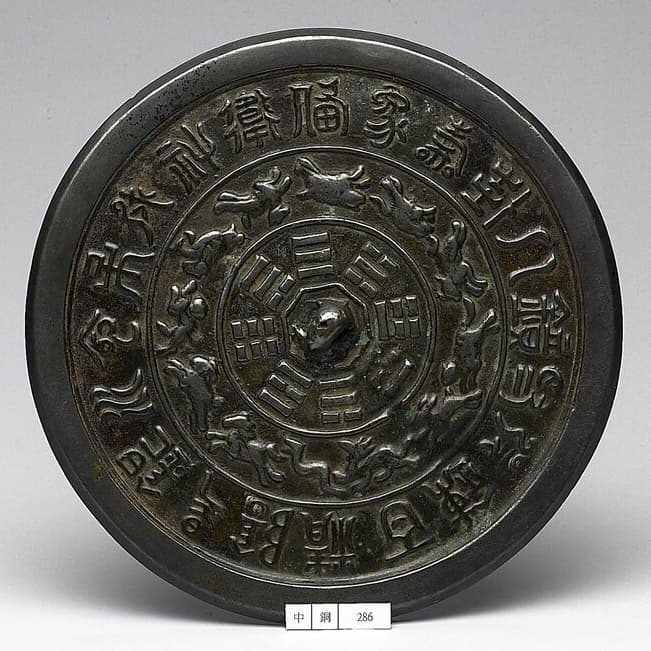
In the I Ching, the Li trigram represents fire and the sun, and the Kan trigram represents water and the moon. These two trigrams occupy the central positions of the Bagua in the Later Heaven arrangement, forming the North-South axis, the axis of light and shadow. This is why in many feng shui diagrams the Nhat Nguyet axis is treated as the basic orienting axis.
The time and calendrical layer
Earlier peoples measured time by the movement of the sun and moon. The sun gives the day, the moon gives the month, and the conjunction cycle of both gives the year. The East Asian lunar calendar, including the Vietnamese lunar calendar, is a system combining both: months follow the moon, and the year is adjusted to the sun through leap months. Nhat Nguyet is therefore a symbol of time itself.
The power and order layer
In classical political thought, the sun was often used as a metaphor for the king, for central power, for the scrutinizing sovereign. The moon was a metaphor for consorts, for ministers, for subordinate ranks. The Nhat Nguyet pair in this context speaks of upper and lower order, of illumination radiating from the center to the periphery. Note that this is a metaphorical usage in classical texts, not a current political doctrine, and today it is mainly mentioned as a cultural phenomenon.
The religious layer
In Buddhism, the images of sun and moon appear as symbols of wisdom and compassion, of illumination that dispels ignorance. In Daoism, Nhat Nguyet is tied to the sun and moon deities and to yin and yang qi in internal alchemy practices. In Vietnamese folk belief, Mr. Sun and Mrs. Moon appear in stories, in folk verses, and in explanations of solar and lunar eclipses.
How is Nhat Nguyet understood in the I Ching and feng shui?
In the I Ching, Nhat Nguyet is not a separate hexagram but a pair of images used continuously in the Tuan and Xiang commentaries and in later annotations. The pair is tied to the Li and Kan trigrams as noted, and also to hexagram 55, Feng, whose name means abundance and grandeur, and which is explained as the sun standing at the center of the sky, blazing like Nhat Nguyet.
In feng shui, the concept of "Nhat Nguyet" appears at a few specific points:
- East and West are associated with sunrise and sunset, that is, the Nhat axis.
- The shapes of land, ponds, and wells are sometimes likened to the moon, that is, the Nguyet image.
- In some schools, the left and right sides of a site are called Azure Dragon and White Tiger, while the front-back axis is associated with Nhat Nguyet in the sense of light and shadow.
It should be stated clearly that these are different interpretive conventions. Feng shui schools do not fully agree on how to assign Nhat and Nguyet to each position, and this article presents only the most common understanding in popular literature, without claiming it is the only rule.
How does Nhat Nguyet appear in names, poetry, and modern life?
In modern life, Nhat Nguyet appears most in three forms.
First, as personal names. Many Vietnamese people name their children Nhat, Nguyet, or combine both into Nhat Nguyet, wishing the child to be bright as the sun and gentle as the moon. In Japanese, the characters 日 and 月 are also the names for day and month, and compounds related to Nhat Nguyet appear densely in modern Japanese.
Second, in poetry and parallel couplets. The Nhat Nguyet pair is one of the most familiar parallel pairs in classical literature, often paired with terms such as mountains and rivers, heaven and earth, or land and nation, forming solemn parallel lines about the cosmos and the country.
Third, in the language of lookup systems such as Eastern astrology, Eastern numerology, feng shui, and the I Ching. Here, Nhat Nguyet is used as a pair of categories for analyzing light and dark, male and female, motion and stillness, not for predicting specific events. These systems, from a cultural studies perspective, are studied as symbolic systems, and they themselves lack scientific basis for asserting a person's fate or finances.
Table comparing the layers of meaning of Nhat Nguyet
| Domain | Nhat (sun) | Nguyet (moon) | Meaning of the pair |
|---|---|---|---|
| Sino-Vietnamese etymology | 日, sun | 月, moon | The two brightest celestial bodies |
| Yin and yang | Yang | Yin | Foundational opposing pair |
| I Ching | Li trigram, fire | Kan trigram, water | North-South axis in Later Heaven Bagua |
| Calendrics | Day | Month | Combined time cycle |
| Classical metaphor | King, central power | Consorts, ministers | Upper and lower order |
| Religion | Wisdom, light | Compassion, gentleness | Illumination dispelling ignorance |
| Everyday life | Male personal name | Female personal name | Wish for brightness and gentleness |
| Feng shui | East, light | Soft shapes, shadow | Interpretive conventions vary by school |
Common misunderstandings about Nhat Nguyet
The most common misunderstanding is to think Nhat Nguyet is simply a flowery way of saying "sun and moon". In fact, the pair carries a whole symbolic system, and in many classical texts the symbolic sense is the primary one, while the literal sense is only the base.
The second misunderstanding is to assign Nhat Nguyet a single fixed meaning. In reality, the meaning shifts by domain: in calendrics it is day and month, in the I Ching it is yin and yang, in poetry it is the cosmos, in personal names it is hope. Readers need to determine the context before choosing an interpretation.
The third misunderstanding is to treat interpretations in astrology and feng shui as scientific truth. These systems are cultural products with research value for the history of thought and symbolism, but they should not be used to make important decisions about health, finances, or marriage.
A quick guide to looking it up
When you encounter the term Nhat Nguyet in a text, you can ask in turn: which domain does the text belong to, is the pair being used literally or symbolically, and what is the parallel phrase around it. These three questions are usually enough to identify the correct layer of meaning. In classical texts, the symbolic sense dominates. In modern texts, the literal or name sense dominates.