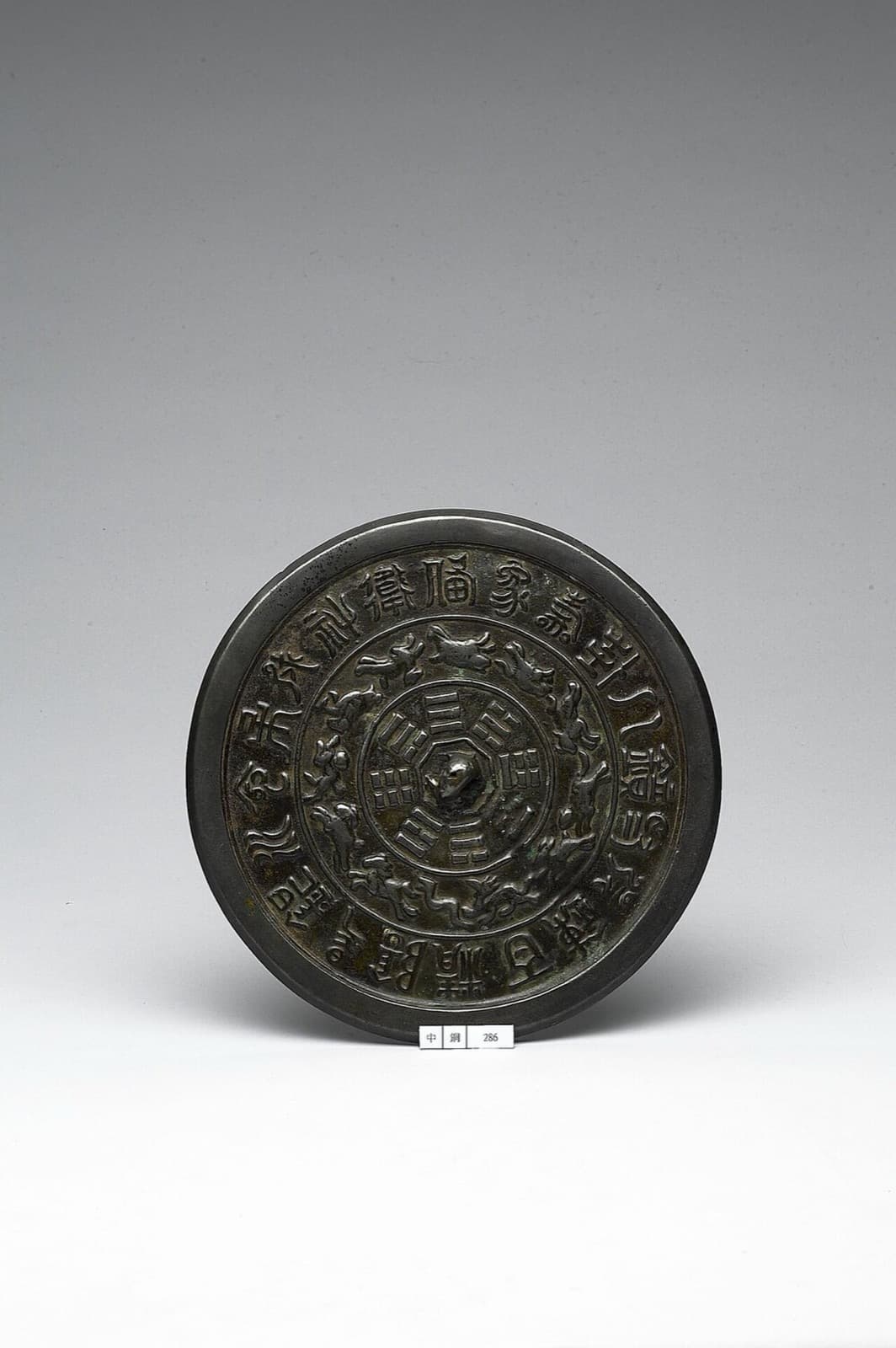
Is feng shui a single unified discipline?
No. Feng shui is a cluster of different technical traditions that share a few foundational concepts (khi, yin yang, ngu hanh, bat quai) but disagree on how to measure and how to interpret. Wikipedia calls feng shui a form of geomancy originating in ancient China, literally "wind and water", assuming that terrain and waterways channel cosmic khi through dwellings and structures. Because the foundational assumption is shared but its application differs, the schools have both inherited from and attacked one another for centuries.
What does "khi thua phong tac tan, gioi thuy tac chi" mean and where does it belong?
This is considered the foundational statement of feng shui: khi scatters when it meets wind and stops when it meets water. It is usually tied to the Zangshu (Tang Thu), a work Wikipedia attributes to Guo Pu (Quach Phac), who lived roughly 276 to 324 from the Western Jin to the Eastern Jin. The Zangshu was originally a commentary on the lost Zangjing; through it, principles linking khi flow to burial site placement were preserved and later greatly influenced feng shui's development.
It must be said plainly: whether the Zangshu is truly by Guo Pu remains an open question. Wikipedia dates the work to the 4th or 5th century and attributes it to Guo Pu, but this is a conclusion based on traditional attribution, not a verified conclusion about a text with a confirmed date. The book Phong thuy co dai Trung Quoc: ly luan va thuc tien, volume 2, lists Guo Pu among representative figures of the Hinh Phap school, and also records the legend that he received this art from a hermit surnamed Guo in Ha Dong. There is a gap between the two accounts: legend accepts Guo Pu as founder, while modern textual scholarship can only say that a text bearing his name was transmitted and had influence.
The two major lines: where did Hinh The and Ly Khi split from?
According to Phong thuy co dai Trung Quoc: ly luan va thuc tien, volume 2, China has long had two major schools. The Hinh Phap school (also called Hinh The, Loan Dau, Loan The, Hinh Gia, Jiangxi) centers on the dragon-vein direction of mountains and rivers, values the minh duong, sa, and thuy, and places each house in its objective environment for examination. Because its origin and spread were mainly in Jiangxi, it is also called the Jiangxi method. This school requires fieldwork, eyes and feet, so it contributed much practical geographic knowledge.
The Ly Khi school (also called the directional school, tong mieu, nha o, la kinh) combines khi theory, yin yang, ngu hanh, bat quai, the twelve can chi, the twenty-four tiet khi, destiny, and taboos into a complex theoretical system. The same book records that Qiu Yanhan (Khuu Dien Han) of the Tang dynasty increased the la kinh directions from twelve to twenty-four, and that figures such as Yang Junsong (Duong Quan Tung), Zeng Wendi (Tang Van Dich), Lai Wenjun (Lai Van Tuan), Liao Yu (Lieu Vu), Zhang Ziwei (Truong Tu Vi), and Cai Mudang (Thai Muc Duong) all discussed both terrain and li khi. In other words, the boundary between the two schools in practice is not as clean as the names suggest: many masters used both.
On Yang Junsong: Wikipedia records him as a Tang-dynasty author credited with the Qing Nang Ao Yu (Thanh Nang Ao Ngu), a book specializing in feng shui. Phong thuy co dai Trung Quoc: ly luan va thuc tien, volume 2, places the Qing Nang Ao Yu among representative works of the Ly Khi school, and lists Yang Junsong among representative figures of the Hinh Phap school. This is a typical example of the same person and the same book being placed in two different schools by different sources.
Why are they called Jiangxi and Fujian?
The place-name labels reflect regions of transmission, not technical essence. The Hinh The school is tied to Jiangxi because its origin and spread concentrated there, according to Phong thuy co dai Trung Quoc: ly luan va thuc tien, volume 2. The Ly Khi school is often called the Fujian school in popular materials, and is also called the directional school. Because the names are regional, learners easily mistake them for two absolutely opposed sects, while in fact many classical books teach combining both: read the land first, then calculate direction and timing.
San He, San Yuan, Bat Trach, Huyen Khong: how do they relate?
These are specific technical systems within the Ly Khi line, or blending both lines, not four peer schools that split off at the same time.
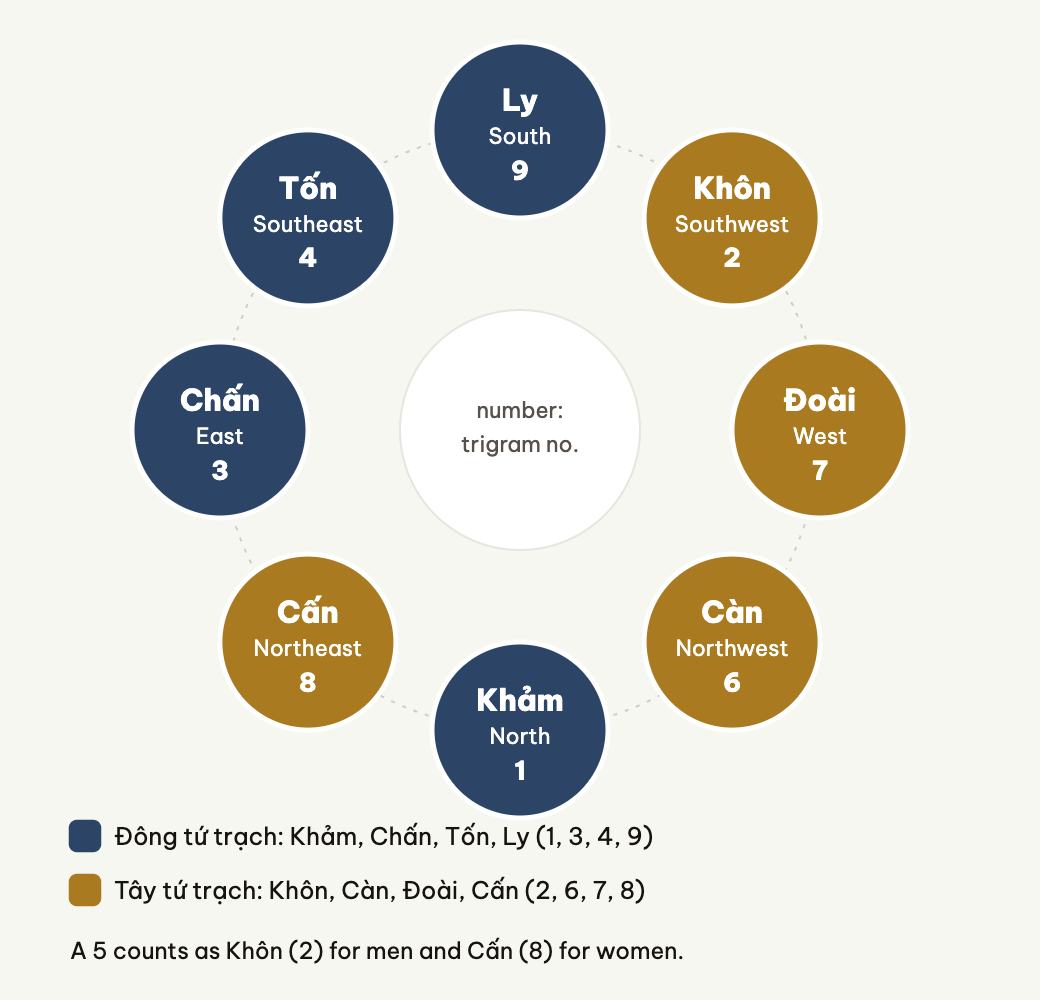
- San He uses the can chi system and the twelve-stage cycle, grouping mountains into san he cu (such as Than Ty Thin forming a Water cu). This system is closer to the can chi calendar and bat tu than to the nine stars.
- San Yuan divides time into three yuan, each of three van, nine van total, tied to the nine-star cycle. The book Tham Truc Nhuong, Trach van tan an, edited and translated by Le Viet Anh, records that Huyen Khong studies take the four aspects Hinh, Ly, Khi, and So as primary and use "the moving opening at the facing direction" as the basis for judgment.
- Bat Trach is the simplest system in this group: it takes birth year and gender to derive the menh quai (East four menh, West four menh), then compares with the house's eight directions to find good and bad directions. Bat Trach needs no nine stars, no van, so it is easy for popular use.
- Huyen Khong uses nine flying stars, combining van and direction, reading by the star chart. Trach van tan an records that Huyen Khong studies developed strongly in the Song dynasty through Wu Jingluan (Ngo Canh Loan), in the Ming dynasty through Jiang Dahong (Tuong Dai Hong) with the Di Li Bian Zheng Chu (Dia Ly Bien Chinh So), and in the Qing dynasty through Shen Zhureng (Tham Truc Nhuong) with the Shen Shi Huyen Khong Hoc and the Di Li Bian Zheng Jue Yao.
The boundary between San Yuan and Huyen Khong is drawn differently by each book. Some materials treat Huyen Khong as a branch of San Yuan, others treat San Yuan as the timing theory and Huyen Khong as the flying-star technique, and still others merge them as "San Yuan Huyen Khong". Shen Zhureng's Trach van tan an uses the term "Huyen Khong hoc" for the whole system, including the San Yuan Cuu Van part. So when reading materials, one must check whether the author uses the term in a narrow or broad sense.
Which compass does each school use?
The la kinh is not a fixed tool. Tuyen tap bai viet Phong Thuy chon loc so 2 records that the la kinh changed across eras, from an early version with only basic directional rings to one integrating many systems such as Bat Trach, Huyen Khong Phi Tinh, and Luc Dieu. The rise of different schools directly affected how the la kinh was constructed: the Loan Dau school leaned toward analyzing mountain and river forms, while the Ly Khi school emphasized the calculation rings on the la kinh to locate khi veins.
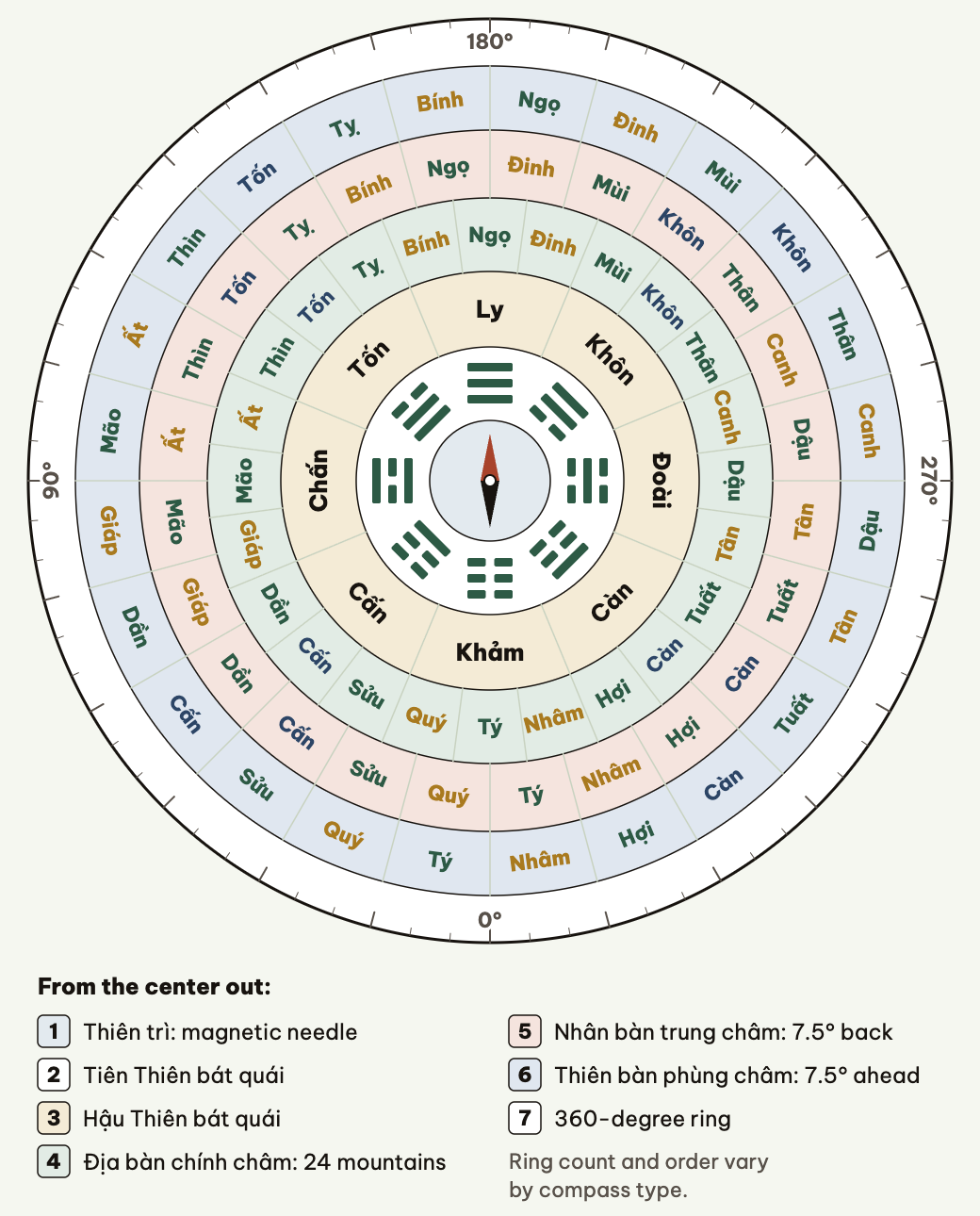
| School | Based on | Data needed | Main compass rings |
|---|---|---|---|
| Hinh The (Loan Dau, Jiangxi) | Mountain forms, waterways, dragon veins, minh duong, sa thuy | Actual terrain, dragon direction, water direction | Mainly used to measure direction, no need for many calculation rings |
| San He | Can chi, san he cu, twelve-stage cycle | House direction, age, can chi of mountain and water | 24-mountain ring, can chi ring, twelve-stage ring |
| San Yuan | Three yuan nine van, nine stars | Year built, house direction, timing | 24-mountain ring, bat quai ring, nine-star ring |
| Bat Trach | Birth year, gender, menh quai, eight directions | Lunar birth year, gender, house direction | Bat quai ring and 24 mountains are enough |
| Huyen Khong | Nine flying stars, van and direction, moving opening | Year built, direction, van, flying-star chart | 24-mountain ring, nine-star ring, van ring |
Jiang Dahong called Bat Trach a forgery, so why is Bat Trach the most popular in Vietnam?
This is a notable paradox. Shen Zhureng's Trach van tan an records that Jiang Dahong of the Ming dynasty with the Di Li Bian Zheng Chu made contemporaries see clearly the "true and false faces" of kham du hoc, that is, distinguishing true from false in feng shui. Phong thuy co dai Trung Quoc: ly luan va thuc tien, volume 2, also records that many later critics attacked the Ly Khi school as "the peak of bad habits", arguing that it does not discuss terrain but only uses quai lieh theory, celestial stars, and li khi to bewilder people. Bat Trach falls within that criticized group.
So why is Bat Trach still the most popular in Vietnam? Because it has three practical features: easy to learn, needing only birth year and gender to get the menh quai; easy to apply, needing only to compare the house's eight directions with the menh quai to get four good and four bad directions; and independent of timing, so no need to update by van. For someone buying or renting a house, or placing a desk, this is enough analysis without nine stars or flying stars. The lookup tools on the Tam An site such as bat-trach and xem-nha-dat follow Bat Trach for that reason: suitable for most ordinary users, simple input data, easy-to-interpret results.
It must be said plainly: a system being popular does not mean it is more correct than others, and a master's criticism does not mean the criticized system is worthless for all purposes. These are two different questions: popularity is a matter of social reception, while correctness is a matter with no scientific conclusion.
How do the schools criticize one another?
Phong thuy co dai Trung Quoc: ly luan va thuc tien, volume 2, cites two critical arguments against the Ly Khi school. First, this school is said not to discuss terrain, only using quai lieh theory to bewilder people. Second, the celestial-star and li khi doctrines are unreliable, because if the dragon lair is not accurate then even good celestial stars fail, while if the dragon lair is correct then even bad celestial stars prosper; therefore the wise only seek the true or false lair, not caring whether celestial stars are good or bad.
This argument has a strong point: it sets priorities. If the land is wrong, all directional calculations are meaningless. But it also has a weak point: it assumes that the "true lair" can be objectively determined, while the criteria for determining the true lair are also set by humans and change across eras. Tuyen tap bai viet Phong Thuy chon loc so 4 also records that not every feng shui school transmitted to today brings equal practical value, and that distinguishing true from false requires real testing.
Timeline summary
| Era | Figure / text | Book | School / system |
|---|---|---|---|
| 4th to 5th century | Guo Pu (276 to 324) | Zangshu, commentary on the lost Zangjing | Common foundation, later tied to Hinh The |
| Tang dynasty | Yang Junsong | Qing Nang Ao Yu | Placed in both Hinh The and Ly Khi depending on source |
| Tang dynasty | Qiu Yanhan | Increased la kinh directions from 12 to 24 | |
| Song dynasty | Wu Jingluan | Added theory and practice to Huyen Khong | |
| Ming dynasty | Jiang Dahong | Di Li Bian Zheng Chu, Yang zhai zhi jin | Criticized the false in kham du hoc |
| Qing dynasty | Shen Zhureng | Shen Shi Huyen Khong Hoc, Di Li Bian Zheng Jue Yao, Trach van tan an | Huyen Khong |
Where should a learner begin?
There is no single right answer for everyone. If the goal is quickly looking up house direction by age, Bat Trach is a reasonable starting point because the data is simple. If the goal is understanding why the schools disagree, one must read both Hinh The and Ly Khi materials, because each describes the other in its own language. And remember that this entire field has no verified scientific evidence, so all auspicious or inauspicious conclusions should be treated as cultural reference only, not as the sole basis for decisions about finance, health, or other important matters.