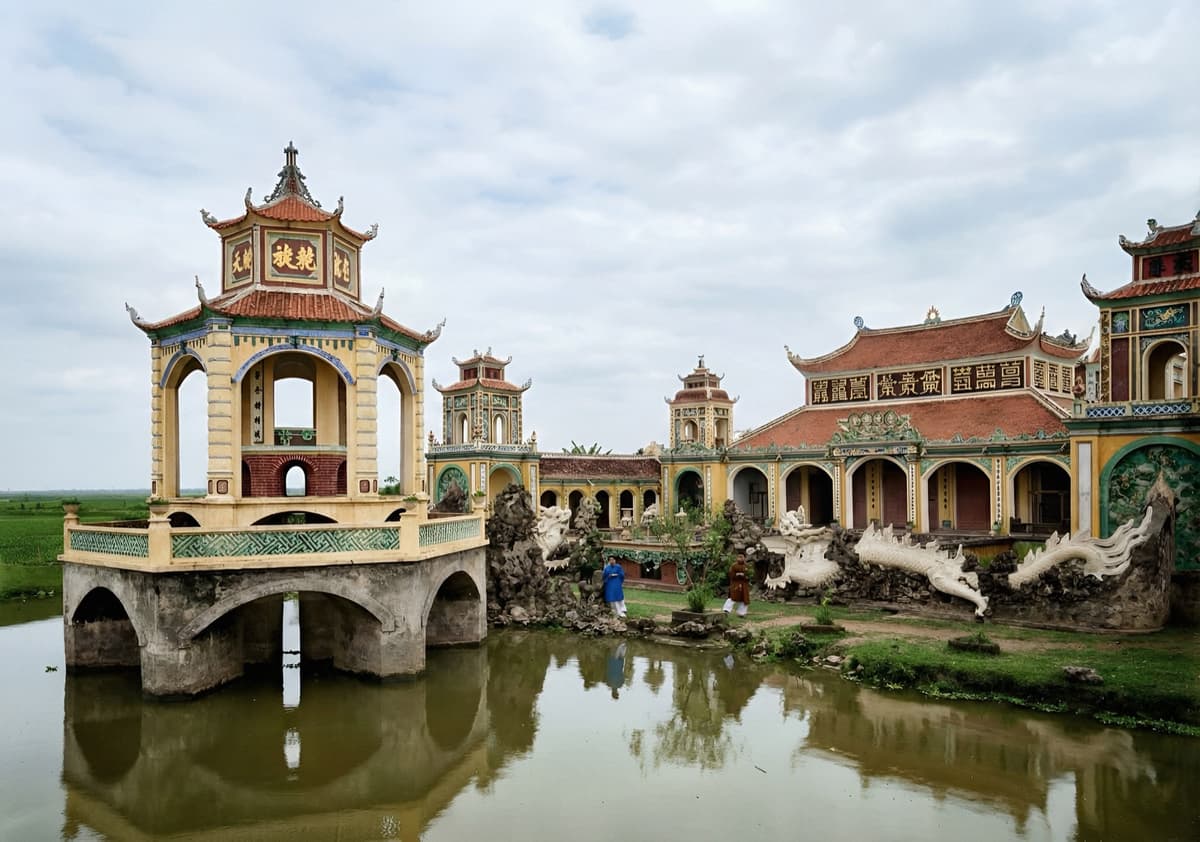
Introduction to the Four Dharma Deities Worship
The Four Dharma Deities worship is a distinctive cultural and religious phenomenon of the Red River Delta, particularly linked to the Dau region (now Thuan Thanh town, Bac Ninh province). It venerates four deities governing weather phenomena crucial to wet-rice agriculture: Phap Van (Cloud deity), Phap Vu (Rain deity), Phap Loi (Thunder deity), and Phap Dien (Lightning deity).
What makes this belief extraordinary is not only the worship of natural forces but also the profound integration of Indian Buddhism with indigenous beliefs of ancient Vietnamese. According to sources, the center of this belief is Dau Pagoda (also known as Phap Van Temple), a structure founded in the 2nd century, marking the beginning of Buddhism in Vietnam. This confluence created a religious and belief center imbued with national identity, where natural deities were 'Buddhicized' and became revered Buddha statues.
Origins and Legends of the Four Dharma Deities
Legend of Man Nuong and the Birth of the Four Dharma Deities
The Four Dharma Deities worship is tied to the legend of Lady Man Nuong, considered the mother of the Four Dharma Deities. According to folk legend, Man Nuong was the daughter of a local mandarin in the Dau region. One day, she attended a festival and met an Indian monk named Khau Da La (some say he brought Buddhism to the region). Through karmic affinity, she became pregnant after eating a mulberry fruit (or due to a spiritual encounter with the monk).
After giving birth, the child sadly passed away, and she buried it under a mulberry tree. When the monk Khau Da La returned, he had the child's remains dug up and found they had transformed into a fragrant piece of mulberry wood. From this wood, the monk carved four statues: the first symbolized clouds (Phap Van), the second rain (Phap Vu), the third thunder (Phap Loi), and the fourth lightning (Phap Dien). Legend holds these statues were highly efficacious, helping people pray for rain and relief from drought, bringing prosperous lives.
Syncretism between Buddhism and Indigenous Beliefs
The legend of Man Nuong and the Four Dharma Deities vividly reflects the process of cultural exchange. The natural deities (Cloud, Rain, Thunder, Lightning) had long been worshipped by ancient Vietnamese. When Buddhism entered Vietnam, instead of rejecting them, it skillfully integrated and transformed these beliefs into its own worship system. This is shown by the Four Dharma statues being enshrined in pagodas, yet locals affectionately call them 'Ba Dau,' 'Ba Dau,' 'Ba Tuong,' 'Ba Dan,' reflecting closeness like mothers or grandmothers in the family.
This syncretism created a unique cultural identity, both Buddhist and deeply folk. It is a testament to Buddhism's vitality and flexible adaptation upon entering Vietnam.
System of Pagodas Worshipping the Four Dharma Deities and Cultural Spatial Structure
Five Main Pagodas in the Dau Cultural Space
The worship space of the Four Dharma Deities is not confined to one pagoda but distributed across a system of five major pagodas in the Dau region, each venerating a different deity:
- Dau Pagoda (Phap Van Temple): The center of the belief, venerating Phap Van (Cloud deity, i.e., Ba Dau). It is considered the founding pagoda of Vietnamese Buddhism.
- Dau Pagoda (Phap Vu Temple): Venerates Phap Vu (Rain deity, i.e., Ba Dau).
- Tuong Pagoda (Phap Loi Temple): Venerates Phap Loi (Thunder deity, i.e., Ba Tuong).
- Dan Pagoda (Phap Dien Temple): Venerates Phap Dien (Lightning deity, i.e., Ba Dan).
- To Pagoda: Venerates Lady Man Nuong, mother of the Four Dharma Deities.
Dau Pagoda: Center of the Belief
Dau Pagoda, located in Thanh Khuong ward, Thuan Thanh town, Bac Ninh province, is the center of this belief. It is not only a religious architectural work but also an invaluable historical and cultural relic. In 2013, it was recognized as a Special National Monument, affirming its immense historical, cultural, and religious value.
Today, Dau Pagoda preserves many precious artifacts, including the set of Four Dharma Buddha statues recognized as National Treasures in 2017, and a system of 107 woodblocks carved from the Le Trung Hung, Tay Son, and Nguyen dynasties (1752-1859), recognized as National Treasures in January 2024. These artifacts are invaluable resources reflecting the history, culture, and beliefs of this land over centuries.
Symbolic Meanings of the Four Dharma Deities
Phap Van (Cloud Deity) and Phap Vu (Rain Deity)
Among the four, Phap Van (Cloud) and Phap Vu (Rain) are considered the most important for agriculture. Clouds signal impending rain; rain irrigates fields, making crops thrive. Farmers often pray to these two deities during droughts, hoping for rain to save harvests. Dau Pagoda venerates Phap Van, and Dau Pagoda venerates Phap Vu; these two always play central roles in rain-praying rituals of agricultural dwellers.
Phap Loi (Thunder Deity) and Phap Dien (Lightning Deity)
Phap Loi (Thunder) and Phap Dien (Lightning) are natural phenomena accompanying rain. Ancients viewed thunder and lightning as symbols of nature's power and majesty. In the Four Dharma belief, these two support Cloud and Rain in creating weather phenomena. The presence of all four deities shows the ancients' keen observation of natural laws: clouds gather, thunder and lightning flare, then rain falls.
Dau Region Festival and Distinctive Rituals
The Dau region festival is held annually from the 6th to the 8th day of the fourth lunar month at Dau Pagoda and surrounding pagodas. It is an occasion for locals and visitors to immerse in a distinctive cultural and belief space tied to the agricultural life of Northern Delta dwellers. The old verse 'Wherever you trade, if you see Dau Pagoda's tower, return; Whatever business you do, on the eighth day of the fourth month, remember to come to the Dau festival' partly shows the festival's strong appeal in people's spiritual life.
Ritual of Lowering and Vesting Statues
One of the first important rituals is lowering and vesting new robes for the Four Dharma Buddha statues. This ritual cleanses and dresses the statues before the main festival days, showing reverence and thorough preparation for subsequent rites.
Procession of the Four Dharma Buddhas
The festival's most unique point is the procession of the Four Dharma Buddhas, an important rite interrupted for nearly 30 years and recently restored. On the main day, villages in the Dau canton process the Four Dharma statues from village pagodas to 'cong dong' (gather) at Dau Pagoda. The four statues of Phap Van, Phap Vu, Phap Loi, and Phap Dien are carried from four different pagodas to converge at the center, creating a sacred and lively space.
The 'Mother Chases Children' Play
When the procession reaches Dau Pagoda, a special rite called 'me duoi con' (mother chases children) occurs. The palanquins of the Four Dharma Buddhas are carried in three clockwise circles before returning to their spots. Meanwhile, the palanquin of Mother Man Nuong is brought in to be placed inside Dau Pagoda. This rite mimics a mother chasing her children, expressing the sacred maternal bond and the connection between the deities and their mother.
The 'Water Grabbing' Play and Harvest Forecasting Custom
Another distinctive rite is 'cuop nuoc' (water grabbing), involving the palanquins of Phap Vu (Rain) and Phap Loi (Thunder). At a signal, the two palanquins race to the tam quan gate. The one arriving first grabs the water and wins. Villagers interpret the race result to forecast the year's harvest: if Lady Rain (Phap Vu) wins, the year will be bountiful; if Lady Thunder (Phap Loi) wins, fields will have many pests and farming will face difficulties. This performance is both spiritual and reflects folk wisdom in observing and predicting natural phenomena.
Cultural Values and Contemporary Vitality of the Four Dharma Deities Belief
Historical and Cultural Value
The Four Dharma Deities worship is an invaluable intangible cultural heritage carrying profound historical, cultural, and spiritual values. It reflects the agricultural belief life of Northern Delta dwellers, expressing aspirations for favorable weather and abundant harvests. Its survival and development over centuries testify to the nation's cultural vitality amid cultural exchange and acculturation.
The recognition of the Four Dharma Buddha statues as National Treasures (2017) and the Dau Pagoda woodblocks as National Treasures (2024) affirms this heritage's immense value. It is not only a pride for Bac Ninh people but also a shared heritage of the entire Vietnamese nation.
Preservation and Promotion Efforts
In recent years, local authorities and Dau residents have made significant efforts to preserve and promote the Four Dharma Deities belief. The restoration of the Four Dharma Buddha procession after nearly 30 years of interruption is a clear testament. Today's Dau festival is organized with an expanded space, including all five major pagodas, allowing locals and visitors to worship and learn about this unique national belief.
Alongside traditional rituals, the festival includes rich cultural, artistic, and sports activities such as performances, water puppetry, chess matches, pigeon releases, and volleyball games. These activities not only enrich people's spiritual lives but also promote the traditional cultural beauty of the Kinh Bac region to domestic and international visitors.
Conclusion
The Four Dharma Deities worship at Dau Pagoda is a unique cultural and religious phenomenon reflecting the confluence of Buddhism and indigenous Vietnamese beliefs. Over nearly two millennia, this belief retains its vitality in the spiritual life of Red River Delta residents. The Dau festival, with its processions, 'mother chases children,' and 'water grabbing' rites, is not only an occasion to express devotion to the deities but also a communal cultural space that bonds neighbors and preserves precious national traditions. Preserving and promoting this belief is not only Bac Ninh people's responsibility but also society's shared duty in safeguarding national cultural identity.