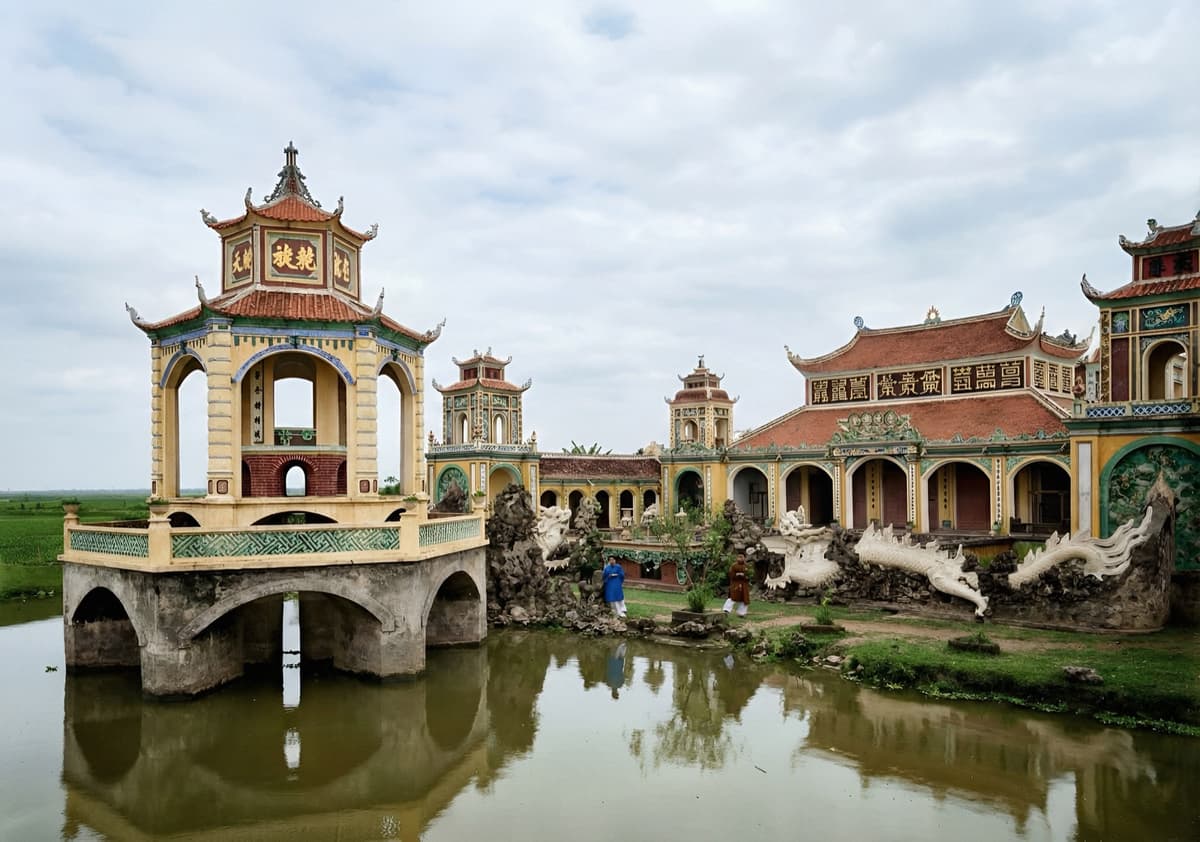
What is Star Worship and Misfortune Resolution?
Star worship and misfortune resolution (dâng sao giải hạn) is a popular folk religious ritual in Vietnam, especially performed at the beginning of the lunar new year. People believe that in a given year, each person is influenced by certain stars. Some stars are auspicious (such as Mộc Đức or Thái Âm), bringing good luck, while others are inauspicious (such as La Hầu or Kế Đô), causing obstacles and misfortunes. To counteract these negative influences, people hold ceremonies to worship the stars and pray for their protection, aiming to reduce bad luck.
The ritual typically takes place at temples or pagodas, or at home, with an offering tray including incense, flowers, candles, and a tablet bearing the name of the star to be appeased. Participants must know their exact age (year of birth) to determine which star is influencing them that year. There are nine stars in total (Cửu diệu) used in Eastern astrology, each with distinct characteristics that affect individuals differently.
Origins of the Star Worship and Misfortune Resolution Custom
This custom originates from Chinese Taoism, emerging in ancient times when people observed the heavens and attributed to the stars the power to govern destiny. In Taoism, the deities governing the stars are called "Cửu diệu tinh quân," each overseeing a star and capable of bestowing blessings or calamities based on human behavior.
Over time, this belief spread to East Asian countries such as Korea, Japan, and Vietnam. In Vietnam, star worship merged with local cults of the Mother Goddesses, tutelary spirits, and Buddhism, creating a unique local identity. Many pagodas today still organize star worship ceremonies at the start of the year, attracting numerous Buddhists and laypeople, although this practice remains controversial among religious scholars.
Cultural Significance of Star Worship and Misfortune Resolution
Beyond being a spiritual ritual, star worship holds deep cultural significance. First, it reflects the human need for peace of mind and protection amid life's uncertainties. In traditional societies, before the rise of modern science, people relied on supernatural forces to explain and cope with adverse events.
Second, the ritual serves as an occasion for community gatherings, strengthening social bonds. During the early days of the new year, people come together at temples and pagodas to pray, share joys and concerns, fostering solidarity and mutual support. It is also a time for descendants to remember their ancestors, embodying the principle of "remembering the source when drinking water."
Third, star worship can remind individuals to live more virtuously, avoiding evil and doing good. Although the form may appear superstitious, the underlying message is morally uplifting, encouraging people to cultivate their minds and take responsibility for themselves and society.
A Buddhist Perspective on Star Worship and Misfortune Resolution
From an orthodox Buddhist standpoint, star worship and misfortune resolution is a form of superstition, inconsistent with the Buddha's teachings. The Buddha taught that all things are governed by karma, which is created by each person through body, speech, and mind. Good karma yields good results; bad karma yields suffering. No one, not even Buddhas or Bodhisattvas, can substitute for or erase another's karma.
In Buddhist scriptures, there is no sutra or ritual instructing the practice of star worship to resolve misfortunes. Praying to stars for blessings or to avoid calamities contradicts the law of cause and effect. If a person committed evil but could be absolved merely by performing a star ritual, the law of karma would be invalidated. Buddhism emphasizes inner transformation through repentance, cultivation, performing meritorious deeds, and nurturing compassion and wisdom.
However, during its integration into Vietnam, Buddhism absorbed certain folk beliefs, leading many pagodas to organize star worship ceremonies to meet people's spiritual needs. Monks often explain this as an skillful means, attracting people to the temple where they can hear the Dharma and gradually understand the true teachings. But essentially, this ritual was not established by the Buddha and is not a path to liberation.
The Mechanism of Star Worship According to Folk Beliefs
According to folk beliefs, each person has a ruling star that changes yearly based on the lunar age. Stars are divided into auspicious and inauspicious groups. The following table lists them:
| Star | Nature | Affected Ages (Examples) |
|---|---|---|
| Thái Dương | Auspicious | Males born in 1950, 1959, 1968... |
| Thái Âm | Auspicious | Females born in 1951, 1960, 1969... |
| Mộc Đức | Auspicious | All ages |
| Vân Hớn | Inauspicious | Born in 1952, 1961, 1970... |
| Kế Đô | Inauspicious | Born in 1953, 1962, 1971... |
| La Hầu | Inauspicious | Born in 1954, 1963, 1972... |
| Thổ Tú | Inauspicious | Born in 1955, 1964, 1973... |
| Thủy Diệu | Inauspicious | Born in 1956, 1965, 1974... |
| Bạch Lạp | Inauspicious | Born in 1957, 1966, 1975... |
When encountering an inauspicious star, people believe they will face misfortunes such as illness, accidents, disputes, or business failures. To mitigate these, they perform a star-offering ceremony on specific days, often the 15th day of the lunar month or at the start of the year, with offerings like lamps, candles, tablets, and reciting prayers. Each star has its own color and number of lamps, for example, La Hầu requires nine red lamps, Kế Đô five yellow lamps, and so on.
The ritual is conducted by a ritual master or monk, who guides the householder in arranging offerings, chanting, and burning votive paper. Afterward, people believe that their misfortunes have been alleviated and their affairs will proceed smoothly.
Multidimensional Analysis: Should One Practice Star Worship or Not?
The question of whether to maintain or abolish this custom draws diverse opinions. Proponents view it as a cultural heritage, expressing reverence for deities and preserving ancestral traditions. They do not fully rely on it for resolving misfortunes but see it as a way to gain peace of mind and confidence for the new year.
Conversely, many cultural researchers and respected monks argue that star worship is superstitious, wasteful of money and time, and can be exploited for profit. They advise focusing on inner cultivation, accumulating merit, and performing good deeds rather than depending on rituals.
In reality, many participants join due to herd mentality or fear of bad luck if they skip it. This inadvertently creates unnecessary mental pressure. If people understand the true nature, they can proactively change their destiny by living well, doing good, and avoiding evil.
Conclusion: Preserving Culture or Eliminating Superstition?
Star worship and misfortune resolution is an age-old folk belief deeply rooted in Eastern culture. Whether to maintain or completely abolish it is a complex issue, requiring careful consideration between preserving tradition and avoiding superstition.
The most reasonable approach is for each person to equip themselves with accurate knowledge, understand the origins and meaning of the ritual, and then respond appropriately. If participating, one should view it as a cultural and spiritual activity, not expect it to alter fate. At the same time, combine it with moral cultivation and living a meaningful life, as that is the true root of peace and happiness.
In line with the Buddhist spirit, there is no external salvation; only self-awakening and inner transformation. Let the star worship ritual become a cultural beauty, but remain mindful, not falling into illusion or superstition.

