Patterns from the Tử Vi Đẩu Số Toàn Thư: how conditions are read and how often each occurs
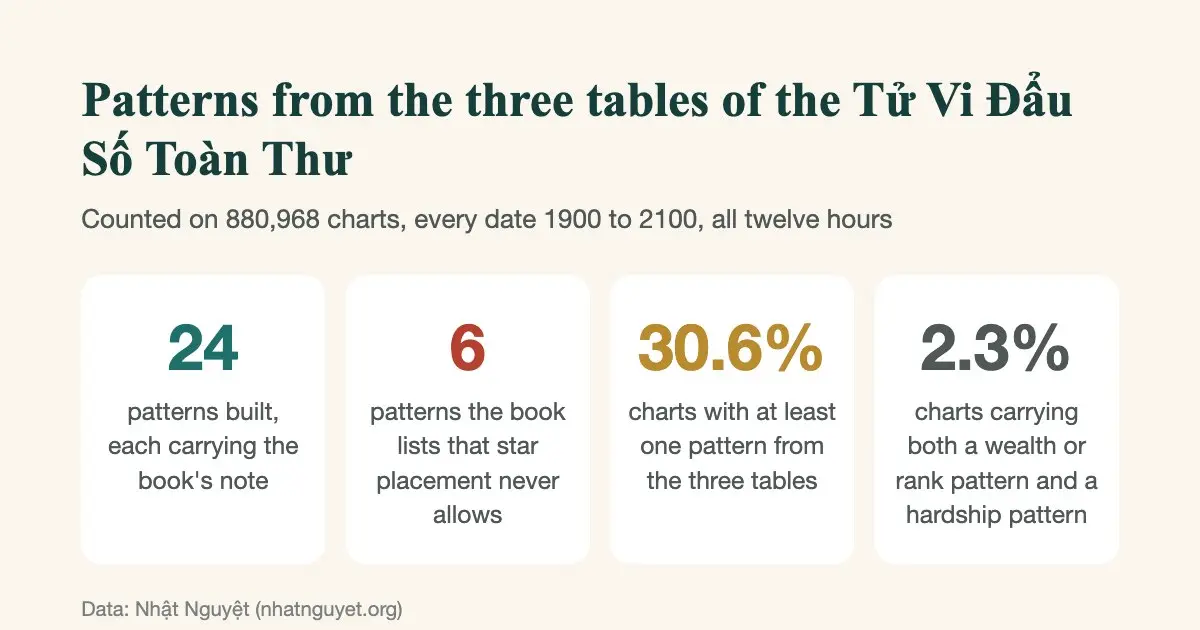
We built 24 patterns from the three tables at the end of book 1 of the Tử Vi Đẩu Số Toàn Thư, each checked by the letter of its accompanying note. Scanning all 880,968 charts, every date from 1900 to 2100 at all twelve hours: 30.6% of charts carry at least one pattern, the commonest appears in 4.85% of charts and the rarest in 0.12%. Six more patterns are listed in the book, but star placement never lets them occur.
Patterns are the rules of an old book and are not scientifically verified. The figures here only say how often a pattern appears, not that it comes true.
What are the three tables of the Toàn Thư?
At the end of book 1 the Toàn Thư has four tables: wealth patterns, rank patterns, hardship patterns and mixed patterns. The mixed table is about the sequence of ten-year periods ("one year good, one year bad"), not star combinations on the natal chart, so we build only from the first three:
| Table | Listed | Built | Impossible | Needs unplaced stars | Note too vague to locate |
|---|---|---|---|---|---|
| Wealth | 6 | 4 | 2 | 0 | 0 |
| Rank | 27 | 15 | 3 | 2 | 7 |
| Hardship | 8 | 5 | 1 | 1 | 1 |
| Total | 41 | 24 | 6 | 3 | 8 |
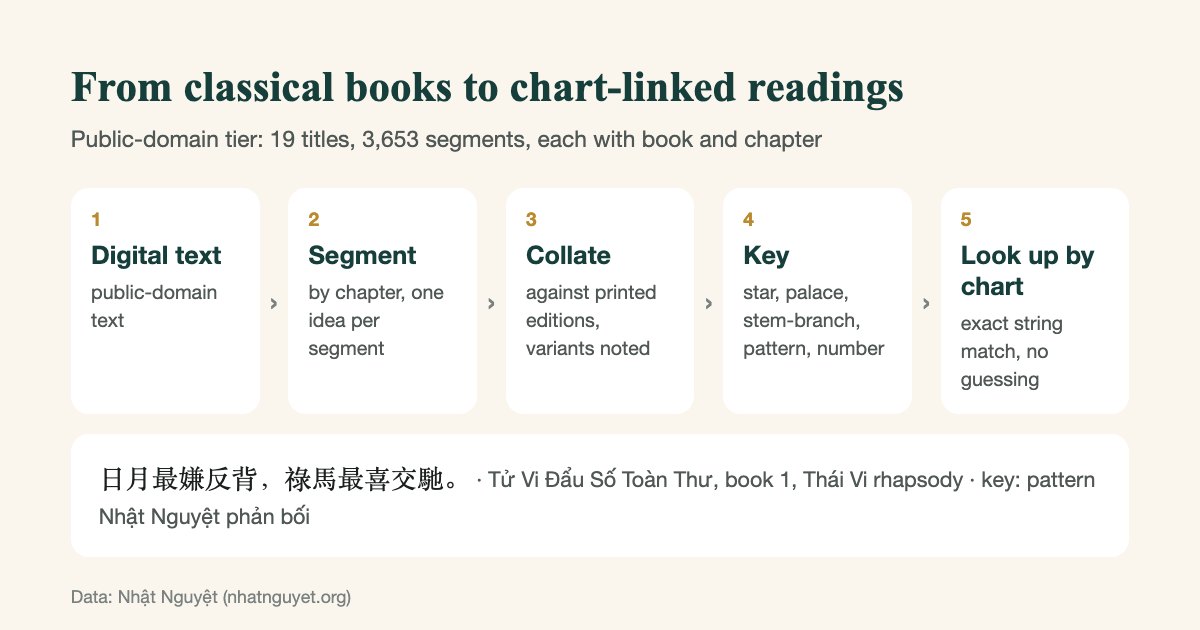
Each built pattern carries its Chinese name, its table and the note's original text; a test requires the note to appear verbatim in the library's copy of the book.
How is a condition read by the letter of the note?
Examples:
- Nhật xuất Phù Tang (日出扶桑): the note 「日在卯守命是也,守官禄宫亦然。」, i.e. Thái Dương at Mão in the Mệnh palace, and the same in the Career palace.
- Nguyệt lạc Hợi cung (月落亥宫): 「月在亥守命是也,又名月朗天门。」, i.e. Thái Âm in the Mệnh palace at Hợi.
- Cự Cơ cư Mão (巨机居卯): the note excludes people of the stem Giáp because Kình Dương at Mão breaks the pattern; the code drops exactly that group.
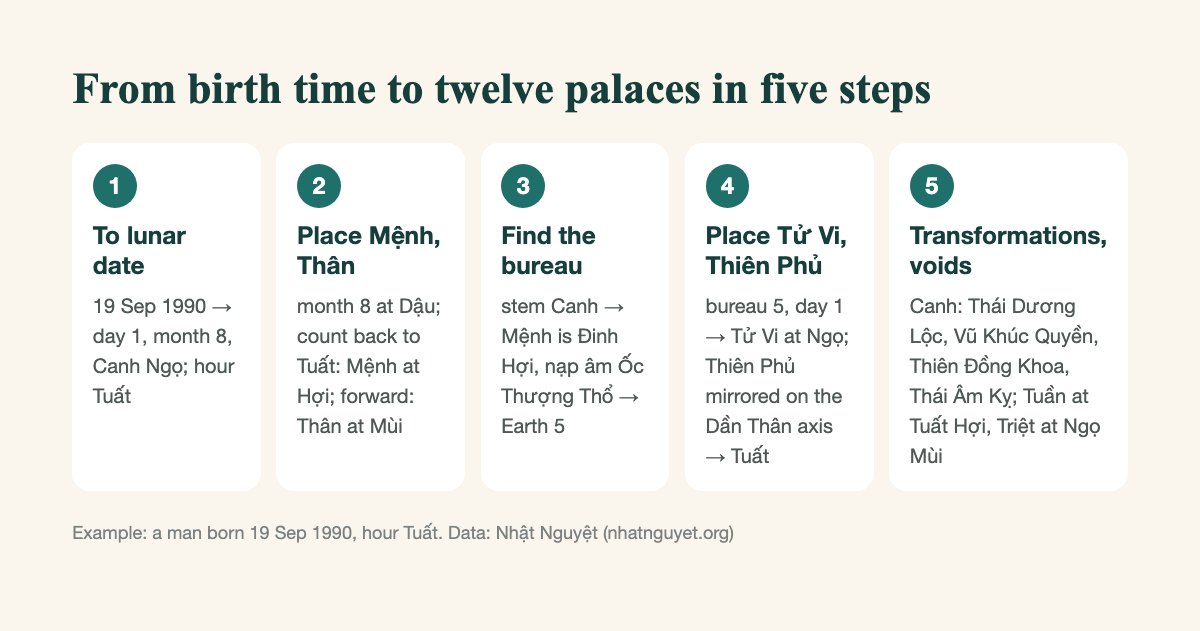
The sample chart in the previous post (a man born 19 Sep 1990, hour Tuất) carries the first two: Thái Dương at Mão in the Career palace, Thái Âm at Hợi in Mệnh.
Where a note only says 「見前批注」 ("see the note above"), we take the note from the book's own annotated verses and record which line. Three terms the notes never define are read as follows, and every pattern using them is flagged as having variant readings:
- 空亡 (empty): a palace with Tuần or Triệt.
- 吉星 (auspicious star): the six auspicious stars (Tả Phù, Hữu Bật, Văn Xương, Văn Khúc, Thiên Khôi, Thiên Việt), Lộc Tồn, or a star carrying Hóa Lộc, Hóa Quyền or Hóa Khoa.
- 祿 (Lộc): Lộc Tồn or a star carrying Hóa Lộc.
The Toàn Thư itself loosens one rule: its annotated verses treat Tử Vi meeting Tả Phù and Hữu Bật from the triangle as a lesser form of Quân thần khánh hội. We keep the strict condition (all three in Mệnh) and note the looser reading in the tool's school-differences section.
How many charts carry each pattern?
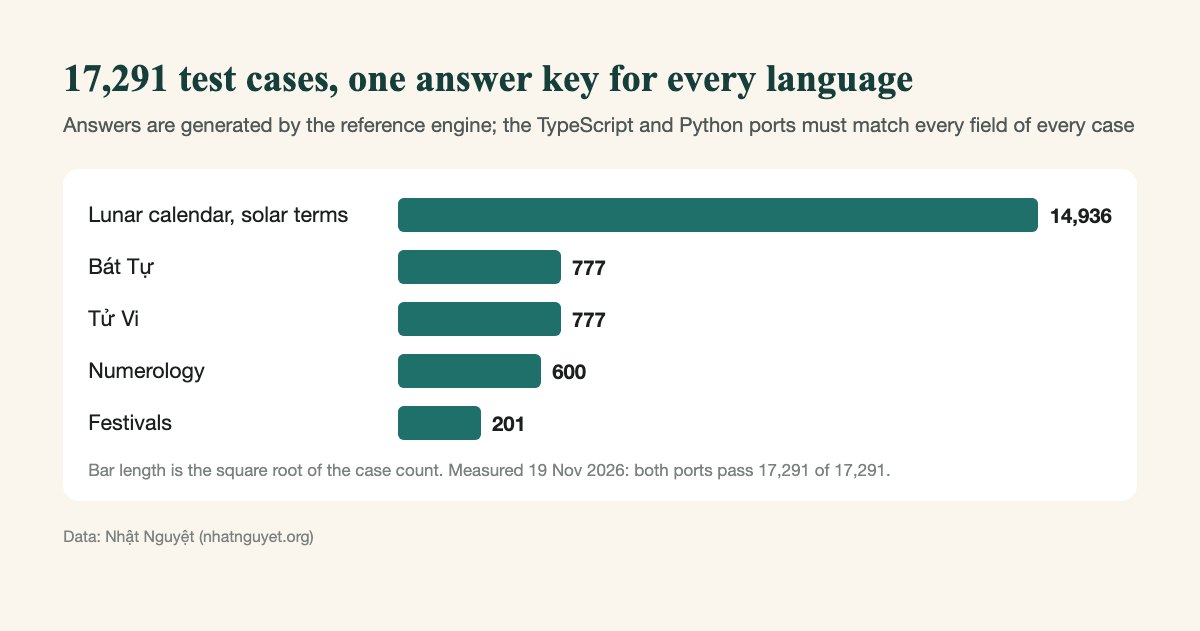
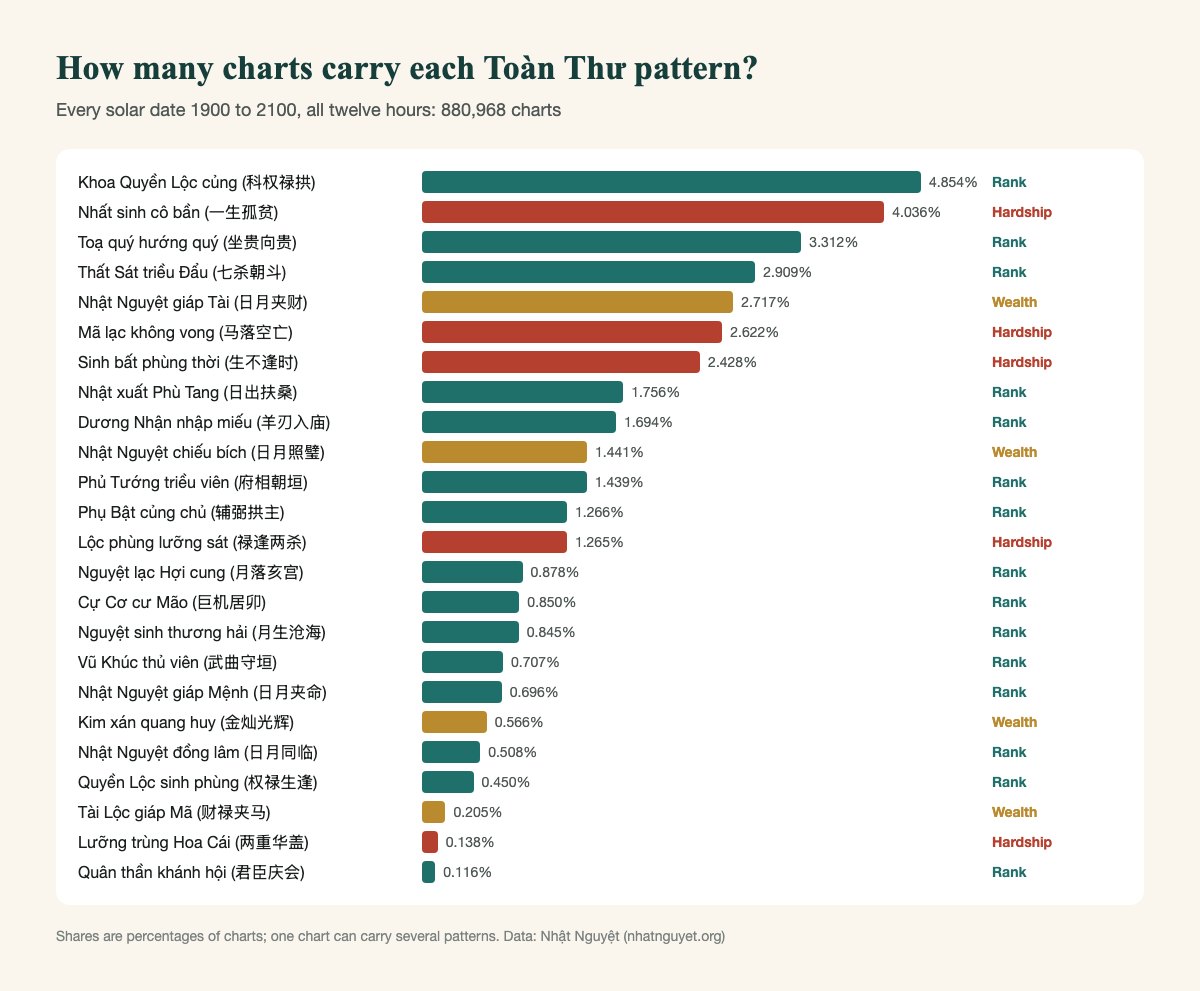
The scan: every solar date from 1 Jan 1900 to 31 Dec 2100 (73,414 days), all twelve hours each, male, charts built with Nhat Nguyet's Python library and patterns detected: 880,968 charts. None of the 24 conditions uses sex.
| Group | Charts | Share |
|---|---|---|
| At least one wealth pattern | 43,411 | 4.9% |
| At least one rank pattern | 172,758 | 19.6% |
| At least one hardship pattern | 81,553 | 9.3% |
| At least one pattern from the three tables | 269,755 | 30.6% |
| Both a wealth or rank pattern and a hardship pattern | 20,352 | 2.3% |
- Commonest: Khoa Quyền Lộc củng, 4.854% of charts.
- Rarest: Quân thần khánh hội, 0.116%, about one chart in 860.
Which six patterns never occur, and why?
The major stars are tied to each other by fixed distances, so some combinations listed in the book are ruled out by star placement:
| Pattern | Condition in the note | Why impossible |
|---|---|---|
| Ấm Ấn củng Thân (蔭印拱身) | the Thân palace on the Property palace | Thân only falls on Mệnh, Fortune, Career, Travel, Wealth or Spouse |
| Tài Ấm giáp Ấn (財蔭夾印) | Vũ Khúc and Thiên Lương flank Thiên Tướng | Thiên Lương always sits right after Thiên Tướng, and Vũ Khúc is never right before |
| Tài Ấn giáp Lộc (財印夾祿) | Thiên Lương and Thiên Tướng flank a palace | the two are always adjacent and cannot flank anything |
| Mã đầu đới kiếm (馬頭帶劍) | Thiên Mã with Kình Dương | Thiên Mã is only at Dần, Thân, Tỵ, Hợi; Kình Dương never reaches them |
| Kim dư phù giá (金輿扶駕) | Thái Dương and Thái Âm flank Tử Vi | Thái Dương is always three palaces from Tử Vi |
| Tài dữ tù cừu (財與囚仇) | Vũ Khúc with Liêm Trinh | the two are always eight palaces apart |
A test holds this claim by scanning charts and failing the moment any of the six occurs. If the placement rules ever change so that one becomes possible, the test fails and the pattern must be built.
Why are the other eleven not built?
- They need stars not yet placed (3): Hình Tù giáp Ấn needs Thiên Hình, Tham Hỏa tương phùng needs Hỏa Tinh, Quân tử tại dã needs Hỏa Tinh and Linh Tinh.
- The note is too vague to locate (8): it only says 「見前批注」 and the verses give no position, as for Minh châu xuất hải or Nhật Nguyệt tàng huy; or the wording allows several readings, as "馬前有祿" in Lộc Mã bội Ấn, which never says which palace counts as "in front".
We do not guess where the book is silent: a wrongly built pattern is wrong on every chart that carries it.
Where can these be reused?
The open library detects all 24 patterns, each with its table and note: see the Open code and data page. To run a scan like this yourself: the post on analysing chart data with Python. Book passages linked to patterns come from the classical-text library; see the post on classical books and readings.

If you reuse these figures, please credit: Data: Nhat Nguyet (nhatnguyet.org).