Where Nhat Nguyet's festival dates and prayer texts come from, and how the dates are computed
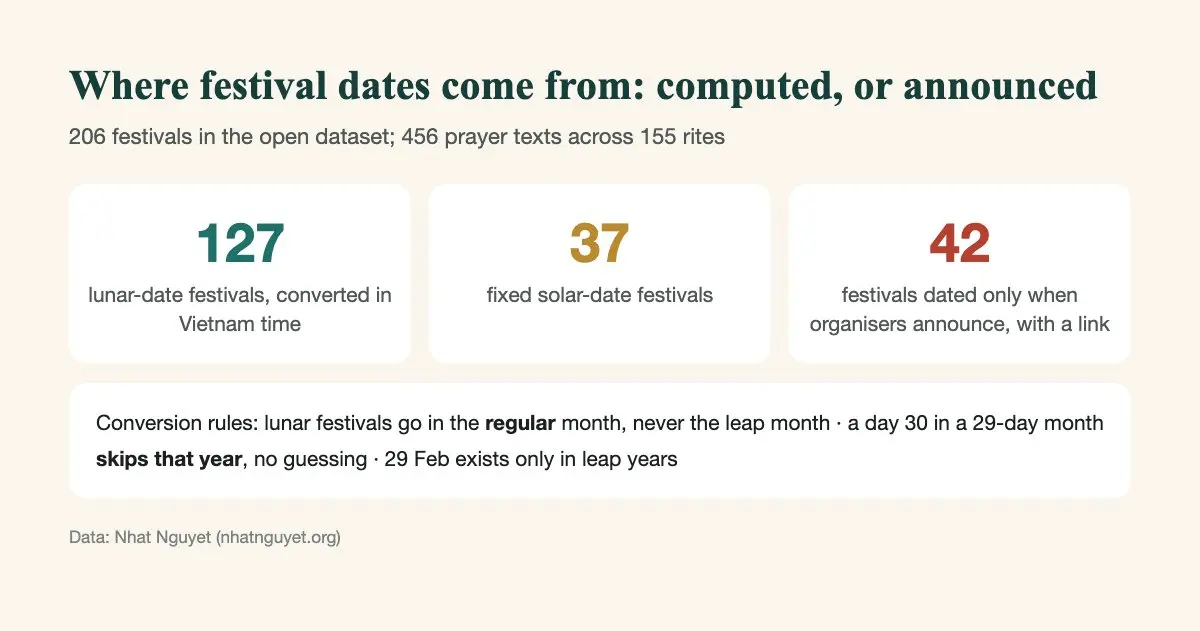
Festival dates in Nhat Nguyet's data come from three places: lunar-date festivals converted to solar dates by the engine, solar-date festivals with fixed dates, and organiser-set festivals recorded only when an announcement with a link exists. The open festival dataset has 206 festivals: 127 on lunar dates, 37 on solar dates and 42 following yearly announced schedules. The prayer texts number 456 across 155 rites, collected from tradition; Nhat Nguyet edits and classifies them and does not claim authorship of the wording.
Festivals and prayer texts are cultural and religious records. This post covers sources and date computation, not which rite is more efficacious.
Where does a festival's date come from?
| Type | Festivals | Date taken from |
|---|---|---|
| Lunar date | 127 | converted to the solar calendar by the engine in Vietnam time, for every year |
| Solar date | 37 | fixed day and month |
| Announced schedule | 42 | the organiser's announcement for each year, with a link; left blank until announced |
Four rules for entering a festival:
- A yearly schedule is recorded only with an official announcement and a link. A lunar festival without an announcement takes the engine's computed date, with no invented source.
- Seasonal festivals without a fixed date are not entered or guessed, such as the new-rice festivals of many ethnic groups.
- Lunar dates converted by a person or a model must be rechecked with the engine. A research pass in September 2026 caught a date that was one day off at this step.
- Each festival carries its alternative names and venue in all three languages, because people search for one festival under several names.
Which rules convert a lunar date to a solar date?
Three rules, each blocking one kind of error:
- Use the regular month, never the leap month. In a year with a leap seventh month, the full-moon festival of month 7 falls in the regular month 7.
- A day 30 in a 29-day month skips that year; no moved date is guessed. The reverse conversion usually returns day 1 of the next month, i.e. a row labelled "30" on a date that is not the 30th; we check every result backward and drop that case.
- 29 February exists only in leap years; in other years that festival has no date.
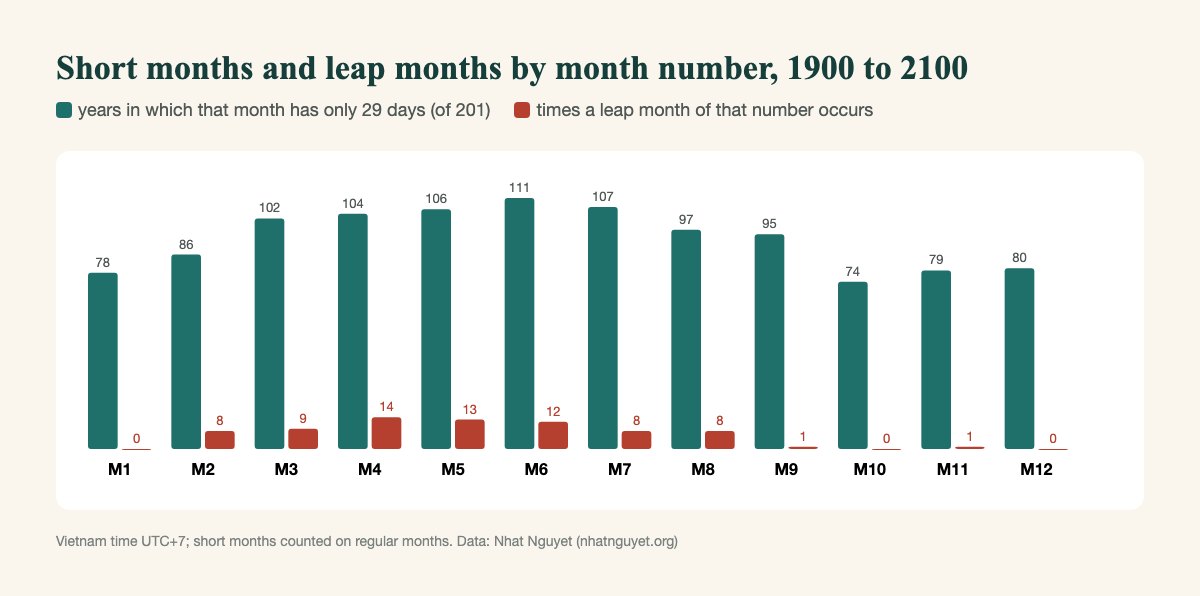
From 1900 to 2100 in Vietnam time, every month has years with only 29 days: least often month 10 (74 of 201 years), most often month 6 (111 years). The twelfth month is short in 80 years, meaning 80 years with no 30th day before Tết. Leap months occur 74 times, in months 2 to 9 and month 11; no year has a leap first, tenth or twelfth month.
How are festival dates checked?
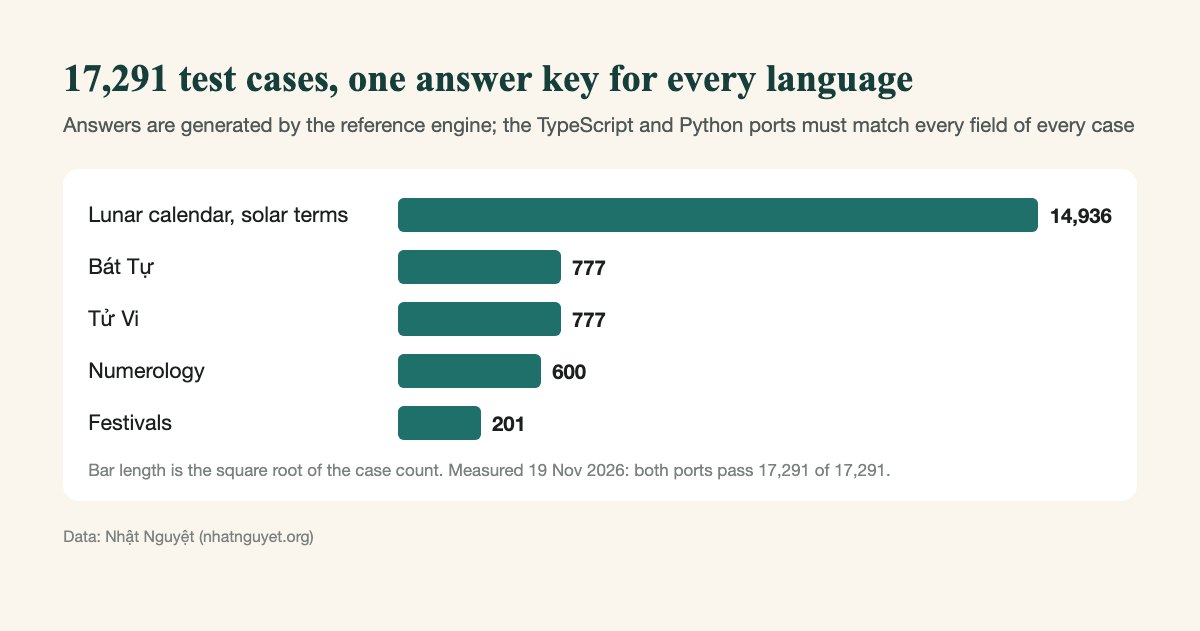
- The festival test set has 201 cases, one per year from 1900 to 2100: the solar date of every lunar and solar festival in the dataset, computed by the very function the server uses. The TypeScript and Python ports match them all.
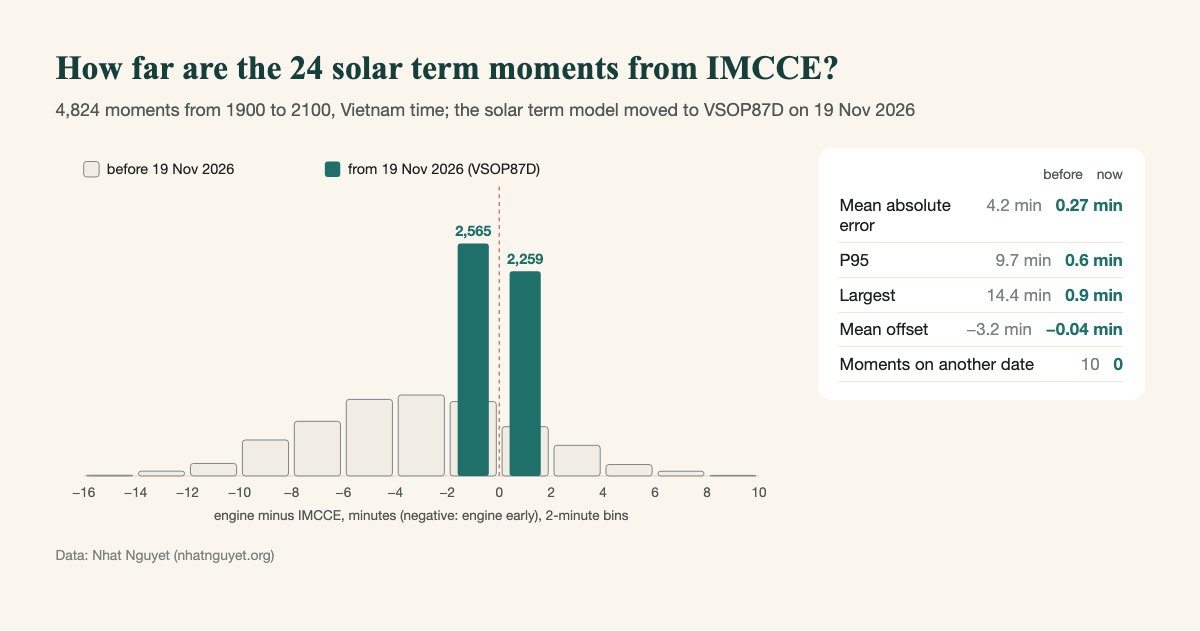
- Date conversion rests on a lunar calendar checked against NASA and IMCCE; see the lunar calendar and the 24 solar terms.
- For 2027, dates are computed for 164 festivals (127 lunar, 37 solar); the 42 announced-schedule festivals await their organisers.
What do the prayer texts contain?
| Part | Count |
|---|---|
| Texts | 456 |
| Rites | 155 |
| Ritual procedures | 407 |
| Offerings | 232 |
| Taboos and notes | 132 |
| Q&A | 158 |
The texts by:
- Tradition: folk 284, Buddhist 82, village communal-house rites 59, Mother Goddess worship 15, Confucian family rites 11, other 5.
- Region: nationwide 353, Central 59, South 35, North 9.
- Genre: invocations 343, sacrificial odes 81, repentance verses 19, petitions 7, other 6.
- Script: Vietnamese alphabet 382, Sino-Vietnamese transcription 72, ethnic-minority languages 2.
How are collected texts edited?
- No claim of authorship. Nhat Nguyet edits, classifies and adds fill-in fields; the wording belongs to tradition and to the sources it was collected from.
- 348 texts cite a source such as a book, journal or newspaper. 108 texts were authored by a website or a pagoda: they carry the label "collected text" and name no website, pagoda or domain, on the site and in the open dataset alike.
- Variants are linked: 260 texts are variants of another (different origin 182, same origin 48, shortened 19, expanded 11). On the website, a text 0.85 or more similar to one that already has a page gets no page of its own.
- Fill-in fields: names, addresses and lunar dates in the wording become fields such as {ho_ten}, {dia_chi}, {ngay_am}; a source pagoda's name inside the wording is replaced by {noi_lam_le}. Names and addresses you type on the website stay on your device and are not sent to the server.
- Wording is edited only to fix copying errors: the line count and fields are kept, at most about 5% of characters change, and a reason is required.
What are the limits?
- 65 festivals do not yet record whether they are national or local; they await manual entry.
- Announced-schedule festivals only have dates for years already announced; none in the dataset has announced 2027 yet.
- The English and Chinese descriptions in the prayer-text datasets are machine-translated and not yet reviewed; the prayers themselves are kept in Vietnamese only.
Festival calendars in your own app: the post on the lunar calendar and festivals for apps. The datasets are on the Open data page, the code on the Open code and data page.


If you reuse these figures, please credit: Data: Nhat Nguyet (nhatnguyet.org).