Bringing Vietnamese customs together: 155 rites across 7 cultural regions
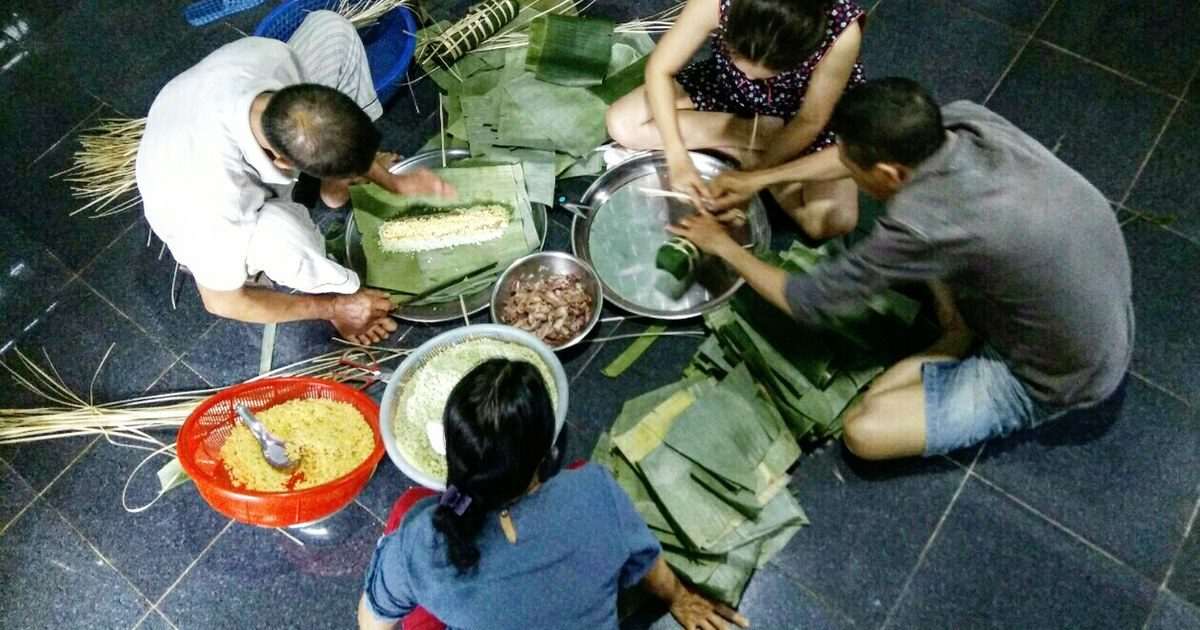
Image: This is Thảo (CC BY-SA), source
Drawing on more than 700 source pages, dozens of scholarly books and heritage dossiers, the Nhật Nguyệt team has built a knowledge base of Vietnamese customs and offering rites, organised by cultural region and ethnic group, with a source for every fact.
Death anniversaries are a good example. Many families in the Red River Delta make the first offering on the afternoon before the day, while plenty of households in the South make it only on the day itself. Tày families invite a Then master; Khmer families go to the pagoda. These differences are real, but they are rarely recorded in one place. Anyone trying to learn has to dig through dozens of web pages copied from one another, most of which never say where their information came from. An earlier post, Traditions are fragmented and easy to exploit, explains why that happens.
Instead of writing more standalone articles, Nhật Nguyệt built one shared framework so that every rite is recorded the same way: its cycle and lunar date, where it is performed, who is honoured, the ethnic group and cultural region, the order of the ceremony, the offerings and the taboos. Each entry carries its own source.
Sources
The foundation is scholarly books, most of them now in the public domain: *Việt Nam phong tục* by Phan Kế Bính (1915), *Nam Kỳ phong tục nhơn vật diễn ca* by Nguyễn Liên Phong (1909), *Việt Nam văn hoá sử cương* by Đào Duy Anh (1938), *Nếp cũ* by Toan Ánh (1969) and *Vũ trung tùy bút* by Phạm Đình Hổ. Alongside them sit more recent studies: Ngô Đức Thịnh on folk belief, Trần Ngọc Thêm on the foundations of Vietnamese culture, and Đinh Khắc Thuân on village guardian spirit worship in Hán Nôm documents.
The team also checked UNESCO nomination files for the Gióng Festival, the Worship of the Hùng Kings and Then practices; ritual records from the Hội An Centre for Cultural Heritage Management and Conservation; and documents from the Ministry of Culture, Sports and Tourism and the Government Committee for Religious Affairs. Press articles are used only from a list of 124 approved sources, including 68 licensed newspapers.
Prayer texts were collected from 717 source pages. They are kept word for word, with no edits and no translation. Books still under copyright are used only for cross-checking, never as a source of prayer texts.
Organised by region, duplicates removed
The geographic framework follows Professor Ngô Đức Thịnh's division of Vietnam into 7 cultural regions:
- Red River Delta
- Việt Bắc
- Northwest and the mountains of the North Central Coast
- North Central Coast
- Central and South Central Coast
- Trường Sơn and the Central Highlands
- the South
Ethnic groups follow the official list of 54 groups issued in 1979.
Many prayer texts turned out to be copies of one another with only a few words changed. Near-identical texts were merged into one, keeping only variants that genuinely differ. Every lunar date was recalculated with Nhật Nguyệt's own calendar engine. Sentences without a source were dropped. The order of rites reserved for members of a community is not published.
What the knowledge base holds
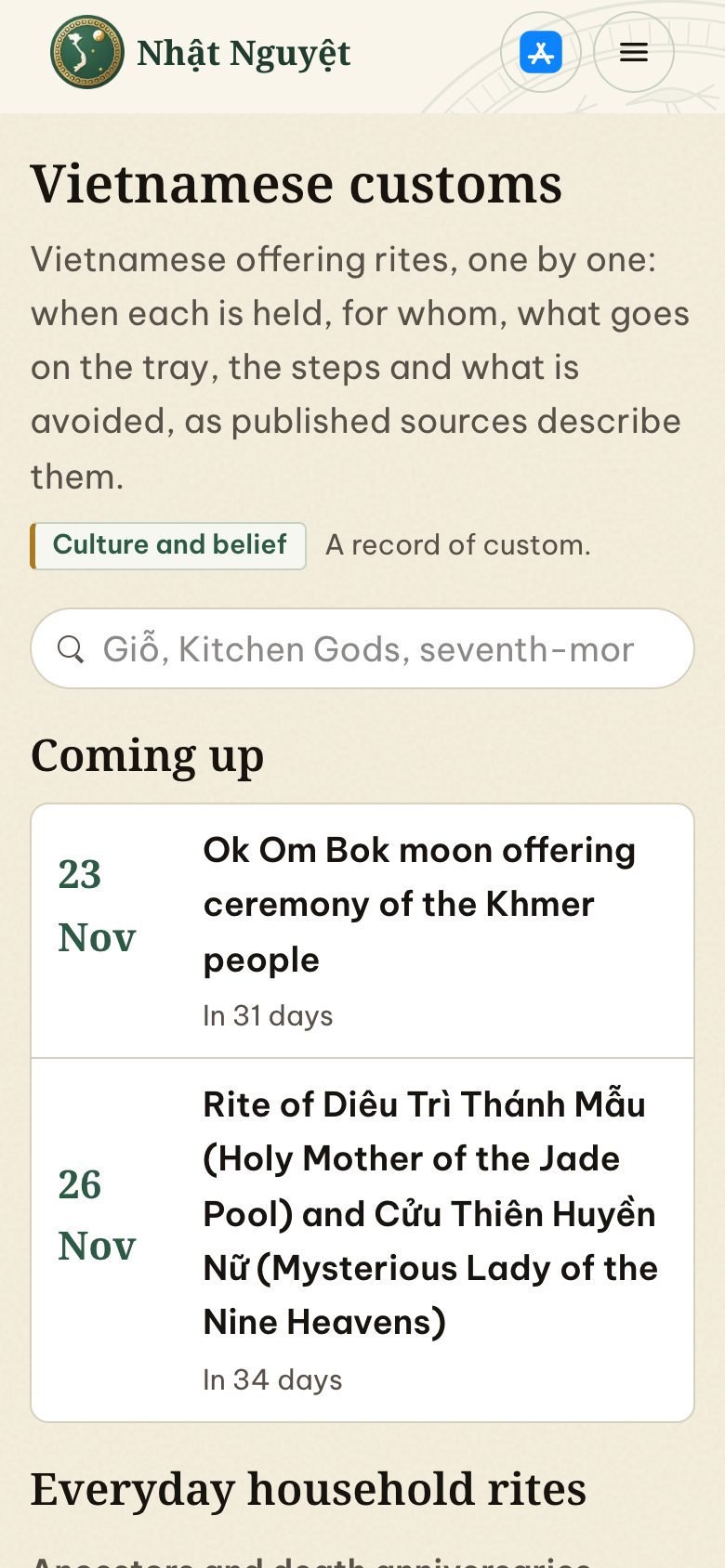
It now covers 155 rites in 15 groups, from the full moon and first day of the lunar month to weddings, funerals and village ceremonies; 438 prayer texts, each on its own page; 232 kinds of offerings and 176 questions and answers on how to make them; and dedicated pages for 7 cultural regions and 16 ethnic groups.
Beyond the customs section, the knowledge map links 633 articles on Tết, festivals, life-cycle rites and folk belief. The festival calendar lists nearly 200 festivals with their alternative names and venues. Six datasets on offering rites are published on the Open data page under a CC BY 4.0 licence.
The gaps that remain
Every region now has a framework, but the content is uneven. Of the 464 prayer texts collected, 354 come from sources that do not say which region they belong to; only 10 are tied to the North. Only 29 of the 155 rites have passed a second review. 38 of the 54 ethnic groups do not yet have their own page, mostly because so little has been published about them.
Nhật Nguyệt will keep adding to the knowledge base based on readers' feedback. Anything corrected after publication is recorded publicly on the Corrections page.
Explore it at Vietnamese customs and Prayer texts.