
Where does Ba Tu read marriage from?
Ba Tu reads marriage mainly from three layers of information. The first is the phu tinh for a female chart or the the tinh for a male chart, meaning the star representing the spouse in the ten gods system. The second is the cung phu the, meaning the earthly branch of the day pillar, considered the seat of the spouse. The third is the relation between the day branch and the remaining branches in the four pillars, and with the branches of major and annual luck. These three layers are not separate but must be placed side by side, because the same good star can be broken by its palace, and the same bad palace can be saved by the useful god of the whole chart.
One thing must be said at once: this is a conventional interpretive system, not a scientific measurement. Results depend on the school, the source text, and the reader. So every conclusion about marriage from Ba Tu should be read as a way of self-reflection, not a verdict.
What are phu tinh and the tinh?
The phu tinh is the star representing the husband in a female chart. In the ten gods classification, these are Chinh Quan and That Sat. The the tinh is the star representing the wife in a male chart, comprising Chinh Tai and Thien Tai. Both groups are looked up by day master, meaning the heavenly stem of the day pillar, because the ten gods are defined by the generating and controlling relations between the day master and the other stems.
For example, with a Giap day master (yang wood), Chinh Quan is Tan (yin metal), That Sat is Canh (yang metal), Chinh Tai is Ky (yin earth), and Thien Tai is Mau (yang earth). The reason: metal controls wood so metal is the Quan Sat of wood, while wood controls earth so earth is the Tai of wood. Different yin and yang makes it Chinh, same yin and yang makes it Thien.
Table of phu tinh and the tinh for the ten day masters
| Day master | Chinh Quan (female phu tinh) | That Sat (female phu tinh) | Chinh Tai (male the tinh) | Thien Tai (male the tinh) |
|---|---|---|---|---|
| Giap (yang wood) | Tan (yin metal) | Canh (yang metal) | Ky (yin earth) | Mau (yang earth) |
| At (yin wood) | Canh (yang metal) | Tan (yin metal) | Mau (yang earth) | Ky (yin earth) |
| Binh (yang fire) | Quy (yin water) | Nham (yang water) | Tan (yin metal) | Canh (yang metal) |
| Dinh (yin fire) | Nham (yang water) | Quy (yin water) | Canh (yang metal) | Tan (yin metal) |
| Mau (yang earth) | At (yin wood) | Giap (yang wood) | Quy (yin water) | Nham (yang water) |
| Ky (yin earth) | Giap (yang wood) | At (yin wood) | Nham (yang water) | Quy (yin water) |
| Canh (yang metal) | Dinh (yin fire) | Binh (yang fire) | At (yin wood) | Giap (yang wood) |
| Tan (yin metal) | Binh (yang fire) | Dinh (yin fire) | Giap (yang wood) | At (yin wood) |
| Nham (yang water) | Ky (yin earth) | Mau (yang earth) | Dinh (yin fire) | Binh (yang fire) |
| Quy (yin water) | Mau (yang earth) | Ky (yin earth) | Binh (yang fire) | Dinh (yin fire) |
The root rule for building the table is compact: Quan Sat is the element controlling the day master, Tai is the element controlled by the day master. In each pair, a stem with the same yin or yang as the day master is Thien, a different one is Chinh. The table above is only a consequence, not data to memorize.
How is the cung phu the at the day branch read?
The branch of the day pillar is considered the cung phu the, the seat of the spouse. The common reading is to see which ten god the day branch sits on relative to the day master, and whether that ten god is a favorable useful god for the whole chart.
For a male chart, a day branch seated on Tai is usually considered favorable, because the the tinh sits in its own palace. For a female chart, a day branch seated on Quan Sat is also considered favorable by the same logic. But this is only a rough reading. The book Tu Binh Chan Thuyen in its chapter On Wife and Children states more precisely: seeing the day branch rest on Tai or Quan ground corresponds to a virtuous and noble wife, but there are also cases where it rests on Tai or Quan yet the wife is unfavorable, and cases where it meets Thuong Quan or Duong Nhan yet the wife is good. The reason is that the month order useful god is matched into favorable or unfavorable. The same Tai character, meeting the An structure, becomes not good; the same Quan character, meeting Thuong Quan, makes it hard to be of one mind. Conversely, a day branch seated on Duong Nhan is normally considered inauspicious, but if the four pillars already form a Tai Quan Sat Thuong structure and the day master lacks energy, then Duong Nhan helps the day master, and the wife then suits the husband. The book's conclusion is that these principles should not be rigidly held.
This is a very important point and often overlooked when reading popular articles. The cung phu the has no fixed meaning. It only has meaning in relation to the useful god of the whole chart.
Combination, clash, punishment, and harm of the day branch
The day branch can be combined, clashed, punished, or harmed by other branches in the four pillars. Six combination and three combination are usually read as binding, attachment, or pulling the spouse toward another force in the chart. Six clash is usually read as shaking, separation, change. Punishment and harm are usually read as simmering friction, a longer discomfort rather than a breakup.
But this reading also depends on the school. Some schools treat a clash of the day branch as a sign of marital difficulty. Some treat clash as opening, as movement, sometimes good if the spouse palace was originally closed. There is no consensus. What should be done is to state clearly which convention is being followed rather than presenting one side.
Trich Thien Tuy reads marriage through the favorable god
Trich Thien Tuy opens its chapter On Husband and Wife with two lines: the marital bond of husband and wife in life, the favorable god has the idea of nearing Thien Tai. The original commentary explains that wife and children are one, and if the chart has a favorable god then a life of wealth and honor is decided by having enough children, and also decided by the wife. Broadly, one relies on Tai to look at the wife: if the favorable god is the Tai god then the wife is beautiful and also wealthy and noble; if the favorable god and the Tai god do not envy each other it is also good; if not then it harms the wife, or is not good, or is discordant.
The core point of Trich Thien Tuy is to place the favorable god first, then examine Tai. The book also warns to use flexible methods: if the Tai god is thin it needs support; if Tai is strong and the self is weak then Tinh Kiep is favorable; if Tai harms An then the Quan star is needed; if Tai is few and Quan many then Thuong Quan is needed; if the Tai luck is not obtained then clash when clash is needed, drain when drain is needed; if Tai energy flows then combine when combine is needed, store when store is needed. If the Tai god drains too much energy, Tinh Kiep is exposed, and with a strong self but no Tai, then husband and wife certainly cannot be perfectly complete. And if Tai is strong and the self is strong then certainly wealth and honor with many wives and concubines, one must know to weigh light and heavy.
Trich Thien Tuy also records the view of Nham: the Tu Binh method takes Tai as wife, because Tai is what I control, the person who takes Tai to come is me. Nham holds that taking Tai as father is a later error, and splitting Tai into Thien and Chinh is ultimately forced, because Tai having Thien and Chinh is only a distinction of yin and yang, not an exchange of different energy. This is where schools disagree, and the reader should know there is real debate in the tradition, not just one way of assigning stars.
Why do popular books give many one-line verdicts?
Popular books, for example Chu dich and du doan hoc when discussing four pillars and marriage, often present lists of short verdicts: Tai star resting on the day and being a general star means the wife is from a wealthy noble family; Chinh An, Thien An resting on the day means the wife is virtuous and intelligent; a noble person resting on the day means the wife is gentle, beautiful, and famous; if the day branch is Ti Ngo Mao Dau then the wife is beautiful, if it is Dan Than Ti Hoi then the wife is short. This style is easy to read, easy to look up, but loses the useful god layer. It is useful as a hint table, not useful as a conclusion.
This book also cites the old view in Tam Menh Thong Hoi that a male destiny should be strong and a female destiny should be weak, and holds that this fits yin-yang and hardness-softness. This is a view marked by its era's gender roles, not a natural law. Modern readers should recognize it as a historical cultural layer, not apply it literally to life today. This article does not copy the specific verdicts for female charts in the source, because they are tied to gender prejudice and easily cause harm when taken out of context.
What does Uyen Hai Tu Binh Toan Tap say about wives and concubines?
Uyen Hai Tu Binh Toan Tap in its section On Wives and Concubines defines Chinh Tai as the primary wife and Thien Tai as the concubine. The book gives many verdicts: if Tai is in a declining, defeated, tomb, or cut-off ground then it indicates the wife has illness and is not virtuous; if Tinh Kien divides and seizes, and Tai reaches the moc duc Dao Hoa ground then it indicates the wife or concubine has an affair; if below the day or below the month it sits on Tai Quan then one receives much help from the wife; if Thien Tai is in position then the concubine surpasses the wife; if Chinh Tai is self-strong then the wife does not tolerate a concubine; if Tai is many and the self is weak then the wife dominates the husband; if the Tai destiny has energy then wives and concubines are harmonious and one gains the wife's strength; if the day sits on Khong Vong then wives and concubines face hardship.
This block must be read in the social context that produced it. Polygamy and the notions of reputation and chastity in old books are no longer suitable as standards for judging people today. The usable value of this passage is in its structure: the book distinguishes Tai energy strong or weak, distinguishes where Tai is positioned, and distinguishes whether Tai is contested by Tinh Kiep. Those are technical variables, not moral judgments.
Are Dao Hoa, Hong Diem, Co Than, and Qua Tu phu tinh?
No. Dao Hoa, Hong Diem, Co Than, and Qua Tu are shen sha, not ten gods. They are placed by their own criteria, usually based on the year branch or day branch, and their weight of meaning depends on the school. Some schools treat Dao Hoa as a sign of attraction and social charm; some treat it more heavily, tied to extramarital affairs. Co Than and Qua Tu are treated by some as loneliness, by others as merely an independent character that relies little on others.
Because this is the shen sha layer, not the ten gods layer, it cannot replace phu tinh and the tinh. Many popular articles mix these two layers and then draw strong conclusions, which is where errors easily arise. This article does not re-teach Dao Hoa and the marriage shen sha, but points to a separate article on Dao Hoa and an article on the six relations palace positions for a full reading.
How do major and annual luck affect it?
The cung phu the in the four pillars is the static foundation. Major and annual luck are the dynamic layer. The common reading is to see whether the major luck branch and annual luck branch combine, clash, punish, or harm the day branch, and whether the major luck stem and annual luck stem draw the phu tinh or the tinh into a three combination, into the spouse palace. A year may be considered to correspond to marriage when the phu tinh or the tinh is activated, or when the day branch is strongly clashed or combined.
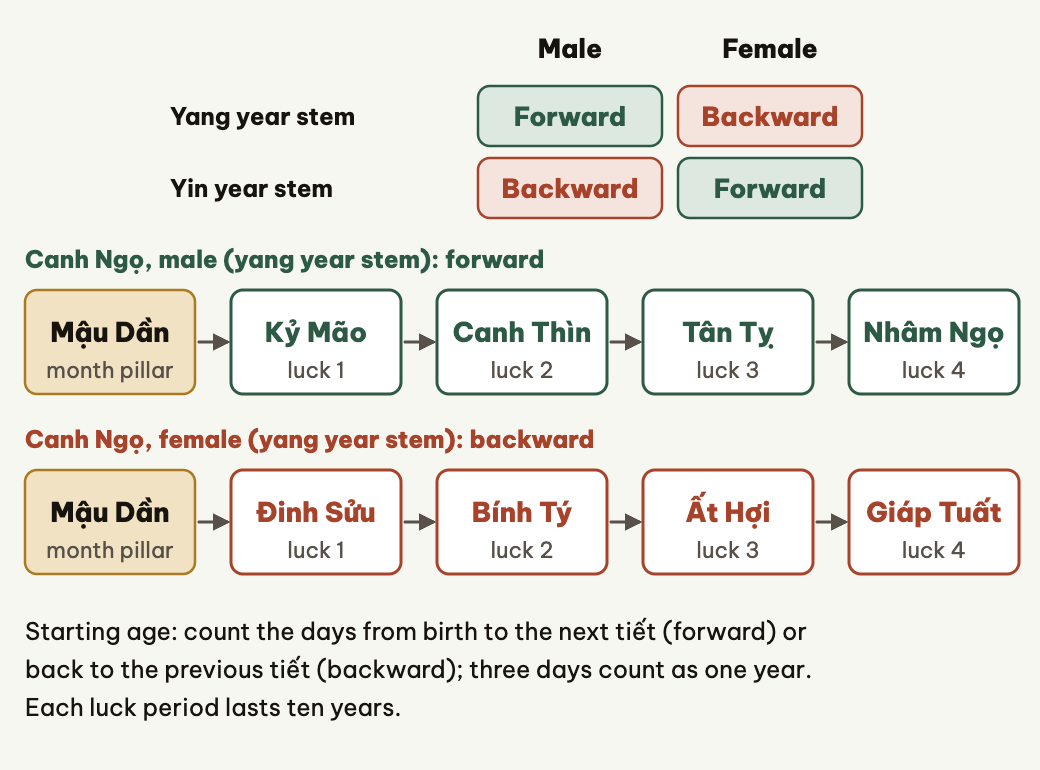
But even within the tradition, pinpointing the year of marriage is considered difficult. Schools use different criteria: some look at three combination, some at clash, some at the favorable god entering luck. There is no common algorithm. So major and annual luck should be read as favorable or unfavorable context, not as an appointment.
Responsible reading
Ba Tu cannot conclude that a person will harm a husband, will be promiscuous, or will have many husbands. Those phrases are moral verdicts tied to an old society, not the result of a calculation. The same chart structure, read by two people of different schools, can yield two opposite conclusions, and both can cite books to defend themselves. That is a sign the system lacks strict predictive power.
A chart should not be used to decide to marry or separate. Marriage decisions should rest on mutual understanding, the ability to negotiate, and real living conditions. A chart can be used as a framework for self-questioning: what tendencies do I have in relationships, where do I easily clash, what should I prepare. Used that way it is harmless and helpful. Used to judge others it becomes a tool for harm.
For beginners, the warning of Tu Binh Chan Thuyen that these principles should not be rigidly held is the best anchor. It reminds us that even the ancients knew this system is flexible, and a good reader is one who knows how to keep a soft spot.


