
Why are family members read through two layers?
In Bát Tự, each family member does not have a fixed slot on the chart, but is inferred through two layers: palace position (the location of the year, month, day branch, and hour pillars) and the Ten Gods (ten types of relationships between the stems and branches and the day stem). These two layers do not replace each other. They are two lenses looking at the same relationship, and when they point in different directions, that is where the interpreter must reconcile them rather than apply them mechanically.
The palace position layer answers the question "where does that family member sit in the structure of the chart". The Ten Gods layer answers the question "what kind of relationship is that family member to me". A father may appear through the year pillar (ancestral palace) or the month pillar (parents palace), and also through Thiên Tài or Chính Tài. Both pieces of information are true, but they speak about different aspects of the same person.
Palace position: year pillar, month pillar, day branch, hour pillar
According to the common palace division in Tử Bình, the year pillar corresponds to ancestors, grandparents, family origins, and early life. The month pillar corresponds to parents and siblings, and is also the palace of career and reputation. The day branch corresponds to the spouse palace, also the palace of marriage. The hour pillar corresponds to children and the later years.
This palace division is not consistent across texts. Some documents call the month pillar the parents palace, others separate the year pillar for father and the month pillar for mother, or vice versa. Some texts use the month pillar for siblings and the year pillar for parents. This shows that palace position is not a fixed table agreed upon by all schools, but a convention with variations.
An important point: palace position not only speaks about the family member, but also about the native himself in that relationship. The month pillar is both the parents palace and the career palace. When interpreting parents, one reads the month pillar; when interpreting career, one also reads the month pillar. Same position, two readings, depending on the question being asked.
Ten Gods: each family member is a type of relationship with the day stem
The Ten Gods are ten types of relationships between the stems and branches and the day stem: Tỷ Kiên, Kiếp Tài, Thực Thần, Thương Quan, Chính Tài, Thiên Tài, Chính Quan, Thất Sát, Chính Ấn, Thiên Ấn. Each corresponds to a type of Five Elements relationship: same element, I generate, I control, controls me, generates me.
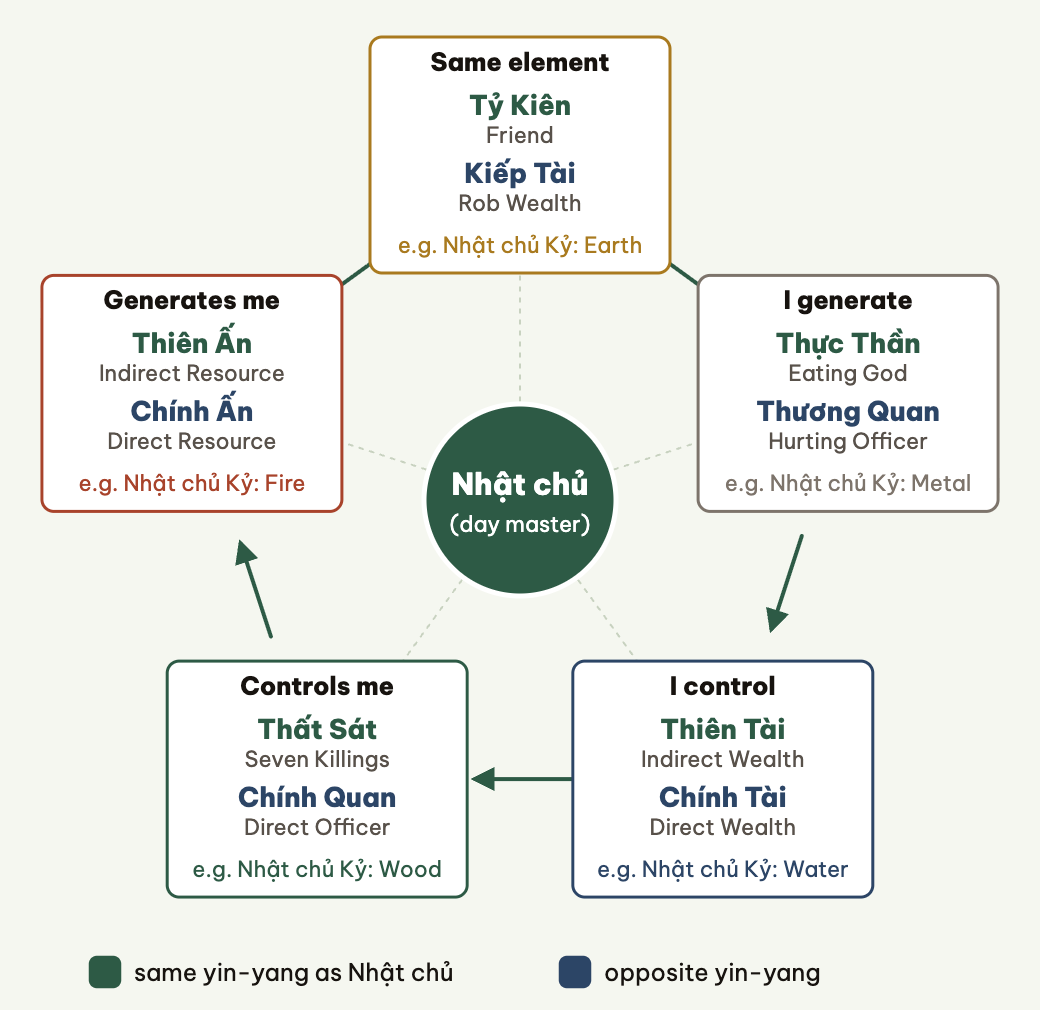
When assigning Ten Gods to family members, the general principle is: Ấn (Chính Ấn, Thiên Ấn) is mother; Tài (Chính Tài, Thiên Tài) is father and the wife of a male; Quan Sát (Chính Quan, Thất Sát) is the husband of a female and the child of a male; Thực Thương (Thực Thần, Thương Quan) is the child of a female; Tỷ Kiếp (Tỷ Kiên, Kiếp Tài) is siblings.
This principle is not a table copied identically in all texts. Trích Thiên Tủy, in the Lục Thân Luận section, chapter Phu Thê, directly criticizes that taking Tài as wife is correct in principle, but taking Tài as father is a "mistake of later people", because if Tài is father and Quan is child, the moral order is reversed. This is one of the places where schools disagree most clearly.
Table of family members by gender
The table below summarizes the most common conventions, with notes on what each text says. This is a definitional table of conventions, not a predictive table.
| Family member | Representing Ten God | Palace position | Textual note |
|---|---|---|---|
| Mother | Chính Ấn (some texts include Thiên Ấn) | Month pillar or year pillar | Uyên Hải Tử Bình, section on Mother: "Chính Ấn is what gives birth to oneself" |
| Father | Thiên Tài, or Chính Tài | Year pillar or month pillar | Trích Thiên Tủy, chapter Phu Thê, criticizes taking Tài as father as a mistake; Uyên Hải Tử Bình separates Chính Tài and Thiên Tài when discussing wives and concubines |
| Wife (male) | Chính Tài is primary wife, Thiên Tài is concubine | Day branch | Uyên Hải Tử Bình, section on Wives and Concubines |
| Husband (female) | Chính Quan, Thất Sát | Day branch | Tử Bình Chân Thuyên, chapter on Useful Gods, places Quan Sát in the useful god group |
| Child of male | Quan Sát | Hour pillar | Trích Thiên Tủy and Tử Bình Chân Thuyên follow this direction; some modern texts use Thực Thương |
| Child of female | Thực Thương | Hour pillar | Many modern texts; Trích Thiên Tủy in places uses Quan Sát for the child of a male |
| Siblings | Tỷ Kiếp | Month pillar | Common in Tử Bình texts |
When the two layers point in different directions, how to reconcile?
This is the hardest part and also the most misunderstood. Suppose the month pillar is the parents palace, but within the month pillar there is no Tài star, while the Tài star is in the hour pillar. Then the palace position says "parents in the month pillar", while the Ten Gods says "father in the hour pillar". The two layers do not match.
The common way to reconcile is: palace position indicates the location of the relationship in the chart structure, while the Ten Gods indicates the nature of that relationship. When they diverge, the interpreter usually examines the Ten Gods first to determine whether that family member is present in the chart, then uses the palace position to see at what stage and in what circumstances that person appears.
Trích Thiên Tủy, in the Lục Thân Luận section, emphasizes an important point: do not read mechanically by label. The text says that looking at the Tài star "requires a flexible method", meaning one must be flexible. If the Tài star is thin, one needs to support Tài; if Tài is strong and the self is weak, then one favors Tỷ Kiếp; if the Tài star harms Ấn, then one needs Quan star; if Tài is few and Quan is many, then one needs Thương Quan. This is not a fixed formula, but a way of examining the favorable and unfavorable elements of the whole chart.
In other words, the same Tài star is a favorable god in one chart and an unfavorable god in another. The same father, the same wife, but different readings depending on the whole chart. This is why one cannot take a table of conventions and apply it mechanically to every chart.
Where schools disagree
There are at least four notable points of debate.
First, whether the child of a male is Quan Sát or Thực Thương. Trích Thiên Tủy and Tử Bình Chân Thuyên follow the Quan Sát direction for the child of a male. Some modern texts use Thực Thương for the child of both male and female, because Thực Thương is what I generate, which fits the parent-child relationship better. These two approaches give different results when interpreting children.
Second, whether father is Thiên Tài or Chính Tài. Uyên Hải Tử Bình clearly separates: Chính Tài is the primary wife, Thiên Tài is the concubine. When interpreting father, some texts use Thiên Tài, others use Chính Tài, others combine both. Trích Thiên Tủy directly criticizes taking Tài as father as a mistake.
Third, whether the month pillar is parents or siblings. Some texts use the month pillar for parents, some for siblings, some separate the year pillar for father and the month pillar for mother. There is no single standard.
Fourth, Trích Thiên Tủy demands examining favorable and unfavorable elements rather than reading mechanically by label. This is a methodological difference, not just a table assignment. The same label "Tài is wife", but the reading depends on the favorable and unfavorable elements of the whole chart, not simply seeing Tài and concluding a good or bad wife.
A sample chart
The chart below is created with LapBatTu, with the Ten Gods of each stem printed by the calculation core. The purpose is to see both layers appearing on one chart, not to interpret fortune or misfortune.
| Pillar | Stem | Branch | Ten God of stem |
|---|---|---|---|
| Year | Mậu | Thìn | Thực Thần |
| Month | Canh | Thân | Thiên Tài |
| Day | Giáp | Tý | Day Master |
| Hour | Kỷ | Tỵ | Chính Tài |
With this chart, the Tài star appears in both the month pillar and the hour pillar. If following the convention that Tài is father and Tài is the wife of a male, then Tài in the month pillar (parents palace) and Tài in the hour pillar (children palace). Two different palace positions, same Ten God. The interpreter must examine whether that Tài star is favorable or unfavorable in the whole chart, then can say whether it corresponds to father or wife, and at what stage.
This is a convention for reading a chart, not a prediction about real people
It must be clear: the family member table and the method of reconciling the two layers are conventions of a symbolic system, not a verdict on real people. When a chart shows the Tài star being overcome, that is a configuration in the symbolic system, it does not mean the father or wife in real life will encounter trouble. Ancient texts were written in a different social context, with different views on family, so many phrases like "overcomes wife", "overcomes father" need to be read as descriptions of configurations, not predictions.
What is worth keeping from ancient texts is the spirit of examining the favorable and unfavorable elements of the whole chart before assigning labels. That is a methodological principle, while the label table is only a tool. When the two layers of palace position and Ten Gods point in different directions, reconciling them according to favorable and unfavorable elements is the only way not to misread, and is also where one distinguishes a person who understands Tử Bình from one who merely copies tables.


