
Why must career and money in Bat Tu be read through Ten Gods combinations?
In Bat Tu, each Ten God is only a relationship between the Day Master and one element in the four pillars, so it says nothing about career or money on its own. A person with a visible Tai Tinh can still lose money for years if that Tai Tinh is surrounded by Ty Kiep without Thuc Than or Quan Sat to regulate it. The right question is not "does the chart have Tai" but "who does that Tai stand next to, what generates it, and what controls it".
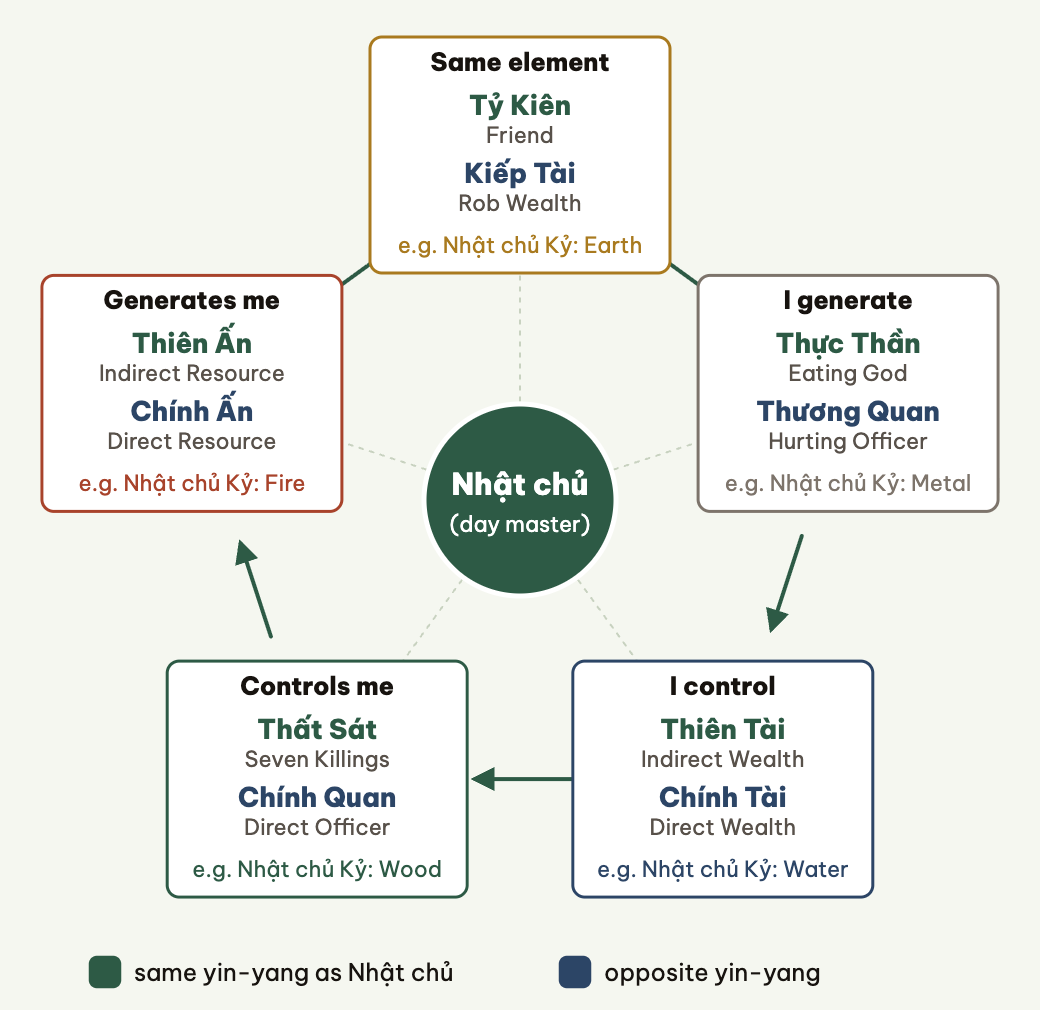
Reading by combination is the method the classical texts themselves use when discussing wealth and honor. Trich Thien Tuy, in the Luc Than Luan section, Phu The chapter, when discussing reading the wife through Tai Tinh, clearly states the method must be flexible: when the Tai god is thin, support Tai is needed; when Tai is prosperous but the self is weak, then Ty Kiep is favored; when Tai harms An, Quan tinh is needed; when Tai is few but Quan is many, Thuong Quan is needed. That is the spirit of reading by combination, not scoring each star.
How do Quan Sat read career, organization, and rank?
Quan Sat is what controls the Day Master, so it represents organization, discipline, superiors, and rank. In the common modern reading, Chinh Quan is usually tied to work within a framework, with a system, while That Sat is tied to pressure, competition, and environments demanding quick reactions. Tu Binh Chan Thuyen, in the section on Quan Sat, emphasizes that if Quan tinh meets the month command and is not broken by punishment or clash, the rank is high and suited to public office; if Quan tinh meets the month in a weak, sick, dead, tomb, or extinct state, the career path faces many difficulties. In other words, the classical text first considers whether it has command or not, then considers the combination.
One point to note is that classical texts often speak directly of the word "quan" in the sense of office in the court or in the bureaucratic system. When applied to modern times, the word "quan" is expanded to management positions, corporate titles, or positions with decision-making power. This is a shift in meaning made by later generations, not the wording in the classical texts.
How does Tai Tinh read money and assets?
Tai Tinh is what the Day Master controls, so it represents money, assets, and what one wants to hold. Trich Thien Tuy, when discussing Tai, distinguishes Chinh Tai and Thien Tai mainly by yin and yang, not as two entirely different qi. Notably, this text also states an academic view: the Tu Binh method takes Tai as wife, but taking Tai as father is a mistake of later generations. Pointing out where the text argues against another view shows that even within the tradition there was debate about assigning the six relations to Tai Tinh.
In application, Tai Tinh only indicates potential related to money, not whether one can keep it. Tu Binh Chan Thuyen, when discussing Tai and An, splits into two cases: if Tai is prosperous and controls An, the person may abandon studies for money or work outside the rules; if An is prosperous and restrains Tai, money comes slowly but lasts. Also according to this text, when the self is prosperous and Tai generates Quan, that is a good configuration; a person with prosperous Quan and Tai as the favorable useful god often holds a high position or heads a large enterprise, but Quan Sat is a double-edged sword, and if one is not strong enough to carry it, it easily cuts oneself.
Thuc Thuong generating Tai: earning money through talent and products
Thuc Than and Thuong Quan are what the Day Master generates, so they represent expressive ability, craftsmanship, products, and creativity. Because Thuc Thuong generates Tai, this combination is considered a direct source of money: the element of Thuc Thuong nourishes the element of Tai, like a tree needing roots before it blooms and bears fruit. When Thuc Than or Thuong Quan in the chart is prosperous and generates output to Tai Tinh, then even if the Day Master is somewhat weak, the person still grasps money-making opportunities, because the nourishing energy source is uninterrupted.
This explains why in practice, people who live by craftsmanship, products, content, or personal services often have Thuc Thuong as the bridge to Tai. But remember: Thuc Thuong is only a bridge, not a guarantee. If Tai Tinh is contested by Ty Kiep without Quan Sat to guard it, or is controlled by Kieu Than clashing with Thuc Thuong and cutting the source of generation, the cash flow may not be retained.
Sat An mutual generation and Quan An mutual generation: authority with education
Sat An mutual generation and Quan An mutual generation are two combinations often mentioned in classical texts when discussing honor. The general mechanism is Quan Sat generates An, An again generates the Day Master, forming a closed mutual generation chain. Tu Binh Chan Thuyen records the case of Chinh An sitting at Thien Quan, that is Sat An mutual generation, acting as the favorable useful god and leading to success. When Quan Sat is prosperous and the Day Master is weak, An Tinh plays the role of favorable god: it dissolves Quan Sat while also generating and supporting the Day Master, so the Day Master has enough strength to bear both power and responsibility. Conversely, when the Day Master is already too prosperous, Quan Sat is the controlling factor, and An Tinh can become an unfavorable god once it weakens Quan Sat or supports the self beyond measure.
In short, Sat An and Quan An mutual generation show authority accompanied by an educational foundation or family foundation, not naked power. But this is a conclusion based on the configuration, not a fixed rule: the same combination, placed in a prosperous or weak self, gives opposite conclusions.
Lookup table of common Ten Gods combinations when reading career and money
| Combination | Condition to recognize in the chart | Common reading | Source |
|---|---|---|---|
| Quan Sat with command | Quan or Sat in the month pillar, not broken by punishment or clash | High official rank, suited to public office | Tu Binh Chan Thuyen |
| Quan Sat without command | Quan Sat in the month pillar but in weak, sick, dead, tomb, or extinct state | Career faces many difficulties | Tu Binh Chan Thuyen |
| Prosperous Tai generates Quan | Prosperous self, prosperous Tai, prosperous Quan, and Tai is the favorable useful god | High position or heads an enterprise | Tu Binh Chan Thuyen |
| Prosperous Tai breaks An | Prosperous Tai, weak An, weak self | Abandons studies for money, easily works outside the rules | Tu Binh Chan Thuyen |
| Prosperous An restrains Tai | Prosperous An, Tai is held back | Money comes slowly but lasts | Tu Binh Chan Thuyen |
| Thuc Thuong generates Tai | Prosperous Thuc Than or Thuong Quan, generating Tai Tinh | Continuous source of money, earning through talent | Trich Thien Tuy, section on Tai |
| Sat An mutual generation | Prosperous Quan Sat, weak Day Master, An transforms Sat and generates the self | Authority with education, able to bear responsibility | Tu Binh Chan Thuyen |
| Quan An mutual generation | Quan generates An, An generates the self, closed mutual generation chain | Stable position, wealth may not be much | Tu Binh Chan Thuyen |
| Thuong Quan meets Quan | Thuong Quan and Chinh Quan both exposed | Depends on school: some say disaster, some say wealth if Tai bridges | Popular sayings on Thuong Quan and Quan Sat |
| Thuong Quan combines with Sat | Thuong Quan and That Sat have stems that combine | Beneficial for study and exams during the corresponding luck period | Popular sayings on Thuong Quan and Quan Sat |
| Thuong Quan generates Tai, then Tai generates Sat | Thuong Quan exposed, Chinh Quan hidden, with Tai, Sat, An linked | Continuous mutual generation, indicating honor | Popular sayings on Thuong Quan and Quan Sat |
Thuong Quan meets Quan: disaster or wealth?
This is where schools disagree most clearly. A line of sayings passed down in Tu Tru circles states directly: when Thuong Quan meets Quan in the chart, without Tai there is no office, meaning Thuong Quan meeting Chinh Quan must have Tai to bridge, and only when Quan is generated by Tai can one hold office, otherwise not. The same line also records: when Thuong Quan is the useful god, the major and annual luck periods most avoid meeting That Sat, and also avoid Chinh Quan; meeting them brings illness, lawsuits, and loss of wealth; and for exams, Thuong Quan meeting Quan is most taboo.
But there is also a reverse reading. Tu Binh Chan Thuyen, when discussing Quan Sat, mentions the case where Quan is many, then meeting Thuong Quan is welcome, meaning in some configurations Thuong Quan is what is needed to restrain Quan. The text also points out a way to resolve: whenever the four pillars show a combining element sufficient to settle Thuong Quan, then Quan tinh is preserved; for example, a yang stem meets Nham, then Nham can combine away Dinh which is Thuong Quan, or a yin stem meets That Sat can also combine away Thuong Quan.
So the honest answer is: Thuong Quan meeting Quan has no fixed conclusion. It depends on whether there is Tai to bridge, on whether the self is prosperous or weak, on the positions of the pillars, and on the school being used. This article does not choose one side as standard, but records both readings so the reader knows where debate remains.
Where schools differ: assigning industries by the element of the useful god is a modern approach
One point to state clearly to avoid confusion: classical texts such as Trich Thien Tuy and Tu Binh Chan Thuyen, when discussing career and money, mainly speak of the words wealth, honor, poverty, and lowliness, that is, prosperity and poverty, not listing job categories. Assigning industries by the element of the useful god, for example if the useful god is Moc then favorable to the East and wood, paper, tree-planting jobs; if Kim then favorable to the West and metal, mechanical jobs, is a modern approach, popular on astrology forums. It is useful as a suggestion, but not the wording in the classics.
This article does not go deep into the industry-by-element-of-useful-god part, because that topic has a separate article on directions and industries. Here it is enough to note that it is a layer of meaning added later, and the reader should distinguish between classical data and modern interpretation.
Some notes when reading the career and money section of a chart yourself
First, determine whether the self is prosperous or weak first, because all conclusions about Tai, Quan, Thuc Thuong change direction with the configuration. Second, consider the command of the birth month, as Tu Binh Chan Thuyen emphasizes when discussing Quan tinh. Third, consider the chain of mutual generation and control among the Ten Gods, not scoring each star. Fourth, remember that sayings like Thuong Quan meets Quan are data from a specific lineage, not a universal rule all schools agree on.
Finally, what Bat Tu says about career and money describes tendencies and structures, not a fixed verdict. The same combination, one person meeting favorable luck develops it, another meeting unfavorable luck faces obstacles. Read to understand your structure, not to let it decide for you.


