What are a moving line and a changed line in Liu Yao?
A moving line is a line changing state, a yang line turning into yin or a yin line turning into yang, and the new line born after that reversal is called the changed line. In Yili I Ching, a moving line is read through the line text of the original hexagram, while in Liu Yao it is read mainly through the relation between itself and the changed line it turns into, a method called reading by dong bien.
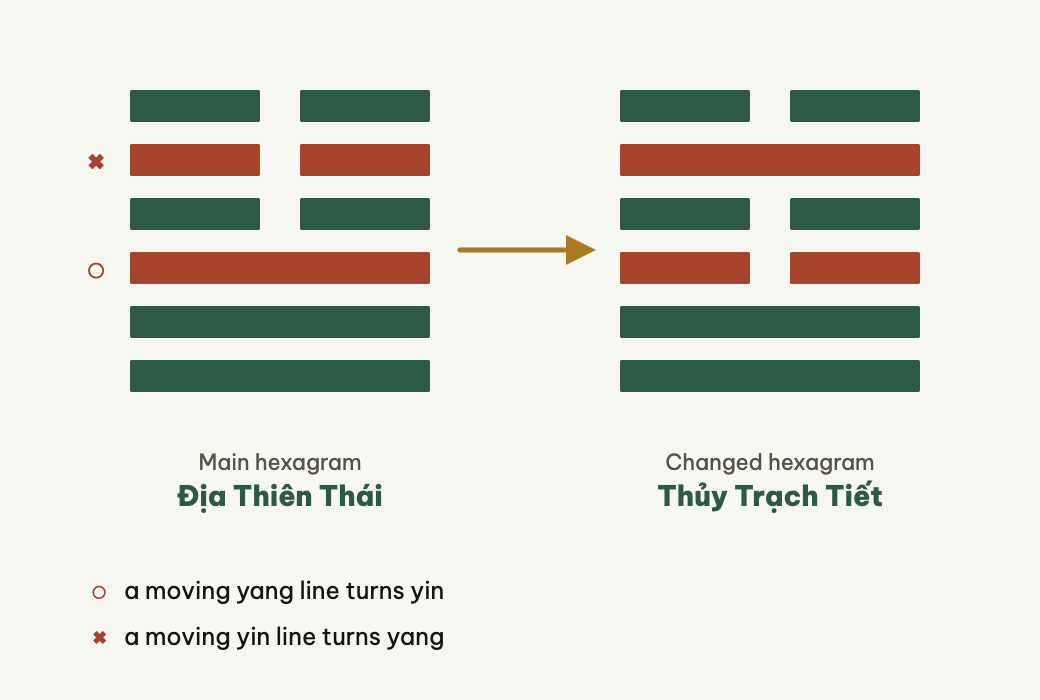
The Tang San Boc Dich by Da He Lao Ren places the Dong Bien chapter right after the The Ung chapter and before the Dung Than chapter, showing this is a required step before judging anything. A student needs to grasp the hexagram layout, know where dong bien sits, along with luc xung hexagrams, luc xung changed hexagrams, luc hop hexagrams and luc hop changed hexagrams, before deciding which line to take as Dung Than.
The two reading methods must be kept distinct. Yili I Ching reads the line text of the moving line in the original hexagram, while Liu Yao reads the element and branch relation between the moving line and the changed line. A companion article on changed hexagrams in the yili manner follows the line text, while this article follows the dong bien approach of Liu Yao. The two do not replace each other, they answer two different questions.
Table identifying transformation types by element and branch
Recognising each transformation type rests on comparing the element and branch of the moving line with the changed line, combined with the state of the moving line at the month and day of casting.
| Transformation type | Condition for recognition | Meaning usually assigned |
|---|---|---|
| Hoi dau sinh | The changed line generates the moving line by the five elements, for example a moving Thin earth line transforming into a Ngo fire changed line | Supported, recovering after upheaval, outcome leans favourable |
| Hoi dau khac | The changed line overcomes the moving line by the five elements, for example a moving Than metal line transforming into a Ngo fire changed line | Self-harm, unfavourable outcome, the moving line is checked back |
| Hoa tien than | Moving line and changed line share an element, the changed line's branch advances along the branch cycle, for example Hoi transforming into Ty, Dan into Mao | Rising force, things moving forward, direction of growth |
| Hoa thoai than | Moving line and changed line share an element, the changed line's branch retreats along the branch cycle, for example Ty into Hoi, Mao into Dan | Fading force, withdrawal, change of mind, things stalling |
| Hoa khong | The changed line falls into the tuan khong of the casting month and day | Outcome left hanging, only clear after a clash or after leaving khong |
| Hoa pha | The changed line is struck by nguyet pha, that is clashed by the month branch | Outcome easily collapses, hard to achieve |
| Hoa mo | The changed line is the mo branch of the moving line in the twelve-stage cycle | Held in confinement, only activates after a clash breaks the mo |
| Hoa tuyet | The changed line is the tuyet branch of the moving line in the twelve-stage cycle | Cut off from its source, strength exhausted |
| Phuc ngam | Moving line and changed line share both element and branch, for example Dan into Dan | Stagnation, repetition, things not budging |
| Phan ngam | Moving line and changed line share an element but their branches clash, for example Ty into Ngo, Mao into Dau | Reversal, opposition, a calm matter suddenly turning |
The table is a recognition frame, not an absolute verdict table. A line turning into tien than can still be unfavourable if the moving line is already weak, while a line turning into thoai than can still manifest in another direction if strongly overcome by nguyet kien, as in the case of a Huynh De Dau metal line transforming into Than metal while also being overcome by a Ngo fire nguyet kien, which cannot be taken lightly.
How do hoi dau sinh and hoi dau khac differ?
Hoi dau sinh is when the changed line generates and supports the moving line that produced it, while hoi dau khac is when the changed line overcomes that very moving line. The old saying sums up the two directions as the moving line being the beginning and the changed line the end, so hoi dau sinh leans toward a favourable outcome and hoi dau khac toward an adverse one.
The Tang San Boc Dich repeatedly mentions hoi dau khac in sections on fortune and fate, treating it as one of the warning signs when the The line meets it. The common explanation is that an outside overcoming force is only an impact from the environment, whereas hoi dau khac is a line creating new energy itself and then being attacked by that same energy, making it harder to resolve.
Still, not every case of hoi dau khac leads to equally bad results. If the moving line is strong at the month and day and is further supported by the Nhat than, the changed line's counter-overcoming can be softened. Conversely, a moving line already weak that also turns into hoi dau khac is even harder to turn around.
Hoa tien than and hoa thoai than: a fixed branch table
Hoa tien than and hoa thoai than are fixed data built from the twelve branch cycle. When moving line and changed line share an element, comparing branches alone tells advance or retreat.
| Element | Advancing branch | Retreating branch |
|---|---|---|
| Water | Hoi into Ty | Ty into Hoi |
| Wood | Dan into Mao | Mao into Dan |
| Fire | Ty into Ngo | Ngo into Ty |
| Metal | Than into Dau | Dau into Than |
| Earth | Thin into Tuat, Tuat into Suu, Suu into Mui, Mui into Thin | Tuat into Thin, Suu into Tuat, Mui into Suu, Thin into Mui |
The Tang San Boc Dich devotes a separate chapter to Tan Than and Thoi Than, treating tien than as rising strength with everything moving forward, and thoai than as withdrawal, change of mind and fading force. Some texts also mention a timing rule for thoai than, holding that the matter manifests when the thoai than is acted upon, for instance a Dau metal line transforming into Than metal may manifest on a Dan or Mao day, the days clashing with Dau.
One easily misread point: hoa thoai than does not mean the trouble dissolves on its own. If the moving line is also struck by nguyet pha or clashed by the Nhat than, then even with thoai transformation the matter can still be serious. This is where beginners often conclude too early.
How do hoa khong, hoa pha, hoa mo and hoa tuyet differ?
All four are adverse events but their mechanisms differ, so the way of waiting for manifestation differs too. Hoa khong is the changed line falling into tuan khong, leaving the outcome hanging. Hoa pha is the changed line struck by nguyet pha, making the outcome prone to collapse. Hoa mo is the changed line being the mo branch of the moving line, holding the moving line in confinement. Hoa tuyet is the changed line being the tuyet branch of the moving line, cutting the moving line off from its source.
The Tang San Boc Dich has separate chapters on Tuan Khong, Nguyet Pha and a section on Sanh Vuong Mo Tuyet, treating these as baseline states to master before judging dong bien. For hoa mo, the principle often cited is that one in the mo does not emerge without a clash, meaning the line in mo needs a clash to break out and exert its power, otherwise matters concerning that line tend to cost effort without success. For hoa khong, the usual wait is for a clash day or a day leaving khong. For hoa pha, if the changed line is clashed, the outcome is hard to keep unless there is rescue from the day or month or from another line.
Phuc ngam and phan ngam: of a line and of a hexagram
Phuc ngam is when moving line and changed line share both element and branch, for example Dan into Dan, Ty into Ty. Phan ngam is when moving line and changed line share an element but their branches clash, for example Ty into Ngo, Mao into Dau. Both signal stagnation or reversal, but by different mechanisms: phuc ngam repeats exactly, phan ngam opposes.
Phuc ngam and phan ngam of a line must be distinguished from those of a hexagram. At hexagram level, the Tang San Boc Dich has a Phan Phuc chapter, examining a hexagram changing into another where the six lines repeat or reverse. At line level, phuc ngam and phan ngam concern only one pair of moving line and changed line. A hexagram may have a phuc ngam line while the whole hexagram is not a phuc ngam hexagram, and vice versa.
In li khi feng shui, phuc ngam and phan ngam are also used for a stationary flying star plate or one opposed to the original Luo Shu, per Tuyen tap bai viet Phong Thuy chon loc so 3. This is the same name used in a different category, and Liu Yao students should keep the two contexts apart to avoid conflating concepts.
Where do the schools disagree?
There are at least three points on which Liu Yao books and schools still differ.
First, whether a changed line may overcome the moving line. Some books hold that a changed line can only generate or overcome the moving line in one fixed direction, that is if the moving line generates the changed line then the changed line benefits, while the changed line generating back the moving line is hoi dau sinh. Other books hold that a changed line can overcome the moving line in all cases, and call that hoi dau khac, even when the moving line is strong. The Tang San Boc Dich leans to the second when it calls hoi dau khac a warning sign, but still places it in relation to nguyet kien and nhat than.
Second, how to treat a tien than meeting tuan khong. One school holds that a tien than meeting tuan khong must wait to leave khong before acting, so during tuan khong the line counts as not yet advanced. Another school holds that a tien than meeting tuan khong keeps its advancing tendency, only the timing is pushed back. The Tang San Boc Dich keeps the Tuan Khong chapter and the Tan Than Thoi Than chapter separate, so the reading depends on how a student joins the two chapters.
Third, phan ngam of a line versus phan ngam of a hexagram. Some schools consider phan ngam only at line level, treating hexagram phan ngam as a matter of a luc xung changed hexagram unrelated to dong bien. Other schools consider both levels, holding that hexagram phan ngam is stronger than line phan ngam. The Tang San Boc Dich has both the Phan Phuc chapter and sections on dong bien, so depending on the reading a student may lean one way or the other.
How does reading a changed line differ from reading the line text of Yili I Ching?
Yili I Ching reads the line text of the moving line in the original hexagram, that is the line statement attached to that line, and the line text is advice for the situation asked about. Liu Yao reads the element and branch relation between the moving line and the changed line, that is the mechanism of generation and overcoming, advance and retreat, khong, pha, mo, tuyet, phuc and phan. The two readings do not exclude each other, but answer two different questions: the line text answers what should be done, while dong bien answers where things are heading.
One easily confused point is that some Liu Yao schools still use the line text of the original hexagram as a reference layer, while others use only dong bien. The Tang San Boc Dich mainly follows dong bien, but still mentions the line text in some places. A student should know which convention they follow so as not to mix the two into one conclusion.
Applying this when reading a hexagram with a moving line
When meeting a hexagram with a moving line, the usual sequence is: identify the moving line, identify the changed line, compare element and branch to recognise the transformation type, check the state of the moving line at the month and day, and only then judge Dung Than and the related lines. The element and branch comparison is a mechanical step independent of school, so it can be done first. The judgement of favourable or unfavourable is where school, nguyet kien and nhat than come in.
One should not declare an absolute verdict from a single transformation type. A line turning into tien than can still meet obstacles, a line turning into thoai than can still manifest in another direction, a line turning into khong can still activate after leaving khong. The safe reading is to state the transformation type, state the strong or weak condition, then state the tendency, without locking in a result.
Frequently asked questions
Can a changed line overcome the moving line?
Schools disagree. Some hold that a changed line can overcome the moving line in all cases, called hoi dau khac. Others hold that the degree of counter-overcoming also depends on whether the moving line is strong or weak at the casting month and day. The Tang San Boc Dich mentions hoi dau khac as a warning sign, but still places it in relation to nguyet kien and nhat than.
How is a tien than meeting tuan khong treated?
There are two readings. The first holds that a tien than meeting tuan khong must wait to leave khong before acting, and during tuan khong counts as not yet advanced. The second holds that a tien than keeps its advancing tendency, only the timing is pushed back. The Tang San Boc Dich keeps the Tuan Khong chapter and the Tan Than Thoi Than chapter separate, so how the two chapters are joined decides the reading.
How do phuc ngam and phan ngam of a line differ from those of a hexagram?
Phuc ngam and phan ngam of a line concern only one pair of moving line and changed line: phuc ngam is same element and same branch, phan ngam is same element with clashing branches. Phuc ngam and phan ngam of a hexagram concern all six lines of the changed hexagram, belonging to the Phan Phuc chapter in the Tang San Boc Dich. A hexagram may have a phuc ngam line while the whole hexagram is not a phuc ngam hexagram, and vice versa.

