
What is I Ching divination and why are there many casting methods?
I Ching divination is a form of divination in which one casts or divides to receive one of the 64 hexagrams, each composed of six yin or yang lines arranged from the bottom up. When casting, each line is assigned one of four numbers: 6 (old yin), 7 (young yang), 8 (young yin), 9 (old yang). Old lines (6 and 9) are moving lines, which transform into their opposite to produce a second hexagram. Different casting methods give different probabilities for the four line types, and that is precisely why the schools are not entirely equivalent when interpreting.
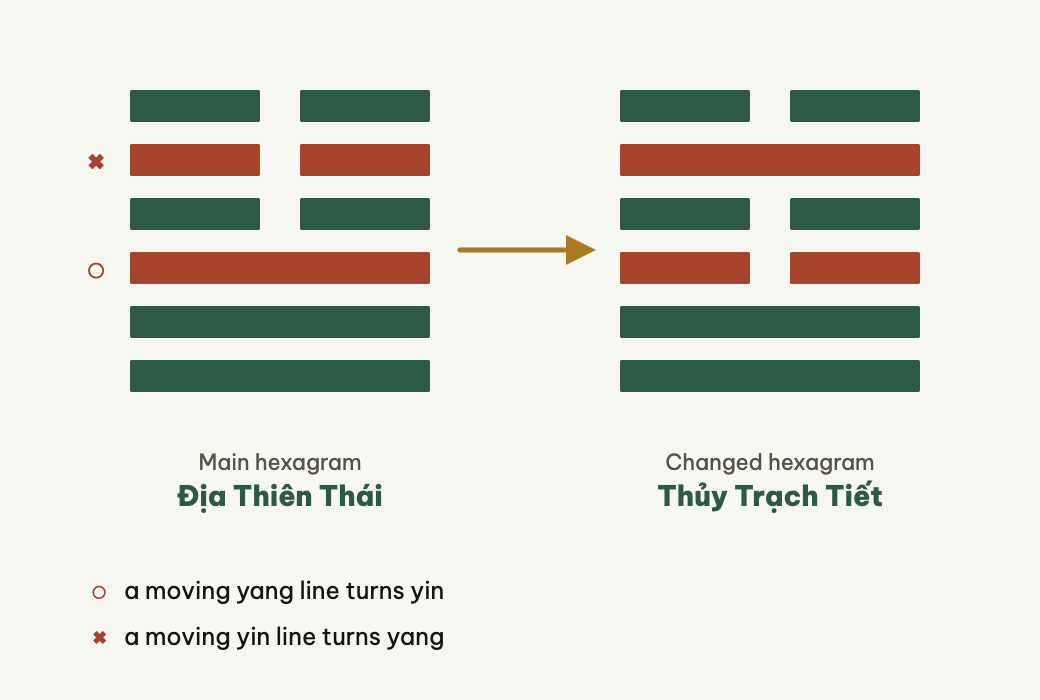
According to the English Wikipedia article on I Ching divination, there are two main methods for building lines: using 50 yarrow stalks or three coins. There are also methods of casting by interpreting time, direction, or people instead of casting or dividing. The yarrow method is often chosen by traditionalists because of its complexity and the time it takes; the coin method is for those who need quick results.
Historically, according to an overview by Le Anh Minh posted on the Ly So Viet Nam forum, plastromancy (using turtle shells) dates to the Shang dynasty, yarrow divination to the Zhou dynasty, while coin divination is of unknown origin and is regarded as a variant of yarrow divination. The same article cites Phan Boi Chau and Nguyen Hien Le, who held that the I Ching should be seen as a philosophical text rather than a divination manual, and cites Richard Wilhelm, who held that divination lacks moral significance. These are perspectives worth knowing before going into casting technique.
How is yarrow stalk divination by the Great Expansion method performed?
The yarrow method uses 50 stalks, but only 49 are used, with one set aside as the Supreme Ultimate. For each line, the diviner performs three changes (three transformations) to produce a number 6, 7, 8, or 9. The procedure involves dividing the stalks into two bundles, taking one stalk from the right bundle and holding it between the fingers, counting the left and right bundles in multiples of four, gathering the remainders, and repeating. After three changes, the remaining number of stalks divided by four gives the line. Six lines are built from the bottom up, line one (the first) first, line six (the top) last.
Yarrow allows from 0 to 6 moving lines in a hexagram. According to Wikipedia, the yarrow method favors static lines over moving lines in a 3:1 ratio. This means most yarrow hexagrams will fall into the case of no moving lines or only a few moving lines, and when there are moving lines, yang moving lines clearly predominate.
How does tossing three coins differ in probability?
Tossing three coins gives four outcomes per line: three heads, three tails, two heads one tail, two tails one head. Depending on which side is assigned yin and which yang, each outcome corresponds to a line type. This method produces a line in a single toss instead of three changes, so it is much faster.
According to Wikipedia, the three-coin method gives line probabilities of 2/16 old yin, 6/16 young yang, 6/16 young yin, and 2/16 old yang. This means the probability of yin moving and yang moving are equal, both 2/16. Meanwhile, the yarrow method gives 1/16 old yin, 5/16 young yang, 7/16 young yin, and 3/16 old yang, meaning yang moving (3/16) is three times yin moving (1/16).
Because of this discrepancy, the two methods are not equivalent in probability. Someone interpreting by yarrow will encounter more yang moving lines, while someone interpreting by coins will encounter yin moving and yang moving at equal frequency. This is a point on which the schools often disagree: some hold yarrow as the standard because of its tradition and complexity, others choose coins for convenience and hold that probability is not the deciding factor.
Table of probabilities for the four line types
| Line type | Name | Yarrow | Three coins |
|---|---|---|---|
| 6 | Old yin (yin moving) | 1/16 | 2/16 |
| 7 | Young yang (static) | 5/16 | 6/16 |
| 8 | Young yin (static) | 7/16 | 6/16 |
| 9 | Old yang (yang moving) | 3/16 | 2/16 |
The table shows that the total moving-line probability for yarrow is 4/16 (1/16 + 3/16), and for coins is also 4/16 (2/16 + 2/16). Although the totals are equal, the distribution by yin and yang is quite different, and that directly affects the transformed hexagram produced.
What is special about number-based and time-based casting?
Number-based and time-based casting do not use yarrow stalks or coins. The caster takes numbers from the moment of asking, from a name, from a date, or from any available data, then reduces them to a hexagram. According to Wikipedia, this is the group of methods that interpret time, direction, or people instead of casting or dividing. The common feature of this group is that it yields exactly one moving line, or no moving line at all, rather than allowing two to six moving lines as yarrow does.
On Tam An, the hexagram of the day using the LapQueTheoNgay tool is a convention specific to the site, not a classical I Ching school. This needs to be stated clearly so readers do not mistake it for a traditional method. Similarly, the GieoLucHao tool uses the three-coin method, while LapQueMaiHoa casts by three numbers. Each tool using a different method is intentional, because each method suits a different interpretive system.
Table comparing casting methods
| Method | Tools | Possible number of moving lines | Tool on Tam An |
|---|---|---|---|
| Yarrow (Great Expansion) | 50 yarrow stalks, 49 used | 0 to 6 | No automated tool |
| Three coins | 3 coins | 0 to 6 | GieoLucHao |
| Number-based | Three numbers or numerical data | Exactly 1 | LapQueMaiHoa |
| Time-based | Date, hour, or moment data | Exactly 1 | LapQueTheoNgay (site convention) |
Why does the same hexagram give different interpretations when cast by different methods?
Because the moving-line probabilities differ, the distribution of transformed hexagrams also differs. With yarrow, since yang moving is three times yin moving, hexagrams with yang moving lines appear more frequently, and the transformed hexagram accordingly leans in one direction. With coins, yin moving and yang moving are equal, so the transformed hexagram is more balanced. With number-based and time-based casting, since there is only one moving line, the transformed hexagram always differs from the original by exactly one line.
This leads to the reality that two people asking about the same matter, one casting by yarrow and one by coins, may get two different hexagrams, or the same original hexagram but different transformed hexagrams. The schools often disagree on which method is more reliable. Some hold that yarrow is the standard because of its tradition and because the 3:1 ratio better reflects the movement of yin and yang. Others hold that coins are sufficient, provided the querent is sincere and keeps the heads/tails convention consistent throughout the toss.
According to the book Kinh Dich tuyen tap so 6, the side with characters is often regarded as yin, the side without characters as yang, but modern translations allow users to set their own convention as long as it is kept consistent. The book also notes that three tails may be old yang, three heads old yin, while two tails one head or two heads one tail are young yang or young yin. This understanding matches the probability table above.
How do you read the hexagram after casting?
After obtaining the original hexagram, the interpreter reads the hexagram statement and the line statements. If the hexagram has no moving lines, reading the hexagram statement alone is enough. If there are one or more moving lines, read the statements of each moving line, then transform the old lines into their opposites to get the transformed hexagram and read its statement. The rules for reading according to the number of moving lines (one line, two lines, three lines, etc.) are a separate topic, outside the scope of this article. Readers who want to go deeper can see the articles on the transformed hexagram, the nuclear hexagram, the reverse hexagram, and the opposite hexagram on Tam An.
Note that every casting method gives only a frame of reference, not an absolute assertion of fortune or misfortune. Ancient books may say different things about the same hexagram, and schools may interpret the same moving line differently. Readers should treat this as a tool for reflection, not a verdict on finances, health, or destiny.
Are yarrow and coins truly equivalent?
No. The total moving-line probability of the two methods is equal (4/16), but the distribution of yin moving and yang moving is quite different. Yarrow gives yang moving three times yin moving, coins give the two types equally. Therefore, if interpreting by the transformed hexagram, the two methods will give two different distributions of transformed hexagrams. This is a point on which the schools often disagree, and also why some people choose yarrow despite it taking more time.
Philosophically, according to the Stanford Encyclopedia of Philosophy on Chinese philosophy of change, the I Ching is regarded as a system of signs that helps people orient themselves in a changing world, and divination is part of that system. Choosing which casting method to use also falls within that system, not outside it.


