
How is Hoa Cái placed in Bát Tự?
Hoa Cái is a thần sát in the Tứ Trụ system, placed by the tam hợp group of the earthly branch rather than by an individual can chi pair. The rule fits in one sentence: Dần Ngọ Tuất sees Tuất, Tỵ Dậu Sửu sees Sửu, Thân Tý Thìn sees Thìn, Hợi Mão Mùi sees Mùi. Uyên Hải Tử Bình records this rule verbatim in its section on Hoa Cái.
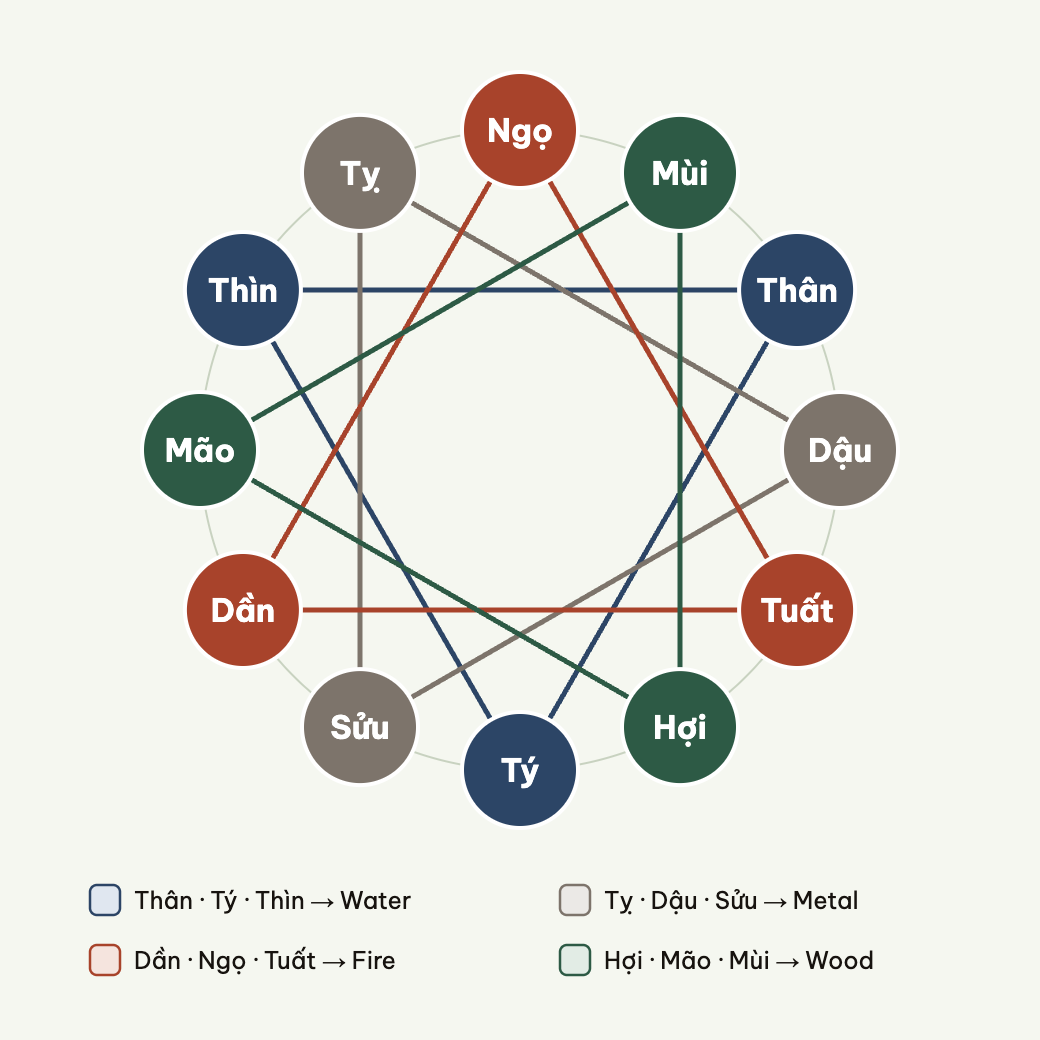
The point to remember is that the four branches chosen as Hoa Cái, Tuất, Sửu, Thìn and Mùi, are all Mộ Khố of the earthly branches. Each tam hợp group has three characters: one Trường Sinh, one Đế Vượng and one Mộ. For example, the Thân Tý Thìn group belongs to Thủy, with Trường Sinh at Thân, Đế Vượng at Tý and Mộ at Thìn. Hoa Cái is precisely that Mộ character. So saying Hoa Cái is the Mộ character of the tam hợp is a statement about structural nature, not a figure of speech.
| Tam hợp group | Trường Sinh | Đế Vượng | Mộ (Hoa Cái) |
|---|---|---|---|
| Thân Tý Thìn (Thủy) | Thân | Tý | Thìn |
| Dần Ngọ Tuất (Hỏa) | Dần | Ngọ | Tuất |
| Tỵ Dậu Sửu (Kim) | Tỵ | Dậu | Sửu |
| Hợi Mão Mùi (Mộc) | Hợi | Mão | Mùi |
This tam hợp method is shared by three familiar thần sát: Dịch Mã, Đào Hoa and Hoa Cái. Dịch Mã takes the Trường Sinh character (Thân Tý Thìn has Mã at Dần, Dần Ngọ Tuất has Mã at Thân, Tỵ Dậu Sửu has Mã at Hợi, Hợi Mão Mùi has Mã at Tỵ, per Uyên Hải Tử Bình). Đào Hoa takes the Đế Vượng character, namely Tý Ngọ Mão Dậu. Hoa Cái takes the Mộ character, namely Thìn Tuất Sửu Mùi. These three stars therefore always follow a single core logic, differing only in which of the three characters of the group is chosen.
Because they share that core logic, these three stars appear together in the Tướng Tinh ring of Tử Vi. The Tướng Tinh ring starts from Tướng Tinh, moves forward along the Thái Tuế ring, passing in turn through Phan Án, Tuế Dịch, Tức Thần, Hoa Cái, Kiếp Sát, Tai Sát, Thiên Sát, Chỉ Bối, Hàm Trì, Nguyệt Sát and Vong Thần. In Vietnamese Tử Vi charts, only three stars of this ring are commonly used: Đào Hoa (that is Hàm Trì), Hoa Cái and Kiếp Sát, and their positions match the Tứ Trụ placement: Đào Hoa at Tý Ngọ Mão Dậu, Hoa Cái at Thìn Tuất Sửu Mùi, Kiếp Sát at Hợi Tý Dần Thân.
Why should you not copy the Tướng Tinh ring table from some websites?
Some forum pages state that for Thân Tý Thìn, Tướng Tinh is placed at Tỵ. This is a typographical error, because Tướng Tinh of the Thân Tý Thìn group must be placed at Tý to match the tam hợp core. If you copy that table and reason onward, the entire Tướng Tinh ring shifts by one palace and Hoa Cái shifts with it. A quick check is to compare against the original rule in Uyên Hải Tử Bình: Hoa Cái always falls on Thìn Tuất Sửu Mùi, Đào Hoa always falls on Tý Ngọ Mão Dậu. Any table giving a different result is wrong.
Why do texts link Hoa Cái to art, religion and scholarship?
Uyên Hải Tử Bình quotes Hồ Trung Tử: Hoa Cái is a star of art, governing cô quả. The text also notes that this star is like a canopy shielding kings and nobles. The canopy image suggests both solemnity and a separate shelter: the person seated under the canopy is set apart from the crowd, in a different ritual position.
From that image, the texts develop two directions of meaning. The first is talent and knowledge. A person with Hoa Cái is often described as intelligent, fond of learning, gifted in painting, music and literature, and sensitive to spiritual, philosophical and fate-calculation fields. The second is separation. Precisely because they blend less into the crowd, those carrying this star are said to drift easily into solitude, find it hard to share, or tend toward an inner life.
It should be stated clearly that this is a label-based reading, not a causal mechanism. Old texts observed a type of person and gave that type a name; they did not prove that anyone with Hoa Cái becomes an artist or lives alone. Uyên Hải Tử Bình itself writes "the majority" and "even if noble, one cannot avoid solitude", meaning an empirical tendency, not an inevitable law.
What must accompany Hoa Cái for it to mean scholarship or religion?
This is where schools disagree, and students should know that several readings run in parallel.
The first reading, common in modern Tử Bình texts, holds that Hoa Cái only becomes scholarly when accompanied by Ấn tinh, especially Chính Ấn in a vượng position. The argument is that Hoa Cái by itself is only a marker of separation, while Ấn is the thập thần governing study, credentials, and the guidance of elders and tradition. Hoa Cái meeting a strong Ấn gives talent a foundation to develop into a scholar or a teacher.
The second reading ties Hoa Cái to Văn Xương and Văn Khúc. When Hoa Cái travels with this literary star pair, texts usually discuss gifts for writing, art and examinations. When Hoa Cái meets Không Vong, the meaning usually leans toward religion, practice and seclusion. Uyên Hải Tử Bình notes in its Thập Can Học Đường section that a person with this star is intelligent, penetrating, passes examinations, but "if Không Vong is violated, they teach". By the same logic applied to Hoa Cái, Không Vong removes talent's foothold in ordinary life and drives it into the inner life.
The third reading, found in some modern Bát Tự texts, holds that Hoa Cái meeting Tam Kỳ or noble stars such as Thiên Ất can mark a scholar indifferent to fame and profit, living in seclusion or working in spiritual fields. These texts also cite an old saying that if Hoa Cái sits on Trường Sinh, Lâm Quan or Đế Vượng the person is a Daoist priest, while if in the Bại Tuyệt Mộ Tử directions they take up religious life. This reading goes by vượng or suy position, not merely the star's presence.
The three readings do not exclude one another. They differ only in which criterion is taken as the standard for when Hoa Cái shifts from "separation" into "a specific profession".
Do schools place Hoa Cái by the year branch or the day branch?
There is a real difference here, and readers should know which convention they are following.
The classical placement, found in Uyên Hải Tử Bình and most Tử Bình texts, takes the year branch as its base. The reason is that thần sát originally belong to the year-branch system, tied to the Thái Tuế and Tướng Tinh rings, both of which start from the birth year. Placement by year branch yields a fixed Hoa Cái in the chart, unchanged by luck periods.
Some modern schools, especially when discussing marriage and relationships, also place Hoa Cái by the day branch. The argument is that the day branch is the Phu Thê palace and also the root of the person, so a thần sát placed by day branch reflects more closely what happens in private life. This resembles how some texts handle Cô Thần and Quả Tú: taking the year branch as standard but adding the day or month branch when discussing marriage.
The practical consequence is that the same chart can have two or three different Hoa Cái positions depending on the school. Readers should determine which convention an article follows before comparing results across sources. This article follows the classical convention, placing Hoa Cái by the year branch, and notes that day-branch placement is still used in some places.
How does Hoa Cái in Tử Vi read by palace differ from Hoa Cái in Bát Tự?
In Tử Vi, Hoa Cái is a star of the Tướng Tinh ring, placed by the year branch, and read by the palace it occupies. This creates a major difference in interpretation compared with Bát Tự.
In Bát Tự, Hoa Cái is one character within a can chi combination, read in relation to the Nhật Chủ, the Thập Thần and other thần sát. Its meaning depends on which pillar it occupies, which can chi it travels with, and whether the Nhật Chủ has enough strength to use it.
In Tử Vi, Hoa Cái affects whichever palace it occupies. Hoa Cái in Mệnh differs from Hoa Cái in Phúc Đức, which differs from Hoa Cái in Tật Ách. Reading by palace allows a clearer distinction between a person whose artistic talent shows outwardly and one with a rich inner life that is little expressed. In addition, Hoa Cái in Tử Vi is read alongside other stars in the palace; with Thiên Hình, for example, the meaning of tăng đạo, religious practice, is emphasized more.
Because the two systems share a star name but differ in reading, readers should keep the two areas separate. This article discusses only Hoa Cái in Bát Tự. Hoa Cái in Tử Vi, including palace reading and combination with other stars, belongs to a separate article.
Is the cô quả label in old texts a verdict?
Uyên Hải Tử Bình states clearly in its Hoa Cái section: "Whenever a person's fate meets it, the majority govern cô quả; even if noble, one cannot avoid solitude; the majority who meet it are judged to be tăng đạo". This sentence should be read as it is: an empirical observation by the text's author, using the words "the majority" twice in the same passage.
"Cô quả" here is a label within an interpretive system, not a forecast that the reader will live alone or have no one beside them. The label describes a type of person who tends to separate from the crowd, has a strong inner life, and therefore may share little with those around them. Sharing little does not mean having no relationships. A person can have a full family and still carry that separateness in their way of thinking.
The texts also note that Hoa Cái does not always lean toward disadvantage. When Hoa Cái receives support from good stars, or sits in a harmonious mệnh cục, it becomes a resource for career and talent. Old documents record that if Hoa Cái meets Chính Ấn and sits in vượng tướng, the person may achieve greatly in scholarship and career. Conversely, when Hoa Cái travels with sát tinh and Không Vong, the meaning usually leans toward religion, seclusion, or paths with less competition.
One more point to note: the same Mộ character carries different meanings in different pillars. Hoa Cái in the year pillar speaks of lineage and early life. Hoa Cái in the month pillar speaks of upbringing and career. Hoa Cái in the day pillar speaks of the self and marriage. Hoa Cái in the hour pillar speaks of children and later life. Reading by pillar is often skipped, leading people to see only the words "cô quả" and worry unnecessarily.
What should be cross-checked when interpreting Hoa Cái?
Because Hoa Cái is the Mộ character of the tam hợp, it relates directly to Dịch Mã and Đào Hoa in the same group. These three stars are often read together to avoid one-sided conclusions.
| Star pair | Common reading |
|---|---|
| Hoa Cái and Dịch Mã | Mã governs movement, Cái governs separation. Together they often describe someone who moves a great deal yet keeps a private inner life, or travels far to study or practice |
| Hoa Cái and Đào Hoa | Đào Hoa governs attraction, Cái governs reserve. Together they often describe someone magnetic but hard to approach, or a romance that comes and goes |
| Hoa Cái and Ấn tinh | Ấn governs scholarship and tradition. Together they lean toward academia, teaching and research |
| Hoa Cái and Văn Xương, Văn Khúc | Literary stars govern writing and art. Together they lean toward composition, performance and examinations |
| Hoa Cái and Không Vong | Không Vong removes the foothold in ordinary life. Together they lean toward religion, practice and seclusion |
The table above lists only common reading directions, not hard rules. In actual interpretation one must also weigh the Nhật Chủ's strength, the favorable and unfavorable five elements, and Hoa Cái's position in the whole mệnh cục. A strong Hoa Cái in the month pillar of a harmonious chart does not read the same as a weak Hoa Cái in the hour pillar of a clashing chart.
Key takeaways about Hoa Cái
Hoa Cái is the Mộ character of the tam hợp, always on Thìn Tuất Sửu Mùi, sharing the tam hợp method with Dịch Mã and Đào Hoa. Old texts link it to art, religion and scholarship and use the cô quả label to describe a separate type of person. Schools differ on whether to place it by year branch or day branch, and on whether Hoa Cái must accompany Ấn, Văn Xương or Không Vong to carry scholarly or religious meaning. In Tử Vi, the star of the same name is read by palace, unlike the Bát Tự reading. The cô quả label is an empirical observation in old texts, not a fixed forecast about the reader's relationships.


