
What are Shen Sha in BaZi and how do they differ from the Ten Gods?
Shen Sha are an auxiliary layer of stars read into the four pillars after the stems and branches of the four pillars have been set. Unlike the Ten Gods, which are the generating and controlling relationships between the Day Master and the other stems, Shen Sha do not grow out of the five-element relations between pillars; they are mostly fixed lookup tables: from a given stem or branch, you match out another branch or stem. In Liu Ren, the book Liu Ren, volume 1: Introduction classifies Shen Sha by four roots: year Shen Sha counted by year, month Shen Sha counted by month, stem Shen Sha counted by stem, and branch Shen Sha counted by branch, and stresses that stem Shen Sha matter most because the stem is the self. This classification helps explain why in BaZi some stars take the day stem, some take the year branch, and some take the day branch.
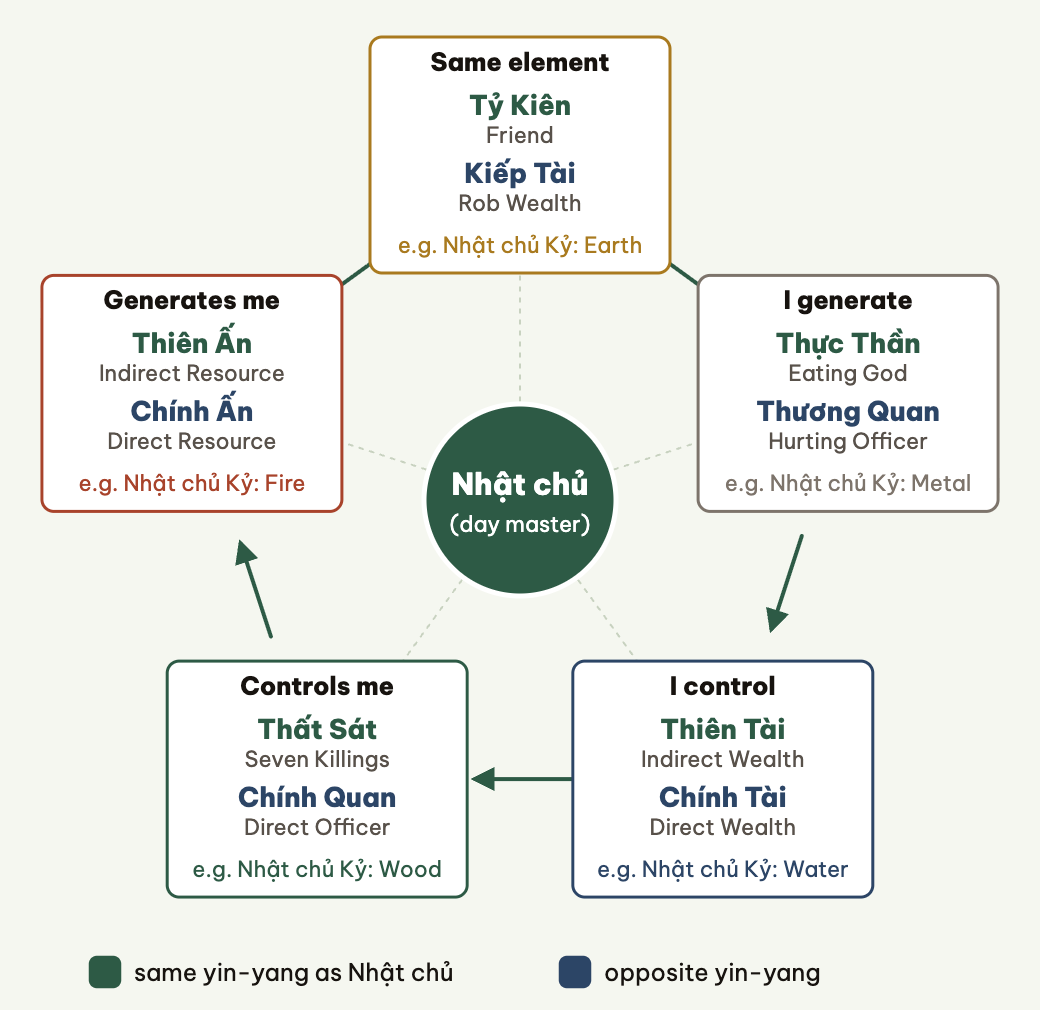
As for role, Shen Sha are not the main axis of interpretation. The main axis is still the strength or weakness of the Day Master and the favorable Useful God. A star called auspicious, such as Tian Yi Gui Ren, standing in a chart that is declining still saves nothing; conversely a star classed as inauspicious, such as Yang Ren, if it is a favorable god, is still useful. The Vietnamese metaphysics forum Lyso.vn, discussing Jing Yang, also notes two sides: Jing Yang mostly governs stagnation, disaster, loss, but if the self is weak and meets it, it has the function of protecting the self, and the old saying "When Officer and Seal support each other, only with Jing Yang does one bring the Lu home" shows it is not purely inauspicious.
Do you read Shen Sha from the day stem, the year branch, or the day branch?
Three common methods are: from the day stem, from the year branch, and from the day branch. There is no single standard for every star, and this is exactly what creates differences between schools. The group of stars based on the day stem includes Tian Yi Gui Ren, Wen Chang, Lu, and Yang Ren (Jing Yang). The group based on the year branch or day branch includes Yi Ma, Tao Hua (Han Chi), Hua Gai, Jie Sha, Wang Shen, and Zai Sha. Kong Wang is different: it is not read from the stem or branch of a specific pillar but calculated from the Jia cycle of the day or year, that is, using the same Jia-cycle method already present in the core of Liu Yao.
The reason many stars take the year branch is that the year branch represents the root of one's age, the environment one was born into, and one's year trine group. The reason many stars take the day branch is that the day branch is the palace of the self, the palace of marriage, closer to the person being read. In practice, many practitioners read both and compare: if a star appears in both the year branch and the day branch, its effect is considered stronger; if it appears on only one side, it is weaker. The book Liu Ren, volume 1: Introduction also notes the general principle that Shen Sha must be placed on the heavenly plate, not the earthly plate, meaning they must be set on the correct moving layer, the correct operating position.
Lookup table for some common Shen Sha
| Shen Sha | Root | How to look up | Core meaning |
|---|---|---|---|
| Tian Yi Gui Ren | Day stem | Jia, Wu: Chou, Wei; Yi, Ji: Zi, Shen; Bing, Ding: Hai, You; Ren, Gui: Mao, Si; Geng, Xin: Yin, Wu or Wu, Yin (two versions) | Noble helper, relief from trouble, support |
| Wen Chang | Day stem | Jia Si, Yi Wu, Bing Shen, Ding You, Wu Shen, Ji You, Geng Hai, Xin Zi, Ren Yin, Gui Mao | Learning, exams, letters |
| Yi Ma | Year branch or day branch | Shen Zi Chen: Yin; Yin Wu Xu: Shen; Hai Mao Wei: Si; Si You Chou: Hai | Movement, change, travel |
| Tao Hua (Han Chi) | Year branch or day branch | Shen Zi Chen: You; Yin Wu Xu: Mao; Hai Mao Wei: Zi; Si You Chou: Wu | Romance, attractiveness, emotion |
| Hua Gai | Year branch or day branch | Shen Zi Chen: Chen; Yin Wu Xu: Xu; Hai Mao Wei: Wei; Si You Chou: Chou | Talent, religion, solitude |
| Yang Ren (Jing Yang) | Day stem | Stem at its peak: Jia Mao, Yi Chen, Bing Wu, Ding Wei, Wu Wu, Ji Wei, Geng You, Xin Xu, Ren Zi, Gui Chou | Fierceness, breakthrough, disaster |
| Kong Wang | Jia cycle of the day or year | Per the Jia cycle, the two branches at the head of the cycle have no stem pairing | Emptiness, void, reduced force |
The table above lists only the most common versions. Where two versions exist, this article presents both rather than choosing one.
How do Tian Yi Gui Ren and Wen Chang differ?
Tian Yi Gui Ren is a star of relief from trouble, considered the leading auspicious star in the day-stem group. Wen Chang is a star leaning toward learning, exams, and letters. Both take the day stem as root, but Tian Yi is broader: it corresponds to meeting a supporter, escaping a bad situation, being introduced to opportunities. Wen Chang is narrower, leaning toward the path of words, degrees, books, and writing work.
With Tian Yi, the lookup table has one point of disagreement: the Geng and Xin stems. The common version gives Geng and Xin as Yin and Wu; another version gives Geng and Xin as Wu and Yin, that is, swapping the two branches for the two stems. The swap does not change the set of branches, but it changes which stem corresponds to which branch when reading each stem separately. Students should state clearly which version they use.
The way Tian Yi is used in practice also has variants. The book Selected BaZi Articles, volume 6 (Thien Hoa Dong Nhan, rewritten version, for reference only) mentions the Gong Gui Ge: when the day stem and hour stem are the same, and the branch between the two pillars is exactly the Tian Yi Gui Ren of that stem, it is called virtual support, considered a noble configuration. The four combinations named are Jia Yin day, Jia Zi hour supporting Chou; Ren Chen day, Ren Yin hour supporting Mao; Bing Xu day, Bing Shen hour supporting You; Wu Shen day, Wu Wu hour supporting Wei. This is a way of reading Tian Yi through pillar structure, not just through a single lookup, and the condition for the configuration to form also depends on the month command not being mixed with observers.
Yi Ma, Tao Hua, and Hua Gai: the branch trine group
These three stars all take root from the year branch or day branch and all use the four trine groups Shen Zi Chen, Yin Wu Xu, Hai Mao Wei, Si You Chou. Yi Ma corresponds to the branch opposite the trine group, symbolizing movement. Tao Hua corresponds to the branch in the cardinal position (Zi Wu Mao You), symbolizing romance and attractiveness. Hua Gai corresponds to the branch in the tomb position (Chen Xu Chou Wei), symbolizing talent, religion, and solitude.
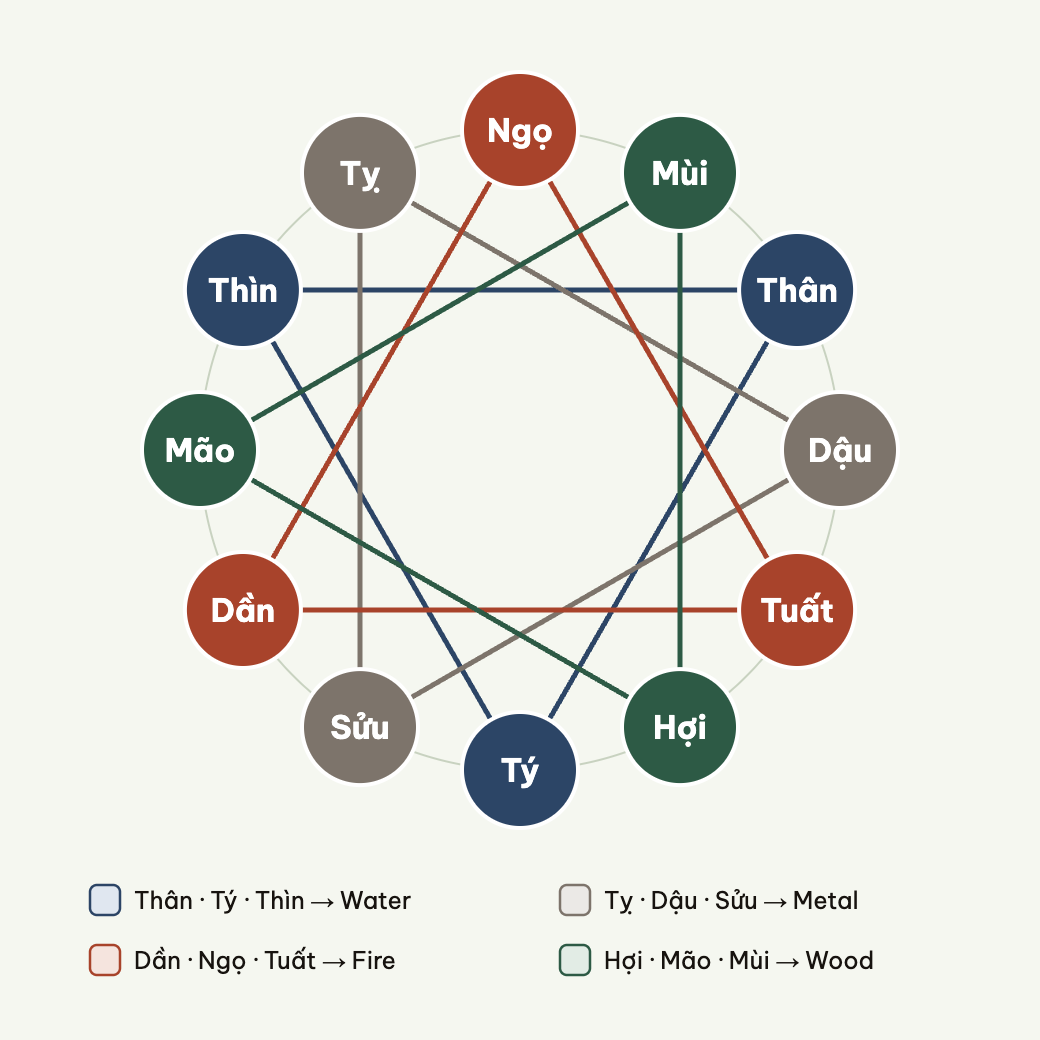
On Tao Hua, one point needs clear distinction: Tao Hua in BaZi is read from the trine group of the year branch or day branch, while Tao Hua in Tu Vi is a star placed by palace and by gender, an entirely different lookup. The two share a name but not a calculation. Readers should determine which system they are using before comparing results.
On Hua Gai, the book Selected BaZi Articles, volume 2 (Thien Hoa Dong Nhan, rewritten version, for reference only) cites the idea from San Ming Tong Hui that a person with Hua Gai mostly governs solitude, and in short even when noble cannot avoid loneliness, and also notes that Hua Gai often appears in people who work in spirituality, study philosophy or religion, or have an artistic inclination. Selected BaZi Articles, volume 8 (same series) mentions an old saying, to the effect that this path leads to taking refuge, wandering here and there, or a solitary scene; even so, this source also adds that the final situation is decided by the combination of stems and branches, the Ten Gods, and other supporting stars, and Hua Gai by itself does not equal solitude.
Yang Ren and Jing Yang: one star, two faces
Yang Ren, also called Jing Yang, is read from the day stem: take the branch where the day stem is at its peak. For example, if the day stem is Xin, then the branch Shen is Jing Yang, because Xin is at its peak at Shen. The Vietnamese metaphysics forum Lyso.vn notes that Jing Yang has both good and bad but mostly governs bad: stagnation, disaster, injury, loss, and even crime. The old saying "Jing Yang clashing with the year lord is extremely bad disaster" stresses meeting or clashing with the annual branch.
But the same source also gives the opposite face: if the self is weak and meets Jing Yang, it cannot be considered bad, because the branch shares the element of the self and helps the self become less weak. When there is Lu, Officer and Seven Killings, and Seal, Jing Yang can play a protective role, and the sayings "Meeting Seven Killings without Jing Yang means no success, having Jing without Seven Killings means no authority" show that Jing Yang is a star that demands reading by structure, not by an auspicious or inauspicious label.
When discussing the punishment and clash of Yang Ren, Selected BaZi Articles, volume 3 (Thien Hoa Dong Nhan, rewritten version, for reference only) also gives a similar note: one must judge on the whole chart, rather than peering at one star or one relationship alone.
Kong Wang in BaZi and Kong Wang in Liu Yao
Kong Wang is the state of a branch having no stem pairing in the Jia cycle. Each Jia cycle contains ten stem-branch days, and the remaining two branches of the sixty Jia Zi have no stem pairing in that cycle, so they are called empty. In BaZi, Kong Wang is usually calculated from the Jia cycle of the day, sometimes also from the Jia cycle of the year.
The understanding of Kong Wang in BaZi and in Liu Yao shares the same Jia-cycle root but differs in use. The book Selected I Ching Articles, volume 2 (Thien Hoa Dong Nhan, rewritten version, for reference only) states that Kong Wang indicates an earthly branch that receives no generating support or has no correspondence in the cycle, causing the line carrying that branch to weaken or become ineffective, and there are two main schools: Kong Wang by month and Kong Wang by day. Selected I Ching Articles, volume 6 (same series) adds that a Kong Wang line has reduced force, if a line is in combination but also Kong Wang the combination may not form, and checking Kong Wang is a step that cannot be skipped when analyzing line combinations.
In BaZi, Selected BaZi Articles, volume 5 (Thien Hoa Dong Nhan, rewritten version, for reference only) states: when Kong Wang meets auspicious gods such as Tian Yi Gui Ren, Tian Yue De Gui Ren, or Long De, it can be resolved, though the blessing is still partly depleted; this source also mentions the concept of "true Kong Wang", that is, the case of Kong Wang in the strict sense, not covered by combination, punishment, or any good star. Also according to that source, if the month, day, and hour all fall into Kong Wang without meeting harm, that case is considered a great noble. This is an example showing Kong Wang is not purely inauspicious.
Why do Zi Ping Zhen Quan and Di Tian Sui play down Shen Sha?
These two books focus on strength or weakness, the month command, configuration, and the Useful God. For them, the good or bad of a chart is decided by the generating and controlling relations between the pillars and the balance of the chart, not by a list of stars. So Shen Sha are mentioned only as an auxiliary layer, used to highlight a feature already present in the structure. Folk manuals are the opposite: many put star names first and judge good or bad by star name, making students easily think that just looking up a star is enough to predict fortune.
In practice, a reasonable way to reconcile is: determine the favorable Useful God first, then look at Shen Sha. A star coinciding with a favorable god highlights the good side; a star coinciding with an unfavorable god highlights the bad side; a star standing alone, not tied to favorable or unfavorable, is usually just a side note. This way keeps the spirit of Zi Ping Zhen Quan and Di Tian Sui while still using the star treasury of folk manuals.
Points where schools disagree
First, reading by year or by day. With Yi Ma, Tao Hua, and Hua Gai, some books take the year branch, some take the day branch, some take both. Results can differ, especially when the year branch and day branch are not in the same trine group.
Second, the Tian Yi table for the Geng and Xin stems. One version gives Geng and Xin as Yin and Wu; another gives Geng and Xin as Wu and Yin. The set of branches is the same but the assignment to each stem differs.
Third, Tao Hua in BaZi and Tao Hua in Tu Vi. The two systems use two different lookups, and the result of one cannot replace the other.
Fourth, attitude toward Shen Sha. Zi Ping Zhen Quan and Di Tian Sui play them down, folk manuals emphasize them. This article follows the convention of treating Shen Sha as an auxiliary layer, read after strength or weakness and the Useful God; readers following another school may give Shen Sha more weight, and that should be stated clearly when interpreting.
Reading Shen Sha correctly: a few practical principles
- Always determine the favorable Useful God before looking up stars. If the favorable Useful God is not yet clear, see the article on the Useful God and the article on strength or weakness in the same BaZi section.
- State clearly whether you read from the day stem, the year branch, or the day branch for each star, because the result depends on the root of the lookup.
- For stars with two versions, such as Tian Yi for Geng and Xin, state clearly which version is being used.
- Do not add up the number of stars to conclude good or bad. A chart with many auspicious stars but a weak favorable Useful God is still not good; a chart with many inauspicious stars but a strong favorable Useful God can still prosper.
- Read Shen Sha in relation to the major luck cycle and the annual cycle, because many stars only activate when the cycle touches them, for example Jing Yang meeting or clashing the annual branch.
A short conclusion for beginners looking things up
Shen Sha are a convenient lookup tool, helping you quickly read the side features of a chart: noble help, learning, movement, romance, talent, fierceness, emptiness. But they cannot replace strength or weakness, the month command, configuration, and the Useful God. The safe way to use them is to look up stars to check against conclusions already drawn from the structure, not to use stars to finalize conclusions in place of the structure.


