
What Is Dịch Mã and How Is It Looked Up by Tam Hợp?
Dịch Mã is a thần sát (spirit-star) marking movement, relocation, and busyness, usually looked up by the Tam Hợp (Triad) group of the root branch. The familiar formula: Thân Tý Thìn has Mã at Dần, Dần Ngọ Tuất at Thân, Tỵ Dậu Sửu at Hợi, Hợi Mão Mùi at Tỵ. In other words, the root branch and the Mã branch are always one clash-position apart within the Tam Hợp circle, and Mã always falls on one of the four branches Dần, Thân, Tỵ, Hợi.
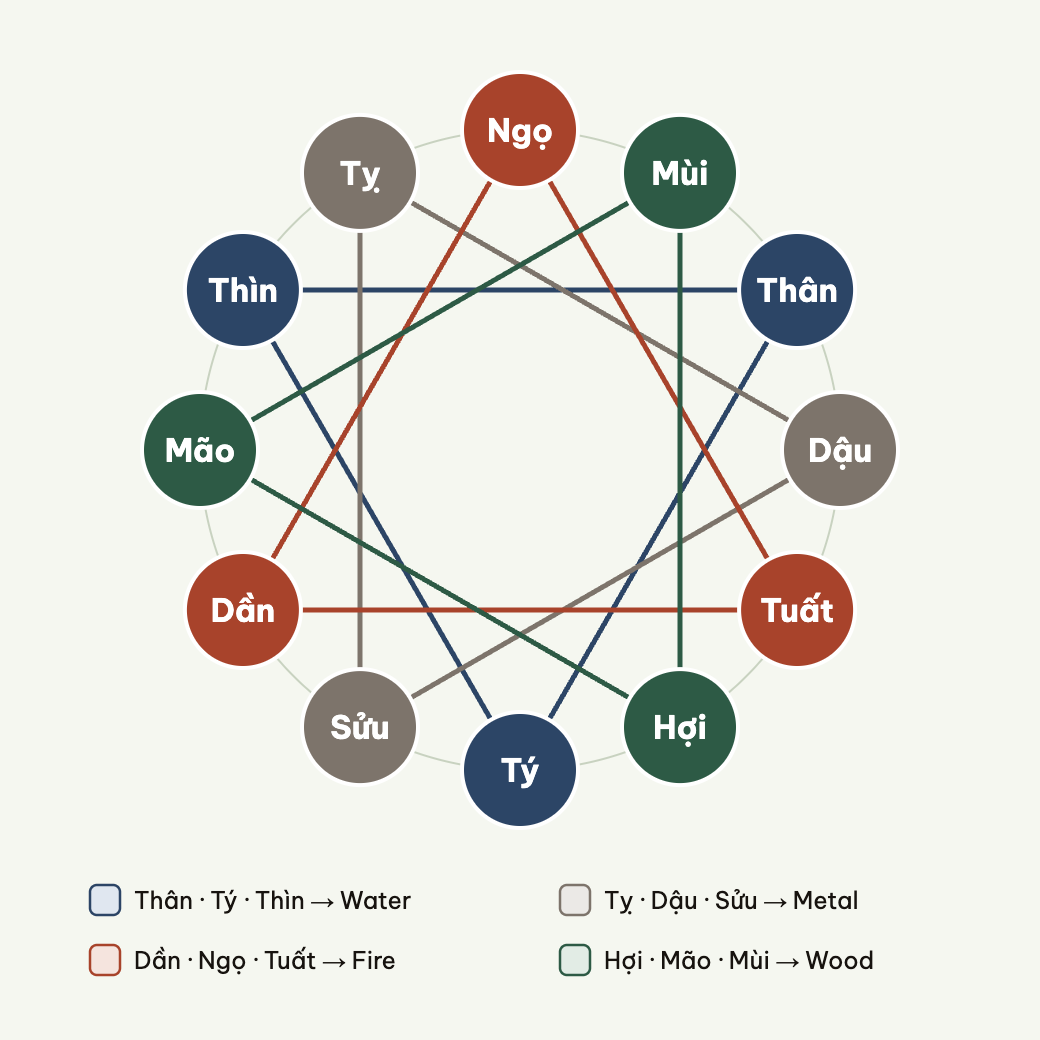
The naming has many variants. Old texts often use the words Mã, Dịch Mã, Thiên Mã, Trạch Mã. In Tử Vi, this star is called Thiên Mã and is placed by the birth-year branch. In Bát Tự (Four Pillars) texts, Mã and Thiên Mã are two different concepts, so Mã is usually called Dịch Mã to avoid confusion.
As for the imagery: in ancient times the horse was the transport and courier of state offices, hence Dịch Mã. The Hiệp Kỷ Biện Phương Thư records that Dịch Mã in the first month starts at Thân, moving backward through the four Tứ Mạnh palaces Thân, Tỵ, Dần, Hợi; by mid-twelfth month, Dần is Công Tào, Thân is Truyền Tống, Hợi is Thiên Môn, Tỵ is Địa Hộ, all images of roads, so Mã is bound to roads.
The 12-Branch Table for Finding the Dịch Mã Branch
The table below is the result of the lookup by the core calculation, cross-checked cell by cell against Uyên Hải Tử Bình under the section Luận Dịch Mã and the article Dịch Mã và Lộc Mã. The thienMaViTri function of the Tử Vi core gives the same table, so a single shared function is enough rather than writing a second one.
| Root branch | Tam Hợp | Dịch Mã branch |
|---|---|---|
| Tý | Thân Tý Thìn | Dần |
| Sửu | Tỵ Dậu Sửu | Hợi |
| Dần | Dần Ngọ Tuất | Thân |
| Mão | Hợi Mão Mùi | Tỵ |
| Thìn | Thân Tý Thìn | Dần |
| Tỵ | Tỵ Dậu Sửu | Hợi |
| Ngọ | Dần Ngọ Tuất | Thân |
| Mùi | Hợi Mão Mùi | Tỵ |
| Thân | Thân Tý Thìn | Dần |
| Dậu | Tỵ Dậu Sửu | Hợi |
| Tuất | Dần Ngọ Tuất | Thân |
| Hợi | Hợi Mão Mùi | Tỵ |
Because the same Tam Hợp gives the same Mã branch, twelve root branches yield only four Mã branches. This is why the lookup table has only four values, and why a second function should not be written for Tử Vi: the thienMaViTri function returns exactly those four values.
Why Does Mã Always Fall on Dần, Thân, Tỵ, Hợi?
Lý Hư Trung calls Dịch Mã "Dịch cư Bệnh Phương," because Mã sits at the four corners Dần, Thân, Tỵ, Hợi. Dần is the position of Water's illness, Thân of Fire's illness, Tỵ of Wood's illness, Hợi of Metal's illness. Spoken in terms of the Trường Sinh (Long Life) cycle of the cục, these four branches are where the Trường Sinh of the cục is clashed, so the ancients called it the land of illness. The word Dịch in Dịch Mã is therefore understood as Phục Dịch, Dịch Vụ, and also as Dịch Bệnh.
Cross-checking with the table above: the Thân Tý Thìn cục takes Water as its root, Water's Trường Sinh is at Thân, the clash of Thân is Dần, so Mã is at Dần. The Dần Ngọ Tuất cục takes Fire as its root, Fire's Trường Sinh is at Dần, the clash of Dần is Thân, so Mã is at Thân. The Tỵ Dậu Sửu cục takes Metal as its root, Metal's Trường Sinh is at Tỵ, the clash of Tỵ is Hợi, so Mã is at Hợi. The Hợi Mão Mùi cục takes Wood as its root, Wood's Trường Sinh is at Hợi, the clash of Hợi is Tỵ, so Mã is at Tỵ. The four branches Dần Thân Tỵ Hợi are the four Tứ Mạnh palaces, and also the four branches clashing with the Trường Sinh of the cục, so Mã always falls there.
Year Branch or Day Branch as Root?
This is where the schools disagree. The Tam Mệnh Thông Hội allows both: using either the year branch or the day branch as root is acceptable. Depending on each school's interpretive method, a few Bát Tự texts also state clearly that when placing this star, one may choose either the year branch or the day branch. Most introductory materials use the year branch as root because it is the familiar and easy lookup. Some schools favor the day branch, arguing that the day branch is closer to the Nhật Chủ (Day Master) and reflects one's own movement more accurately.
The practical handling is to look up both roots and note both Mã positions if they differ. When the two roots give two different Mã branches, the interpreter should state clearly which convention they follow, rather than quietly picking one side and presenting it as if there were only one way.
What Mã Says and Does Not Say
Mã speaks of movement, relocation, busyness. Its core nature is động (movement), activity, wandering. In Tử Vi, Mã carries the Fire element, and Fire flames upward, is hasty, hot, rising, so Mã is also movement. Old texts also say Càn is Mã; Càn is hard, strong, highly active, and that too is Mã's character. Hence Mã is forceful, resilient, fond of activity.
Mã says nothing about absolute fortune or misfortune. Mã is not inherently good or bad; it only amplifies the tendency to move. Mã standing alone shows only movement, not yet results. A familiar folk saying is "Mã without Lộc runs forever without a destination." Old texts also record that Mã tightly combined is as if absent, while Mã clashed away travels a thousand miles a day; this shows Mã's nature is strongly influenced by other factors.
Mã also says nothing about health or finances in an affirmative sense. The Tam Mệnh Thông Hội Toàn Văn has a line that the five elements fear excess and perversity, and that much Mã brings illness; but that is only an observation about excess, not a fixed conclusion for every chart with many Mã.
Common Combinations
This section only names the configurations, the meaning the texts assign, and the source, without going deep into interpretation.
- Lộc Mã giao trì: Mã meets Lộc Tồn or Hóa Lộc. Old texts record this as an auspicious configuration, signaling fast money, career advancement, especially when the native moves, changes jobs, or goes abroad. Thiên Mã governs movement in career and wealth.
- Mã meeting a clash: Mã clashed moves more strongly. Old texts record that Mã clashed away travels a thousand miles a day. Mã Tinh is associated with movement and travel.
- Mã falling into Không Vong: Mã meets Không Vong. The Tam Mệnh Thông Hội records that if the Tứ Trụ have Mã but the Mệnh does not meet Không Vong, Phá bại, Giao, Thoái, Phục Thần, then one is certain to have glory, wealth, and honor. Source: the article Dịch Mã và Lộc Mã on Lý số Việt Nam.
Other combinations such as Mã đầu đeo tiễn, Cửu Địa Mã, and Mã nhiều bệnh are also mentioned in texts, but each has its own conditions and is outside this article's scope.
Does Mã Need a Clash to Become Active?
This is where the schools disagree. One view holds that Mã must be clashed to truly move, because Mã is a post-horse and needs a spur to run. Another view holds that Mã is movement by itself, and a clash only makes it move more strongly rather than being a required condition. Old texts record that Mã tightly combined is as if absent, while Mã clashed away travels a thousand miles a day, implying that clash strengthens Mã, but they do not say Mã without clash is inactive.
The reconciliatory reading is that Mã always carries the meaning of movement, while clash is an amplifying factor. When interpreting, one should state clearly which view one follows rather than asserting there is only one way.
Tử Vi's Thiên Mã Shares the Position but Is Read by Palace
Tử Vi's Thiên Mã shares its position with Bát Tự's Dịch Mã, both lying in the four palaces Dần, Thân, Tỵ, Hợi, called the four Mã địa. The thienMaViTri function of the Tử Vi core gives the same table as the Bát Tự lookup above, so a single shared function is enough.
The difference is in how it is read. In Tử Vi, Mã is read by the palace it occupies, in combination with the stars in that palace's tam phương tứ chính (the three directions and four corners). Mã in the Mệnh palace differs from Mã in the Thiên Di palace, and from Mã in the Tử Tức palace. In Bát Tự, Mã is read by the pillar in which it appears, in combination with that pillar's can-chi and thập thần. So the same position unfolds with different meanings, and one system's reading should not be applied directly to the other.
One more point: Tử Vi places Mã by the birth-year branch, while Bát Tự may place it by the year branch or the day branch. When comparing the two systems, one should note which root is being used.
Applications and Limits
The main application of Dịch Mã is to identify the tendency to move within a chart: prone to changing place, changing job, traveling far, tied to work requiring much travel. Mã is also commonly used to discuss timing of upheaval, such as when the đại vận (major cycle) or lưu niên (annual cycle) touches the Mã branch.
Limits to remember: Mã does not decide fortune or misfortune by itself. Mã is only one thần sát and must be placed within the whole Tứ Trụ or the whole Tử Vi chart to mean anything. A strong, well-supported Mã can bring agility, adaptability, and renown; a weak Mã meeting bad stars or strongly clashed can lead to drifting and worry. But these are tendencies, not fixed conclusions about a specific person's destiny, finances, or health.


