What are the Six Relatives and Six Beasts in a Liu Yao hexagram?
In a Liu Yao hexagram, each line is given two labels at once. The first layer is the Six Relatives: Father-Mother, Brother, Child-Grandchild, Wife-Wealth, Officer-Ghost. The second layer is the Six Beasts: Azure Dragon, Vermilion Bird, Hook Chen, Coiling Snake, White Tiger, Dark Warrior. These two layers are independent and do not replace each other.
The book Zeng Shan Bu Shi Yi by Elder Ye He places two separate sections in its first volume: one on the Six Relatives, one on the Six Spirits (that is, the Six Beasts). This separate presentation shows that the ancients considered these two layers to be different matters, not combined in interpretation.
An easy point of confusion: the Six Relatives are attached to lines according to the hexagram structure, fixed once the hexagram is cast. The Six Beasts are attached according to the stem of the casting day, so the same hexagram cast on different days will yield different Six Beasts. This is why many tools print both layers next to each line.
How are the Six Relatives calculated from the generating and controlling relation between the line and the palace?
The calculation of the Six Relatives starts from the element of the hexagram palace, called the palace element. Each line has its own element. Comparing the line's element with the palace's element according to the five-element generating and controlling rules gives the line's Six Relatives label.
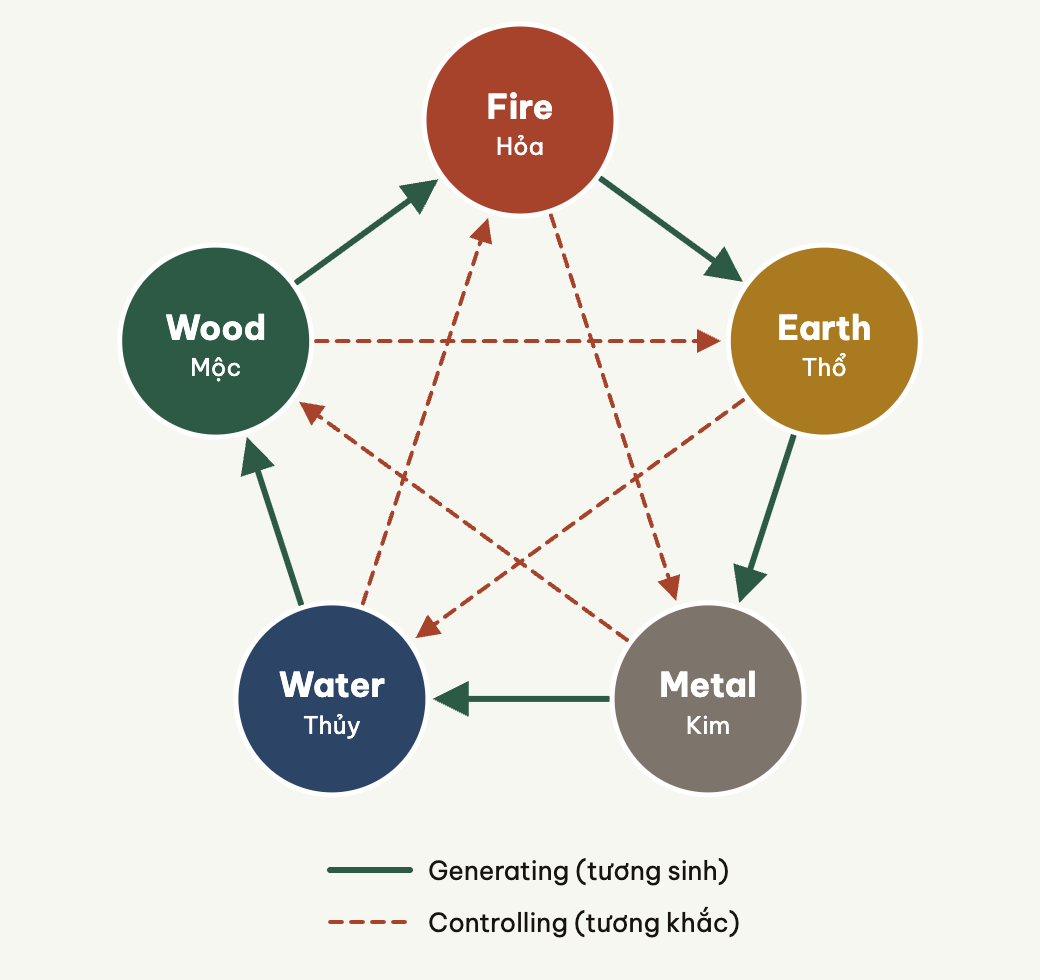
Basic principles:
- Palace element generates line: the line is Child-Grandchild.
- Line generates palace element: the line is Father-Mother.
- Line shares element with palace: the line is Brother.
- Line controls palace element: the line is Officer-Ghost.
- Palace element controls line: the line is Wife-Wealth.
An easy example: the Qian palace belongs to Metal. The Shen and You lines also belong to Metal, sharing element with the palace, so they are Brother. The Chen, Xu, Chou, Wei lines belong to Earth, Earth generates Metal, so they are Father-Mother. The Hai and Zi lines belong to Water, Metal generates Water, so they are Child-Grandchild. The Yin and Mao lines belong to Wood, Metal controls Wood, so they are Wife-Wealth. The Si and Wu lines belong to Fire, Fire controls Metal, so they are Officer-Ghost.
Comparing with the Six Relatives table in the introductory article that lists "Self and Other" as the sixth row: that arrangement wrongly mixes Self and Other into the same group as the Six Relatives. Self and Other are two special positions in the hexagram, not one of the five relatives. The correct Six Relatives table has only five rows: Father-Mother, Brother, Child-Grandchild, Wife-Wealth, Officer-Ghost. Self and Other should be separated into their own section.
What does each relative represent?
The book Zeng Shan Bu Shi Yi devotes a whole chapter, the Useful Spirit chapter, to teaching how to choose which line serves as the Useful Spirit according to the matter asked. That choice is precisely choosing the corresponding relative. Common assignments:
| Six Relatives | Relation to palace element | Matters and people usually represented |
|---|---|---|
| Father-Mother | Line generates palace | Parents, elders, teachers, documents, contracts, houses, papers, study |
| Brother | Line shares element with palace | Siblings, friends, colleagues, competitors, loss of wealth, division |
| Child-Grandchild | Palace generates line | Children, students, blessings, health, joy, medicine, averting disaster |
| Wife-Wealth | Palace controls line | Wife, money, assets, goods, profit, servants |
| Officer-Ghost | Line controls palace | Husband, officials, career, illness, disaster, lawsuits, oppressors |
This table is a common assignment, not a rigid formula for all cases. The same relative can carry different meanings depending on the question. For example, when asking about exams, Officer-Ghost is career; when asking about illness, Officer-Ghost is the illness; when asking about a lawsuit, Officer-Ghost is the opposing side. The book Zeng Shan Bu Shi Yi emphasizes that one must consider who the querent is and what the matter is, then choose the Useful Spirit, rather than mechanically following the relative's name.
Also note: Child-Grandchild carries the meaning of averting disaster, so when seeking career and Child-Grandchild holds the Self line or moves in the hexagram, the book Zeng Shan Bu Shi Yi ranks it as unfavorable for seeking fame. Conversely, when asking about illness, Child-Grandchild is the line that removes the illness. The same relative reverses meaning according to the question.
How are the Six Beasts assigned from the casting day stem?
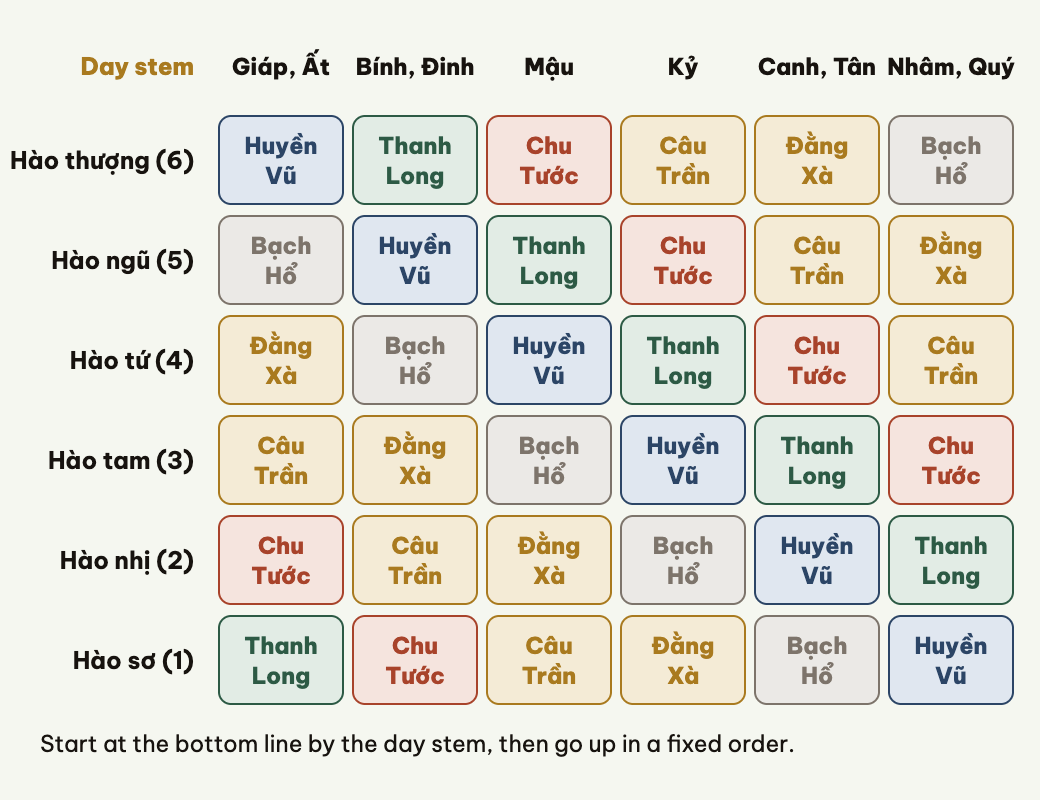
The Six Beasts are assigned according to the stem of the day the hexagram is cast, starting from the first line and moving up in a fixed order. That order is: Azure Dragon, Vermilion Bird, Hook Chen, Coiling Snake, White Tiger, Dark Warrior.
The starting point at the first line depends on the day stem:
| Day stem | First line starts with |
|---|---|
| Jia, Yi | Azure Dragon |
| Bing, Ding | Vermilion Bird |
| Wu | Hook Chen |
| Ji | Coiling Snake |
| Geng, Xin | White Tiger |
| Ren, Gui | Dark Warrior |
After assigning the first line, the lines above follow that same order upward. For example, on a Jia day, the first line is Azure Dragon, the second is Vermilion Bird, the third is Hook Chen, the fourth is Coiling Snake, the fifth is White Tiger, the sixth is Dark Warrior.
Where schools disagree: some books have Wu start with Hook Chen and Ji start with Coiling Snake, while other books reverse them. In this article I follow the convention that Wu starts with Hook Chen and Ji starts with Coiling Snake, because this is the common way in the editions of Zeng Shan Bu Shi Yi and Bu Shi Zheng Zong circulating in our country. Learners should know there are variant versions to avoid confusion when comparing books.
Why do the Six Beasts only add flavor and not determine fortune?
The Six Beasts do not carry their own element in the five-element generating and controlling way like the Six Relatives. It is a layer of color over the line, indicating what form the matter takes if the line responds: loud or quiet, public or secret, joyful or mournful, dispute or theft.
The book Zeng Shan Bu Shi Yi, when discussing fortunes, states: if Azure Dragon or Heaven Joy holds the Self line or generates the Self line, it indicates joy; if Ghost breaks and moves, it indicates mourning. If Flying Snake or Vermilion Bird meets a Brother line holding the Self line, and Ghost moves to control the Self line, beware of gossip, disputes, lawsuits. If Dark Warrior meets a Brother line holding the Self line, and Ghost moves to control the Self line, beware of thieves or harmful people.
Reading these passages carefully shows the condition for fortune lies elsewhere: Self, Ghost moving, generating or controlling. The Six Beasts only indicate the type of matter. For the same moving Ghost line controlling the Self line, meeting Vermilion Bird leans toward gossip, meeting Dark Warrior leans toward theft. Remove the Six Beasts, fortune still remains; remove fortune, the Six Beasts have nothing to attach to.
For this reason, some books downplay the Six Beasts, even using them only for fun verification after interpreting with the Six Relatives and generating-controlling. The book Bu Shi Zheng Zong by Wang Wei De has sections refuting many ancient views, showing that even within the tradition there is debate about the importance of auxiliary labels. Learners should treat the Six Beasts as a clarifying layer, not a deciding one.
What is the cycle of Original Spirit, Enemy Spirit, and Adversary Spirit around the Useful Spirit?
Once the Useful Spirit is chosen, the four lines around it are usually classified as follows:
- Original Spirit: the line that generates the Useful Spirit.
- Enemy Spirit: the line that controls the Useful Spirit.
- Adversary Spirit: the line that generates the Enemy Spirit, indirectly strengthening it.
- Drain Spirit: the line generated by the Useful Spirit, draining its strength.
Example using Father-Mother as the Useful Spirit. Then Brother is the Drain Spirit, because Father-Mother generates Brother. Child-Grandchild is the Adversary Spirit, because Father-Mother controls Child-Grandchild. Wife-Wealth is the Enemy Spirit, because Wife-Wealth controls Father-Mother.
This classification is not fixed by relative name but shifts with the Useful Spirit. Change the Useful Spirit, and the whole cycle changes. This is an easy mistake when memorizing the table without grasping the principle.
A note on terminology: Liu Ren books use a slightly different set of names, calling the lines Zheng Shi, Ke Shen, Chou Shen, Sheng Shen, Zhu Shen. The corresponding rules are close to Liu Yao naming but not entirely identical. Liu Ren books also note that if the hexagram has no Sheng Shen line, then the Zhu Shen line is itself the Ke Shen line. This is a Liu Ren detail and should not be applied directly to Liu Yao.
Where do the schools differ?
There are at least three notable differences among books and schools:
- How much weight is given to the Six Beasts. Some books use them as a main interpretive layer, others only to add flavor after interpretation. The book Zeng Shan Bu Shi Yi places the Six Spirits in a separate section, apart from the Useful Spirit and generating-controlling, showing an auxiliary role. Some other materials devote many chapters to the Six Beasts, making beginners think they are as important as the Six Relatives.
- How to start the Six Beasts for Wu and Ji. As noted, some books have Wu start with Hook Chen, Ji with Coiling Snake; others reverse. Learners need to know which convention their edition uses.
- How to assign meanings to each relative. The same relative: one book says parents, another expands to teachers, elders, documents. The degree of expansion varies.
Additionally, some books distinguish the Six Beasts by season and line position, for example which line Hook Chen or Coiling Snake sits on leans toward certain matters. These details belong to deeper interpretation and should not be put in introductory sections, as they easily make beginners think they are rigid rules.
Key takeaways
The Six Relatives are a structural label layer, calculated from the line's element compared with the palace's element, used to choose the Useful Spirit according to the question. The Six Beasts are a label layer based on the day stem, assigned from the first line upward in fixed order, used to add flavor to the line. Fortune and misfortune lie in generating-controlling, strength-weakness, movement-stillness, void, month break, not in the Six Beasts. When interpreting, choose the Useful Spirit first, determine the cycle of Original Spirit, Enemy Spirit, Adversary Spirit, then read the Six Beasts as a clarifying layer. Where schools differ on starting the Six Beasts for Wu and Ji, one must state which convention is being followed, not silently pick one side.


