
Thuần Ly (離, ䷝) is the 30th hexagram among the 64 I Ching hexagrams. Another name is Ly Vi Hoả, or simply Ly. It is made of two Ly trigrams (☲) stacked, with both the inner and outer trigram being Ly, fire over fire, light over light.
What is the structure of Thuần Ly?
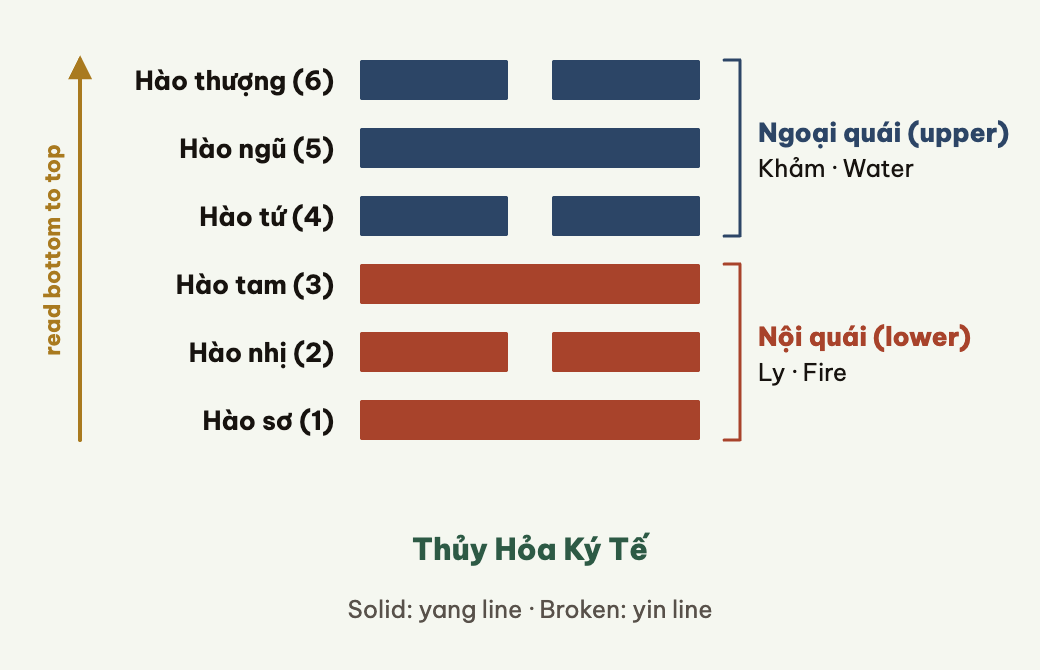
Thuần Ly has six lines, from bottom to top: Sơ Cửu, Lục Nhị, Cửu Tam, Cửu Tứ, Lục Ngũ, Thượng Cửu. Each Ly trigram has two yang lines flanking a yin line in the middle, so the whole hexagram has four yang lines and two yin lines. The two yin lines sit in the second and fifth positions, both central positions of the lower and upper trigrams. Its five phases element is Fire. Its opposing hexagram (thác quái) is Thuần Khảm (hexagram 29), Khảm over Khảm, water over water.
According to the Tự Quái truyện, Ly follows Khảm. Thuần Khảm and Thuần Ly close the Upper Canon of the I Ching, before the Lower Canon begins with Hàm and Hằng. This arrangement shows Khảm and Ly as a foundational pair: Khảm is danger, Ly is light, danger and light go together.
Why does the character Ly mean both to separate and to cling?
This is a point the texts often stress. The Thoán truyện says: "Ly, lệ dã" (離, 麗也), meaning Ly is to cling to, to adhere to, to rely on. But the character Ly in Chinese also means to separate, to part, to be distant. These two meanings do not conflict when placed side by side. Fire must cling to wood to burn, light must have an object to shine on to be seen, so clinging is the condition for shining. But once it clings to one place, fire cannot leave on its own; it burns only there, and when the wood is gone it separates from that place and goes out. Clinging and separating are two faces of the same process.
Some texts emphasize the meaning "to cling," to rely on. Others emphasize "bright," radiant. Trình Di and Chu Hy in the classical commentaries usually read Ly as clinging, then derive the brightness from that. Modern commentators sometimes stress the brightness first. This article follows the convention of reading Ly as "clinging" first, "bright" second, and notes the difference so readers can compare.
What does the judgment of Thuần Ly say?
Original Chinese: 離:利貞,亨;畜牝牛,吉
Hán Việt reading: Ly: Lợi trinh, hanh; súc tẫn ngưu, cát.
Meaning: Holding to the right path is beneficial, success; nurturing a cow is auspicious.
The phrase "súc tẫn ngưu" (畜牝牛) is the strangest part of the judgment. A cow is among the gentlest of animals, completely opposite to the rising force of fire. The classic suggests that a flame burns long only when something soft nurtures it nearby. Brightness without gentleness beside it soon goes out. This is an important caveat: Ly is not advice to flare up for brilliance, but advice to keep gentleness while shining.
What does the image text of Thuần Ly say?
Original Chinese: 明兩作,離;大人以繼明照于四方
Hán Việt reading: Minh lưỡng tác, Ly; đại nhân dĩ kế minh chiếu vu tứ phương.
Meaning: Two lights arise in succession, called Ly; the great person continues the light to shine over the four directions.
Two Ly trigrams stacked is the image of today's sun then tomorrow's sun, the sun rising then the bright moon. No flame burns forever alone. Lasting light comes from being continued. From this the image draws its lesson: one who does great work must have a successor, must pass the fire to the next generation so the light travels far and shines in all four directions.
How are the six line texts of Thuần Ly explained?
The six lines of Ly describe six ways light operates, read from the bottom up.
- Sơ Cửu (履錯然,敬之,無咎 / Lý thác nhiên, kính chi, vô cữu): Steps still in disarray, holding reverence brings no fault. This is the beginning stage, the feet still misaligned. The line does not say to walk straight at once, only to keep reverence for the work, for those who came before, for a situation not yet fully understood.
- Lục Nhị (黃離,元吉 / Hoàng ly, nguyên cát): Yellow light, greatly auspicious. This is the finest line of the hexagram. Yellow in the I Ching is the color of the center, of harmony. The person here shines without glare, holds a position without overshadowing others.
- Cửu Tam (日昃之離,不鼓缶而歌,則大耋之嗟,凶 / Nhật trắc chi ly, bất cổ phẫu nhi ca, tắc đại điệt chi ta, hung): The sun declining, if one does not drum on a pot and sing, then comes the sigh of great old age, misfortune. Same declining scene, two ways of receiving it, two outcomes. One who accepts the law of things keeps enjoying what is present.
- Cửu Tứ (突如其來如,焚如,死如,棄如 / Đột như kỳ lai như, phần như, tử như, khí như): Suddenly it comes, it burns, it dies, it is cast away. This is the heaviest line of the hexagram. A fire flaring up abruptly, burning fiercely, then dying down. The lesson: fire without wood soon goes out, brightness without foundation harms itself.
- Lục Ngũ (出涕沱若,戚嗟若,吉 / Xuất thế đà nhược, thích ta nhược, cát): Tears flowing, grieving and sighing, auspicious. This is the ruling line, a high position. Surprisingly, the line describes weeping yet calls it auspicious. The common reading holds that the person here has become aware of the pressure of the position, has recognized the weight of responsibility and personal limits. To weep before acting is better than to act wrongly out of arrogance.
- Thượng Cửu (王用出征,有嘉折首,獲匪其醜,無咎 / Vương dụng xuất chinh, hữu gia chiết thủ, hoạch phỉ kỳ xú, vô cữu): The king uses it to go on campaign, success means beheading the leader, capturing but not taking the followers, no fault. The line is very humane: behead only the ringleader, do not pursue the followers. This is the principle of one with authority: strict at the source, lenient with those connected.
How many readings does the Cửu Tứ line have?
The Cửu Tứ line is where commentaries differ most clearly. One classical reading takes "đột như kỳ lai như" as the scene of a rebellious child driven from home, rushing in then being pushed out, flaring then being abandoned. This reading stresses unfilial, disobedient conduct, rejected by family and society.
Another reading takes it as the image of a flame flaring up then going out at once, with no fuel to burn on. This reading stresses the physical law of fire: fast flare, fast end. Both readings lead to the same lesson about prominence without foundation, but differ on the subject. This article does not choose one as standard, only records both so readers know where the schools disagree.
How does Thuần Ly stand beside Thuần Khảm?
According to the Tự Quái truyện, Khảm and Ly are the pair closing the Upper Canon. Side by side, the two hexagrams show two poles of one axis: Khảm is danger, water, the deep sinking place; Ly is light, fire, the place where one clings and burns. Facing Khảm, one worries about crossing danger; facing Ly, one worries about keeping the light. Both are pure hexagrams, one trigram over itself, so the degree of the quality is also pure, undiluted.
What is Thuần Ly used for in life?
Reference sites today often divide applications by field, but this division is for reference, not an absolute verdict.
- Romance: The hexagram is often read as signaling a passionate relationship, strong attraction, easy mutual feeling. But a strong fire needs good wood to burn long, so the reminder is to check the foundation: whether the two understand each other enough, share enough life values, can bear each other when romance fades.
- Career: Leans toward a period of attention, of being spotlighted. It may be a promotion, a successful project, a praised presentation. The accompanying reminder is still "nurture a cow": while shining, keep humility, gentleness, listening.
- Wealth: Signals a time of large income opportunity but with risk. Fire can cook food, it can also burn a house. The danger is that spending easily flares up with income. The Cửu Tứ line warns directly: it comes suddenly then dies.
- Health: Usually read as pointing to issues related to heat and internal heat, such as inner heat, inflammation, fever, eye problems, heart and blood pressure issues. This is a hint to pay attention to care, not a medical diagnosis.
It must be said clearly: different reference sites give lists of fortune and misfortune that are not entirely the same. Some sources hold that Ly signals difficult fortune, that the brightness is only illusion, that career is not yet ready for major moves. Other sources stress the successful, favorable side of the judgment. This difference arises from how each place weighs the judgment against the line texts, the meaning of clinging against the meaning of brightness. Readers should look at both sides rather than choose one.
Quick reference table for Thuần Ly
| Item | Content |
|---|---|
| Number | 30 / 64 |
| Hán Việt name | Thuần Ly (純離) |
| Other names | Ly Vi Hoả (離為火), Ly |
| Symbol | ䷝ |
| Structure | Ly ☲ over Ly ☲ (Fire over Fire) |
| Inner trigram | Ly ☲, image of fire and light |
| Outer trigram | Ly ☲, image of fire and light |
| Five phases | Fire |
| Number of yang lines | 4 / 6 |
| Opposing hexagram (thác quái) | Thuần Khảm (hexagram 29) |
| Judgment | Ly: Lợi trinh, hanh; súc tẫn ngưu, cát |
| Image text | Minh lưỡng tác, Ly; đại nhân dĩ kế minh chiếu vu tứ phương |
Is Thuần Ly an auspicious hexagram?
Thuần Ly is not an absolutely auspicious or inauspicious hexagram. The judgment says "lợi trinh, hanh," meaning holding to the right path brings success, but adds the condition "súc tẫn ngưu," meaning one must keep gentleness. The six line texts range from very good, like Lục Nhị "nguyên cát," to very heavy, like Cửu Tứ "phần như, tử như, khí như." This shows the hexagram speaks of how light operates in each stage, not a fixed verdict for every situation.
A reasonable reading treats the hexagram as a map of six stages: a stumbling start with reverence brings no fault, keeping yellow light is very good, at the declining hour one must enjoy the present, flaring without foundation dies, in a high seat with worry is good, and with enough authority use light to quell disorder but be lenient with those connected. The lesson throughout is clinging to the right place and light that knows how to continue.
Structure of Thuần Ly in one table
| Item | Value |
|---|---|
| Number in the Chu Dịch | 30 |
| Chinese character name | 離 |
| Upper trigram | Ly (Fire) |
| Lower trigram | Ly (Fire) |
| Six lines, top to bottom | yang, yin, yang, yang, yin, yang |
| Nuclear hexagram | Trạch Phong Đại Quá (hexagram 28) |
| Opposing hexagram | Thuần Khảm (hexagram 29) |
| Reversed hexagram | Thuần Ly (hexagram 30) |


