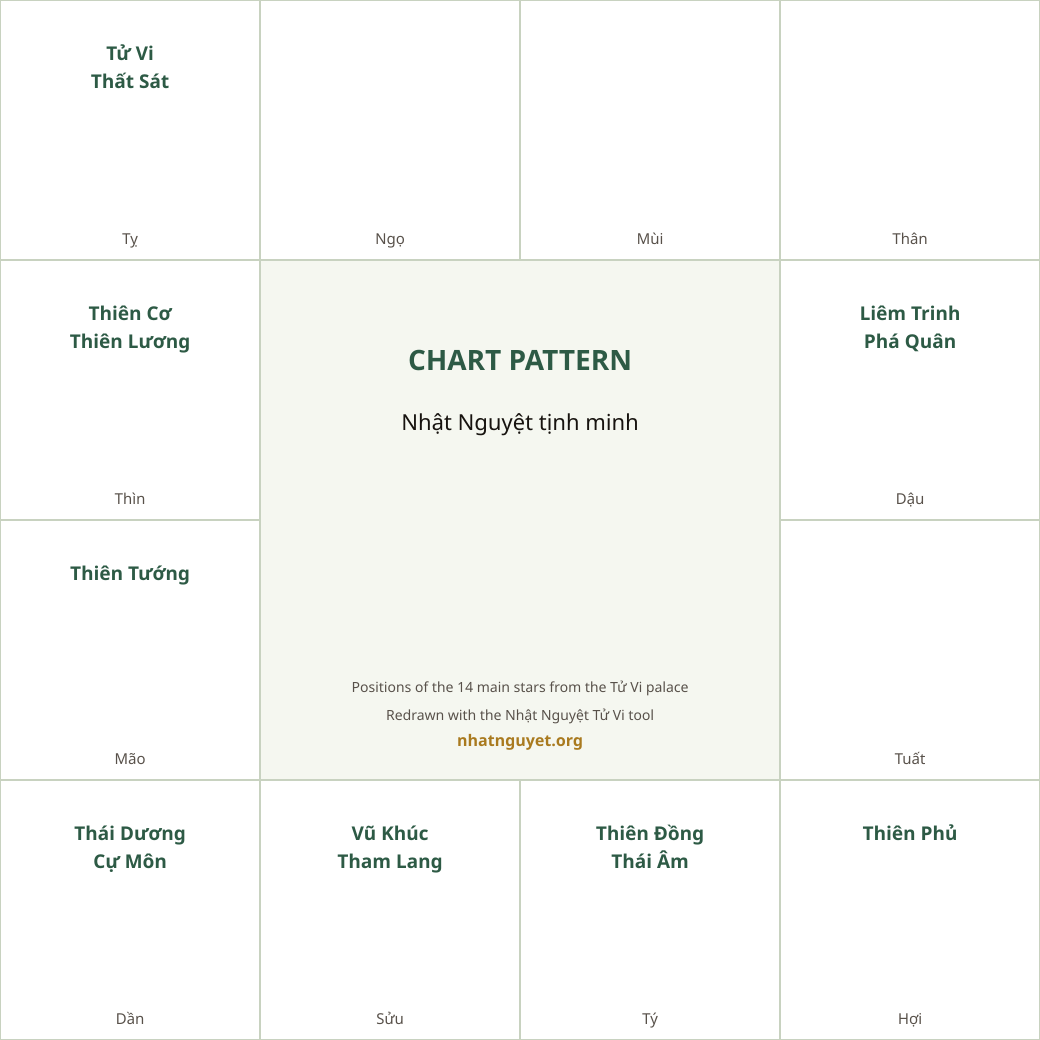
TL;DR: Thái Dương is a yang star belonging to the Hỏa element, symbolizing light, fame, and the father; the degree of good or bad depends greatly on whether this star is miếu or hãm địa according to birth hour and cung vị. According to the site's star placement table, Thái Dương is miếu at Tỵ Ngọ, vượng at Dần Mão Thìn, đắc at Sửu Mùi, hãm at Thân Dậu Tuất Hợi Tý; some books place it a few cung off, so cross-checking is needed. The same set of stars, placed in a bright cung or a dark cung, gives opposite results, typically Nhật Lương at Mão is better than at Dậu, and Cự Nhật at Dần is rated higher than at Thân.
What is the origin and meaning of the name of the Sun Star?
Thái Dương (太陽) literally means "the sun", one of the fourteen most important principal stars of Tử Vi Đẩu Số (Vietnamese astrology), belonging to the Fire element and purely Yang in nature. In the star system, Thái Dương and Thái Âm (the moon) form the "sun and moon" pair symbolizing the two poles of light and dark, father and mother, career and emotion. Thái Dương governs the noble energy of career and the blessings of the male side of the family, and also represents the father, the husband, or an influential man in the life of the person whose chart is being read.
Thái Dương is the star that expresses abundant yang energy, warmth and light; in Tử Vi, this star governs career, authority, reputation, clarity and transparency. Its imagery includes the father, the husband, the eyes, creative ability and the role of command. When it sits in a miếu or vượng position, this star indicates a smooth life and career, developing and prospering.
A summary table of the miếu, vượng, đắc and hãm positions of the Sun Star by palace and time of day.
| State | Palace | Time of day | Main meaning |
|---|---|---|---|
| Miếu địa | Mão, Thìn, Tỵ | Morning to midday | Illustrious career, support from benefactors |
| Vượng | Ngọ | ||
| Đắc địa | Dần, Sửu, Mùi | ||
| Hãm địa | Tuất, Hợi, Tý | Night | Hardship, obstructed career, prone to misunderstanding or undeserved blame |
What is the brightness level of Thái Dương across the twelve palaces?
According to the star-placement table that the site's chart-casting tool uses, Thái Dương is miếu at Tỵ and Ngọ, vượng at Dần, Mão, Thìn, đắc at Sửu and Mùi, and hãm at Thân, Dậu, Tuất, Hợi, Tý. This is the standard level to compare against when reading a chart on the site.
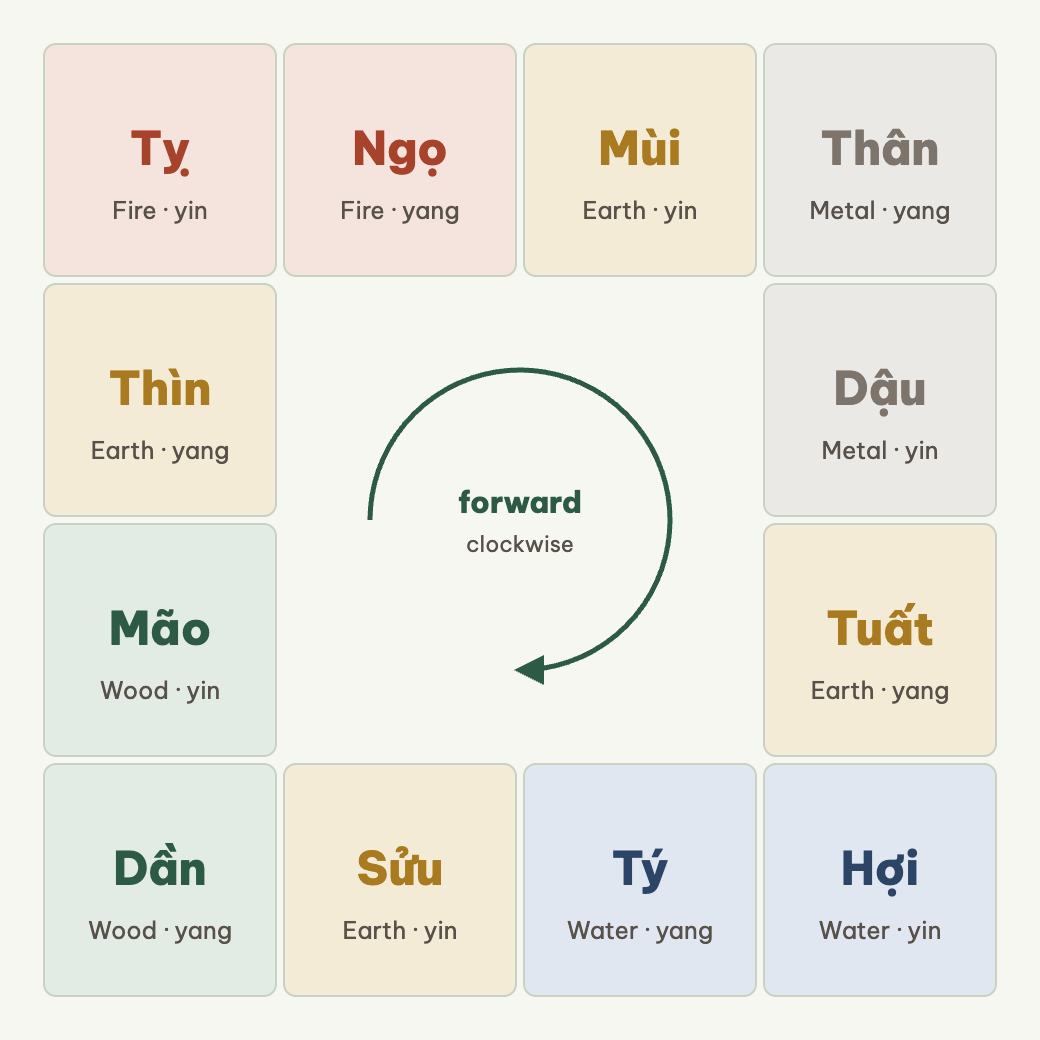
It must be said at once that the books are not entirely consistent on a few palaces. There is a way of reading that copies the old saying that Thái Dương is miếu at Tỵ and Ngọ, vượng at Dần, Mão, Thìn, đắc at Sửu and Mùi, and explains that these are daytime palaces, where sunlight expresses itself most naturally. Another way of reading instead places Thái Dương as vượng at Dần, Mão, Thìn, Tỵ, Ngọ, Mùi, and hãm at Thân, Dậu, Tuất, Hợi. Another way of reading also groups Dần, Mão, Thìn, Tỵ, Ngọ into the "miếu vượng land" category and cites the old saying that in miếu vượng land it does not fear the Kỵ star, though this brings much wealth but little nobility, and if there are one or two malefic stars they are only small blemishes that do no great harm. The discrepancies are mainly in the Mùi palace and in how Thìn and Tỵ are arranged; you should take the site's table as the basis and treat the passages cited above as reference.
The image the books use to explain this is the sun's circuit through the day. During the day the sun rises and climbs higher, reaches its peak at midday, then sets toward the horizon and disappears entirely when night falls. The brightness level of the star follows exactly that circuit: the early-morning and midday palaces are radiant, while the late-afternoon and night palaces are faint. Also according to one way of reading, to see a bright star and immediately think of wealth and nobility is a mistake; it is the vượng or hãm level in the twelve earthly-branch palaces that decides whether that radiance truly shines or is merely a dying flame before the wind.
On interpretation, one way of reading distinguishes the two poles fairly clearly. When Thái Dương sits in a miếu vượng position and meets Hóa Kỵ, the person can still manage, with hardship but not to the point of utter extremity. In the case of Thái Dương in a fallen hãm position accompanied by Hóa Kỵ, the book takes the old saying "Thái Dương cư Tuất Hợi Tý hóa Kị, một đời gian khổ nghèo khó" (Thái Dương in Tuất, Hợi, Tý with Hóa Kỵ, a life of hardship and poverty) as evidence and holds that reality matches what this saying describes. The book also recounts the case of Thái Dương hóa Kỵ at Hợi in the Thiên Di palace, meaning a lifetime of heavy labor and difficulty accumulating, whereas Thái Dương hóa Kỵ at Ngọ still keeps one's position and income, only with mental tension. This is one author's observation, not a mandatory rule for every chart.
The nature and character of the Sun Star according to Tử Vi Đẩu Số Tân Biên
According to the Tân Biên school, a person with Thái Dương ruling the Mệnh palace usually carries an open and upright temperament, is straightforward, generous, and dislikes petty calculation. They tend to like being in the spotlight, enjoy social activity, are good at leading, and have a strong sense of responsibility toward family and community. The downside of Thái Dương is hot temper, bluntness to the point of tactlessness, and a tendency to take on other people's burdens out of a wish to please, ending up mentally and physically exhausted while their contributions are not always properly recognized. There is a folk saying: "Thái Dương như ánh mặt trời, tỏa sáng cho người khác trước khi sưởi ấm chính mình" (Thái Dương is like the sunlight, shining for others before warming itself).
What do the miếu, vượng, đắc, hãm and bình states of the Sun Star mean?
This is the principal star most clearly influenced by the hour of birth within the day and by the palace where it is placed. Thái Dương is miếu địa at the Mão, Thìn and Tỵ palaces (morning to midday), the most radiant light, governing an illustrious career and support from benefactors, and usually corresponding to people born during the day. Vượng at the Ngọ palace. Đắc địa at Dần, Sửu, Mùi. Conversely, Thái Dương is hãm địa at Tuất, Hợi, Tý (night), with weakened light, governing hardship, obstructed career, and a tendency to be misunderstood or unfairly blamed, especially unfavorable for the role of father or husband in the chart. A person with Thái Dương in a hãm địa can still succeed, but usually has to go through many difficulties, "tiên khổ hậu cam" (bitter first, sweet later) more so than a person whose star is miếu vượng.
Another way of reading raises an additional point worth noting: Thái Dương does not only mean light, it also symbolizes blazing heat, the kind that can burn if allowed to exceed control. When Thái Dương enters hãm palaces such as Thân, Dậu, Tuất, Hợi, or when it transforms into Hóa Kỵ, it can indicate disadvantages in career, notoriety, gossip and litigation. Another way of reading also notes that Thái Dương strongly dislikes meeting Hóa Kỵ when in a hãm position such as Hợi or Tý, because the light is damaged and this is easily linked to eye problems; if Kình Dương, Đà La and Thiên Hình are added, there may be accidents involving the head and eyes. These are warnings based on book experience, not definite statements about the health of any specific person.
How is Thái Dương interpreted in the important palaces?
In the Mệnh palace: such a person usually has a bright appearance, a square or full round face, an open character, likes to work openly and transparently, and does not care for scheming. If miếu vượng, this is the type with an innate leadership quality, respected by many.
In the Quan Lộc palace: Thái Dương is highly valued here because this is the star governing career and authority, suited to professions that are public in nature, state management, education and media. Thái Dương miếu vượng in Quan Lộc usually signals a solidly advancing career path, with the possibility of reaching a high position in society.
In the Phu Thê palace: with Thái Dương placed here, a female chart usually implies that the husband is a person of standing, upright in character, but also easily busy with work and with little time for family; if in a hãm position, marital trouble is likely, or the husband faces hardship and setbacks. For a male chart, this star in Phu Thê affects the image and role of the father-in-law, or of the person himself in marriage.
In the Tài Bạch palace: it governs money coming from reputation, position, or openly transparent income sources rather than speculation or murky dealings.
In the Phụ Mẫu palace: according to one way of reading, one should first look at whether Thái Dương is in a miếu vượng or hãm địa. The book cites the old saying that if the palace energy is greatly auspicious, meeting a harmonious Thái Dương is a joy, and if the palace has no Tử Phù and Địa Kiếp and also has the "lạp hoàn" effect of self-resolution, then the parents are wealthy and noble. When Thái Dương is miếu vượng at Dần, Mão, Thìn, Tỵ, Ngọ, it is usually good for the parents, especially the father. When it is hãm địa at Tuất, Hợi, Dậu, Thân, the meaning changes and is more unfavorable. Another way of reading adds: if Thái Dương hóa Kỵ is in the same palace as both Hỏa Tinh and Linh Tinh, then the likelihood of traffic accidents, surgery, or losing one's father is higher; it recounts a specific case where Thái Dương hóa Kỵ in the Thiên Di palace met Đà La and the person had a traffic accident. This is the author's recorded experience, not a rule applied to every chart.
How is Thái Dương and Thiên Lương in the same palace at Mão and Dậu interpreted?
The same Nhật Lương combination, placed at Mão and placed at Dậu, gives two opposite results, and the key lies in the brightness of Thái Dương. According to one way of reading, at Mão, Thái Dương is in a miếu vượng position while Thiên Lương, though hãm, benefits from that strong light, so this combination is considered a good configuration, also called Nhật Phù Tang or Dương Lương sitting in Mệnh at Mão, especially fine for people born in the year Tân Mão. A person with this configuration is usually intelligent and decisive in work thanks to the brightness of Thái Dương combined with the intellectual quality of Thiên Lương.
Conversely, when placed at Dậu, Thái Dương falls into a hãm position and so shines very weakly, while Thiên Lương is also not in a favorable position. One way of reading holds that Nhật Lương sitting together at Dậu is considered a hãm configuration, requiring self-cultivation and remedy; a person with this configuration easily meets setbacks, a career that does not sail smoothly, and is prone to gossip and fierce competition. However, another way of reading records a different view: although Thái Dương at Dậu is inherently hãm, thanks to Thiên Lương's quality of dispelling darkness, the Dương Lương combination at Dậu is raised to the bình palace level; a person with this configuration usually has deep knowledge, enjoys research, and can make a name in academia or law, but still carries an anxious mindset and tends to change jobs. This is where the two books do not fully agree; you should read both and then weigh them for yourself against the specific chart.
Another way of reading also recounts a case of Nhật Lương in the Mệnh palace, when the daily transit activated Hóa Quyền, the person was given a great responsibility, but because Thái Dương was not miếu vượng they had to bear heavy pressure, were somewhat stubborn in handling matters, and this led to conflict with colleagues. From this the author concludes that Tứ Hóa plays the role of a catalyst, and cannot change the inherent nature of the star.
How is Thái Dương and Cự Môn in the same palace, or in opposition, interpreted?
This is the star pair the books mention most when discussing Thái Dương, because Cự Môn carries a gloomy energy that blocks the sunlight. According to one way of reading, among the combinations, Cự Môn is the star Thái Dương dislikes most; if these two stars sit together at Dậu or Hợi, the person is often misunderstood, meets gossip, and has a career path full of thorns. Another way of reading says more clearly: if Thái Dương in a miếu vượng position is in mutual illumination with Cự Môn, the structure of the Mệnh configuration becomes bright, helping to bring out eloquence and persuasiveness with little gossip; conversely, if Thái Dương is in a hãm position and its light is not enough to dissolve it, Cự Môn brings out its negative side.
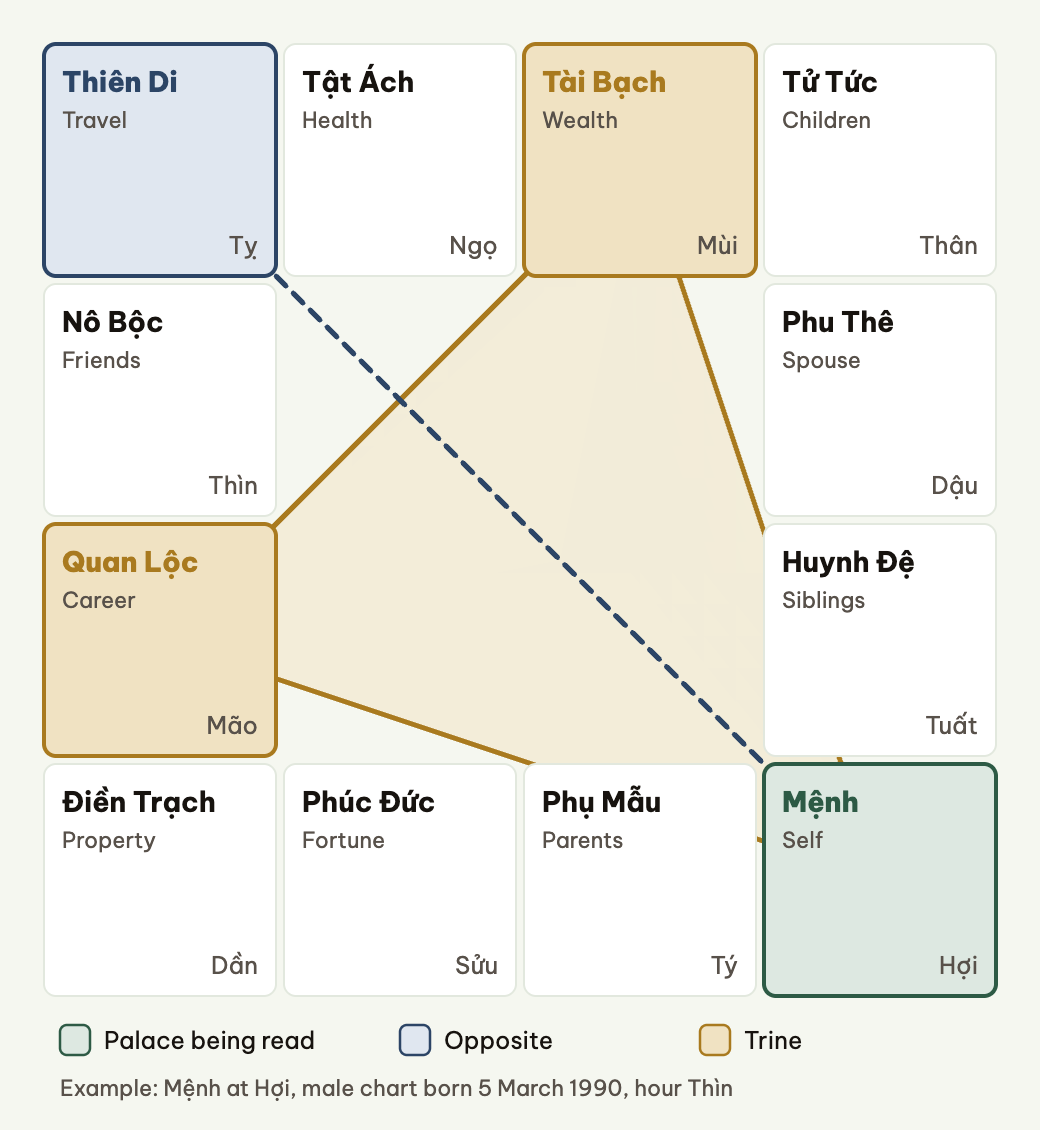
On the same-palace configuration, another way of reading cites the old saying that if Cự Nhật are in the same palace at Dần without meeting Tứ Sát, Không and Kiếp, then the person will be granted office through three generations; it also classifies Dần as a superior configuration, while Thân is only a secondary one. Another way of reading also mentions the phrase "Cự Nhật Dần Thân, quan phong tam đại" (Cự Nhật at Dần and Thân, office granted through three generations), with the explanation that at the Dần palace Thái Dương is in its rising phase, radiating glorious light, and thanks to this Cự Môn loses some of its gloom and reveals its good aspects. This book notes further that it is not the case that Cự Nhật at Dần is automatically success; for example, a person born in the year Giáp has Thái Dương hóa Kỵ and is also squeezed between Kình Dương and Đà La on either side, so their career meets many obstacles, even failure. The book also stresses that both stars need to be in vượng palaces to bring out their full strength; if in hãm positions, the combination does not bring much good.
On the opposition configuration, another way of reading records the phrase "Cự Nhật cũng chiếu diệc vi kỳ" (Cự and Nhật illuminating each other is also extraordinary), meaning a Mệnh sitting at Dần with Cự Môn at Tuất and Thái Dương at Ngọ, or a Mệnh sitting at Mão with Cự Môn at Hợi and Thái Dương at Tỵ, also belongs to this configuration. The book stresses that if Thái Dương is in a hãm position it is no longer that configuration; meeting additional auspicious stars is better, governing fame first and profit later, with the year Quý being a superior configuration, while for people born in the year Tân there is more reputation than profit. When Thái Dương and Cự Môn are in two opposite palaces and also gather Quyền and Lộc, the degree of wealth and nobility is very high; another way of reading records this through the phrase "Cự Nhật củng chiếu là kì cách, kiến các cát tinh Quyền Lộc thì cự phú đại quý" (Cự and Nhật flanking and illuminating is an extraordinary configuration; seeing auspicious stars of Quyền and Lộc means great wealth and great nobility).
What are the famous star combinations with Thái Dương?
The "Nhật Nguyệt tịnh minh" combination (Thái Dương and Thái Âm both in favorable positions) is considered a noble and illustrious configuration, harmonious in both career and emotion. The "Nhật Nguyệt phản bối" combination (both hãm) instead governs hardship and constant ups and downs. In addition, Thái Dương meeting Xương Khúc, Khôi Việt usually adds literary talent and benefactor support; meeting malefic stars such as Kình Dương and Đà La easily makes the character more hot-tempered and extreme.
According to one way of reading, when Thái Dương gathers with bright stars such as Tả Hữu, Khôi Việt, Xương Khúc, its radiance is increased and the person gains additional benefactor support. At the Ngọ palace, Thái Dương usually stands in the same palace as, or opposite, Thiên Lương, creating a relative balance between luminous authority and blessed wisdom, though Thái Dương's overly strong light can also have its own effect. This book cites the "Kim quang huy cách": Thái Dương entering the Mệnh palace at Ngọ standing alone but gathering enough Lộc Tồn, Khoa, Quyền, Lộc, Tả, Hữu, Khúc, Khôi, Việt is a proper configuration, governing a lifetime of nobility and wealth.
On Tứ Hóa, another way of reading records the experience: Thái Dương hóa Lộc in the daily transit, if in a miếu vượng position, brings fame and profit, possibly news of promotion or a favorable contract signing, while if in a hãm position, money comes and goes or promises are not kept. Thái Dương hóa Quyền makes the person tend to hold power and direct others, but easily becomes domineering and stubborn, so they should restrain themselves and listen in order to avoid conflict. Thái Dương hóa Khoa usually brings fame and recognition, but without supporting auspicious stars it is only empty fame. Another way of reading also says that Cự Môn greatly rejoices in meeting a miếu vượng Thái Dương; if Thái Dương transforms auspiciously, verbal talent is good and the person is likely to be from a different family line or live away from their homeland; if meeting a hãm địa Thái Dương, there is much verbal trouble and gossip, and with Hóa Kỵ there is much resentment and entanglement.
Overview article on the topic: What Is Vietnamese Astrology? An Overview of Reading Methods and Foundational Concepts