
Why must career reading start from the Mệnh Tài Quan triangle?
The Mệnh Tài Quan triangle is the group of three palaces, Mệnh, Tài Bạch and Quan Lộc, which always sit in a tam hợp position with one another on the chart. These three palaces illuminate each other, so stars in one palace affect the other two. Mệnh is the person, Tài Bạch is how money is earned and managed, Quan Lộc is how work is done and the path of career.
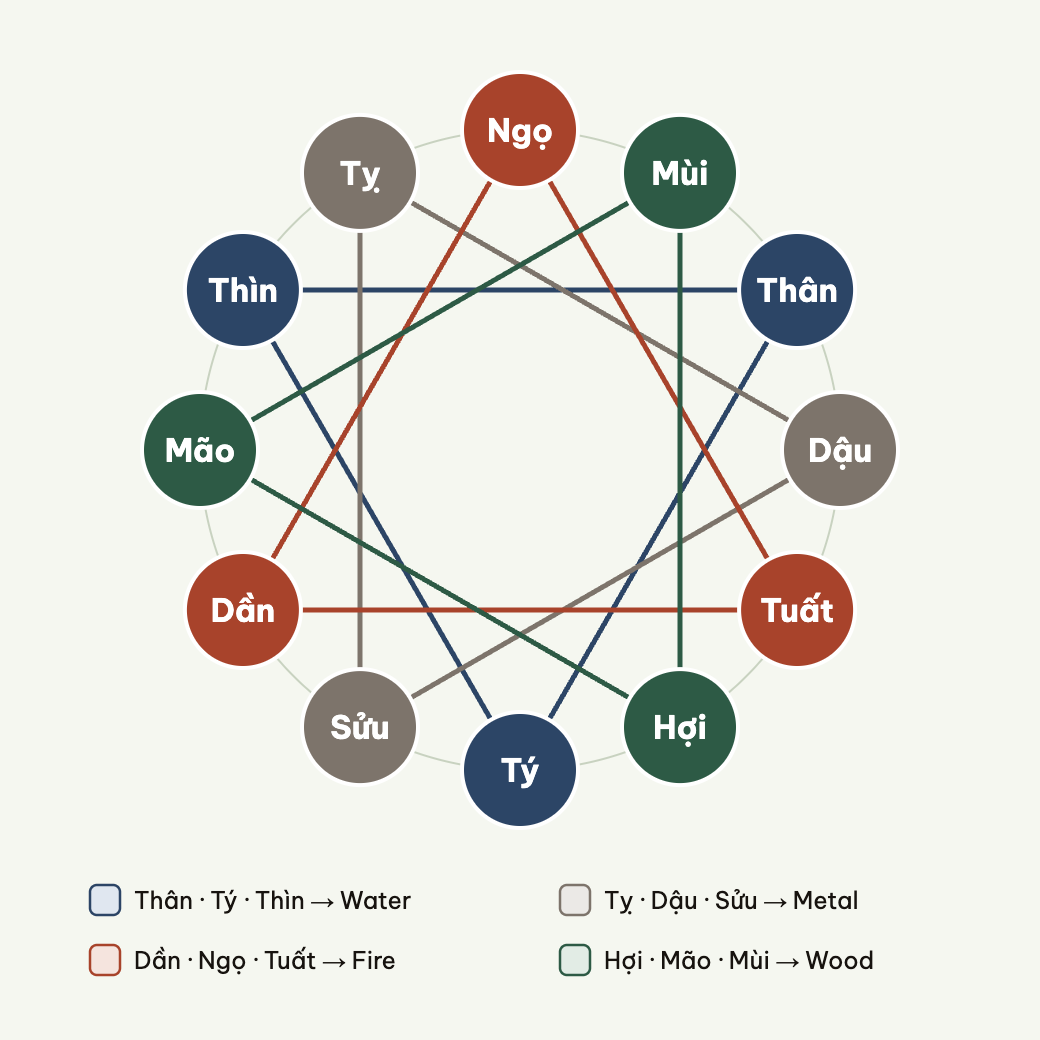
The logic is very ordinary: the kind of person you are shapes the way you tend to work, and money usually arrives that way. A good star in Quan Lộc is not only good for work but also pulls up confidence in Mệnh and eases the money path in Tài Bạch. Conversely, if one palace in the group is broken, the whole group suffers.
The book Đẩu số tinh thành (volume 1) states clearly: the Mệnh palace governs the broad direction and the scope of a career but remains general; the Quan Lộc palace speaks of the specific occupation and the degree of fulfilment. That means you cannot drop Mệnh and look only at Quan Lộc, nor can you look only at Mệnh and guess the occupation.
How do the twelve Mệnh palace positions produce the three tam hợp palaces and the opposite palace?
Whichever earthly branch the Mệnh palace falls in differs between charts, but the distances between palaces are fixed. From the Mệnh palace, the Tài Bạch and Quan Lộc palaces always form the tam hợp; the palace opposite Mệnh is Thiên Di, and the palace opposite Quan Lộc is Phu Thê. The table below lists all twelve positions.
| Mệnh palace at | Tam hợp with Mệnh | Palace opposite Mệnh (Thiên Di) | Palace opposite Quan Lộc (Phu Thê) |
|---|---|---|---|
| Tý | Thân, Thìn | Ngọ | Tuất |
| Sửu | Tỵ, Dậu | Mùi | Hợi |
| Dần | Ngọ, Tuất | Thân | Tý |
| Mão | Hợi, Mùi | Dậu | Sửu |
| Thìn | Tý, Thân | Tuất | Dần |
| Tỵ | Dậu, Sửu | Hợi | Mão |
| Ngọ | Dần, Tuất | Tý | Thìn |
| Mùi | Mão, Hợi | Sửu | Tỵ |
| Thân | Tý, Thìn | Dần | Ngọ |
| Dậu | Tỵ, Sửu | Mão | Mùi |
| Tuất | Dần, Ngọ | Thìn | Thân |
| Hợi | Mão, Mùi | Tỵ | Dậu |
How to read the table: if the Mệnh palace is at Dần, the tam hợp is Ngọ and Tuất, meaning Tài Bạch and Quan Lộc fall in those two palaces, Thiên Di is at Thân, and Phu Thê is at Tý. This is a fixed way of building palaces, independent of birth date and time, depending only on the position of the Mệnh palace.
What does the Quan Lộc palace read, and what does it not read?
The Quan Lộc palace discusses career, rank, position and the way work is done. One point must be made at once: in Tử Vi Đẩu Số, reading Quan Lộc means reading the stars that gather into that palace, not the five elements of the earthly branch where the palace sits. The earthly branch only affects the brightness of stars, while the nature of the career is decided by the star set.
Quan Lộc does not judge whether you succeed or fail. It sketches career leanings, how you handle work, and what to cultivate to go further. A common misunderstanding is seeing Thất Sát or Phá Quân in Quan Lộc and immediately thinking of a troubled career. In fact those are stars of people who dare to break through, suited to pioneering work. The only question is whether auspicious stars support them.
The fourteen main stars, when seated in Quan Lộc, give different career flavours. Tử Vi suits management and leadership; Thiên Cơ suits strategy, consulting and planning; Thái Dương suits external affairs and outreach; Vũ Khúc suits finance and work needing decisiveness; Thiên Đồng suits service and a gentle environment; Liêm Trinh suits discipline, law and technical work; Thiên Phủ suits stable work and asset management; Thái Âm suits hidden wealth, real estate and backstage work; Tham Lang suits socialising, business and the arts; Cự Môn suits work using the tongue such as speaking, writing, teaching and law; Thiên Tướng suits assisting and coordinating; Thiên Lương suits helping professions such as medicine, education and social work; Thất Sát suits pioneering and action; Phá Quân suits trailblazing and innovation.
The four major star sets and the career leanings books attach to them
The book Đẩu số tinh thành (volume 1) offers a classification by star set in the Mệnh palace. This classification has been reused by many Vietnamese books, so it is worth knowing for comparison.
- Cơ Nguyệt Đồng Lương (Thiên Cơ, Thái Âm, Thiên Đồng, Thiên Lương): the book calls this the civil-servant mode, stable work inside an organisation. The book says plainly that people of this mode should not strike out as big owners, but choose work fitting within that frame.
- Sát Phá Tham (Thất Sát, Phá Quân, Tham Lang): the book ties this to military posts, technical work, and occupations with competition and breakthrough.
- Tử Phủ Vũ Tướng (Tử Vi, Thiên Phủ, Vũ Khúc, Thiên Tướng) together with Xương Khúc, Tả Hữu, Khôi Việt: the book ties this to civil posts, civilian work with little competition, leaning to management and expertise.
- Cự Nhật (Cự Môn, Thái Dương): leaning to speaking, writing, external affairs and communication; Đẩu số tinh thành takes the example of Nhật Nguyệt shining together into "Minh", suited to social work, charity and teaching, and possibly holding high positions in commerce but not suited to pure commercialisation.
There is a view that Tử Vi is a form of divination. 1) adds another direction: people with Vũ Khúc seated at Mệnh often work in politics, industry and commerce, finance and economics, insurance, the military, the police, and sports. This listing is broader than the four star sets, and this is where books do not entirely overlap.
Why can you not read Quan Lộc alone but must also pull in Thiên Di and Phúc Đức?
Quan Lộc sits within the tam phương tứ chính, comprising the main palace, the two tam hợp palaces and the opposite palace. For Quan Lộc, the tam hợp are Mệnh and Tài Bạch, and the opposite is Phu Thê. But when reading fortune, one must also look at Thiên Di and Phúc Đức, because these two palaces speak of the outside environment and the fortune base of the whole chart.
Thiên Di faces Mệnh and speaks of the external environment, where you meet society. A fine Quan Lộc with a poor Thiên Di still meets obstacles on the career path from the environment, from relationships, from the workplace. Phúc Đức speaks of the spiritual foundation and family fortune, affecting stamina in pursuing a long-term occupation.
Phu Thê, opposite Quan Lộc, is also worth noting. There is a view that Khâm Thiên Tứ Hóa is a form of divination. 3) records the case where Quan Lộc is broken by Song Kỵ opposing, making the native wander for career, and an unstable career in turn affects emotional life, creating a vicious circle. The book also notes the case where Quan Lộc Hóa Kỵ flies to Phu Thê, hinting that work pressures marriage. This is why many readers refuse to read Quan Lộc separately from Phu Thê.
How does the Tứ Hóa school trace career fortune differently from reading by star set?
This is where schools disagree and it must be stated clearly. Reading by star set, common in Vietnamese books, takes the star set in Mệnh and Quan Lộc to infer career leanings. The Tứ Hóa school traces career fortune through palaces and the Hóa.
The book Đẩu số tinh thành (volume 1) presents a method of taking the Tài Bạch palace and flying Tứ Hóa, then taking the main star in the palace where Hóa Kỵ sits to represent the occupation, and considers this method fairly accurate. The book also warns: the occupation inferred from the birth chart is only a sign, a broad direction; the specific occupation must also fit the luck cycles, especially from the second major limit onward, every major limit must be examined, even the annual ones. The book also notes that when the major limit's Hóa Kỵ enters the Quan Lộc palace, one should work as an employee and in services, not suited to commercial business.
There is a view that Khâm Thiên Tứ Hóa is a form of divination. 1) goes deeper into the Phi Hóa mechanism. It distinguishes Lộc xuất, the Lộc energy radiating outward from Quan Lộc, which can be a path-opener, market-opener, creating opportunities for others, but can also be large investment with initial loss. It also says Quan Lộc Hóa Kỵ flying outward is a signal of binding, loss, or deep focus on career. This reading differs sharply from reading by star set, and the two can give non-overlapping results on the same chart.
There is a view that Khâm Thiên Tứ Hóa is a form of divination. 2) notes the case of Tham Lang Tự Hóa Lộc at Quan Lộc as a structure favourable for career and durable earning, but with challenges in financial management and values. The same volume also speaks of stars bearing the Mậu Thổ nature being suited to processing industries and retail business.
Vương Đình Chi and the warning about the "exam career" meaning of Quan Lộc
One point must be put on the table: the original meaning of Quan Lộc is tied to the era of examinations, when the career path had almost a single door, sitting exams then becoming an official. Vương Đình Chi reminds us that this "exam career" meaning no longer matches today's society, when occupations have split into thousands of trades and a career path no longer passes through a single door.
The consequence is that when reading Quan Lộc, one should not translate old stars directly into modern job titles. That practice has been criticised. Cụ Phong Nguyên, in an article on the Lý số Việt Nam forum, recounts the case of a Tử Vi reader in Saigon who tried to make the art scientific and updated to the point of decisively detailing jobs such as agricultural engineer, bridges and roads, electricity, bank director, film director, and there were many outright wrong cases. Cụ Phong Nguyên also cites the opinion of many people versed in Tử Vi: this art can only guess the occupation approximately or state a leaning, few dare to assert which job one must do, except a very small number of clear-cut trades.
Where should you stop?
The chart does not choose a job for the reader. It cannot measure real ability, cannot measure interests, cannot measure the labour market, cannot measure the study opportunities or the network a person has. The same star set can correspond to many different occupations depending on life context, and a person may change jobs several times in life.
A reasonable use is to take the chart as a map of leanings: it suggests which working style you are strong in, which environment suits you, what to cultivate. It does not decide for you, and should not be used to assert absolute fortune or misfortune for a specific occupation. Where books differ, both ways should be presented rather than quietly choosing one side and presenting it as if there were only one way to read.
Once you have the Mệnh Tài Quan axis, have considered the opposing Phu Thê palace, have looked at Thiên Di and Phúc Đức, have compared both reading by star set and tracing fortune by Tứ Hóa, you should stop at the level of leanings. Going further, to a specific job title or a narrow specific industry, exceeds what a chart can reliably give.


